
Widow's Holi 2027 – Vrindavan's Festival of Reclaimed Colour
विधवा होली
When is Widow's Holi in Vrindavan in 2027?
Widow’s Holi in Vrindavan is expected around mid-March 2027, in the days just before the main Rangwali Holi on 22-23 March. It is organised each year by NGOs such as Sulabh International, so the exact day is announced close to the event. Hundreds of widows gather at temples like Gopinath to play with gulal and flower petals.
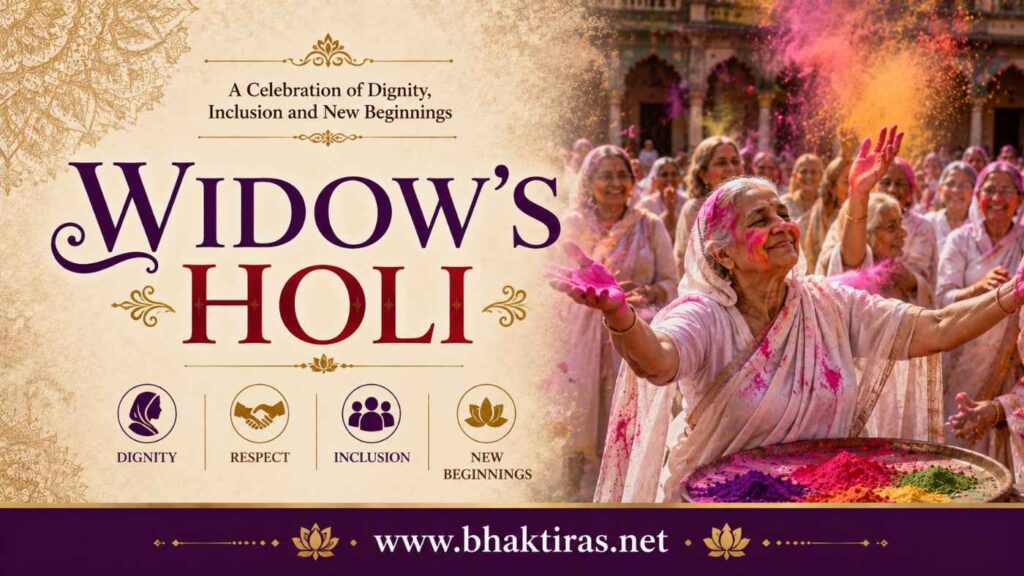
Widow’s Holi is one of the youngest and most moving traditions in Vrindavan. For generations, the widows who came to this Krishna town were expected to wear only white and stay away from colour, music and celebration. Since around 2013, that silence has been gently undone. Each year, in the days before the main Holi, hundreds of these women gather at temples such as Gopinath to throw gulal and shower flower petals, singing to Radha and Krishna. It is quiet social reform dressed as festival.
Widow's Holi 2026-2028: When It Is Held
Widow’s Holi has no fixed calendar date of its own. It is organised each year in the run-up to the main Holi, usually a few days before Rangwali Holi in Vrindavan, so the dates below follow Holi and are approximate.
| Year | Approx. window | Main Holi | Notes |
|---|---|---|---|
| 2026 | Late Feb / early March | 3-4 March 2026 | Held in the days before Holi (now passed) |
| 2027 | Around mid-March | 22-23 March 2027 | Next occurrence, expected a few days before Holi |
| 2028 | Early March | 11-12 March 2028 | Tied to Holi 2028 |
Because the gathering is organised rather than fixed by the panchang, treat every date here as a planning guide, not a confirmed schedule. The most reliable signal each year is the date of Rangwali Holi in Mathura-Vrindavan; the widows’ celebration is usually slotted into the two or three days before it.
Why Widow's Holi Matters
Widow’s Holi is celebrated as an act of dignity and healing. It gives Vrindavan’s widows, long excluded from colour and festivity, the freedom to play Holi and worship Krishna openly again.
For centuries, widowhood in parts of India carried harsh social rules. Many women, some widowed young, travelled to Vrindavan and Varanasi to live out their days in prayer, wearing white and keeping apart from festivals. Colour, sweets and celebration were considered off-limits. Widow’s Holi challenges that idea directly, and does it in the most public, joyful way possible.
Reclaiming colour
The white sari was a symbol of everything a widow was expected to give up. Playing Holi with pink and yellow gulal is a small but powerful reversal, a statement that grief does not have to mean a colourless life.
Devotion, not pity
The women here are lifelong devotees of Radha and Krishna. Widow’s Holi is not charity performed on them; it is their own bhakti finally allowed a festive form, sung and danced in the town where Krishna is believed to have played.
Quiet social reform
Begun around 2013 through the work of NGOs, notably Sulabh International, the celebration has grown into an annual event covered by media worldwide. It has helped shift public attitudes about how widows are treated and seen.
A place of belonging
For women who often arrived in Vrindavan alone and forgotten, the shared singing, cooking and colour of Holi rebuilds a sense of family and community that many had lost.
Deities Worshipped
Widow’s Holi is offered to Radha and Krishna, the divine couple at the heart of Vrindavan’s devotion. The colour and song echo the playful Holi that Krishna is said to have enjoyed with Radha and the gopis.
Krishna
Vrindavan is Krishna’s town, the setting of his childhood and his raas-leela with the gopis. The widows sing to him and shower his image with colour, joining the same Holi they believe he first played here.
Radha
Radha represents pure, selfless love and is inseparable from Krishna in Vrindavan’s worship. The women’s songs and gulal are offered to Radha-Krishna together, celebrating a love the whole town lives by.
How Widow's Holi Unfolds
The day blends temple worship with the ordinary joy of Holi. It usually runs at temples and ashrams where the widows already live and pray.
- Gathering at the temple. Widows from ashrams such as Meera Sahbhagini and Radha Gopinath come together at temples like Gopinath and the Pagal Baba temple, often walking in as a group in the morning.
- Prayer and bhajans. The celebration opens with worship of Radha and Krishna and the singing of devotional songs, setting the day in bhakti before any colour is thrown.
- The first colour. Handfuls of pink, yellow and green gulal are exchanged, many of the women playing Holi for the first time in decades of white-clad life.
- A rain of flowers. Marigold and rose petals are showered over the crowd, a gentler, fragrant form of Holi that has become the tradition’s signature image.
- Song and dance. Women dance together to dholak and cymbals, some in tears, celebrating openly in a way social custom once denied them.
- Sharing sweets and food. Festive food and sweets, once thought forbidden to widows, are shared freely, turning the gathering into a communal feast.
- Closing devotion. The day winds down with more kirtan and quiet prayer, the colour on their saris standing in for years of celebrations missed.
Where It Is Celebrated
Widow’s Holi is centred on Vrindavan, with a linked celebration in nearby Barsana, both in the Mathura region of Uttar Pradesh.
Vrindavan
The heart of the tradition. Temples such as Gopinath and the Pagal Baba temple, and ashrams including Meera Sahbhagini and Radha Gopinath, host the main gatherings of widows each year.
Barsana
Barsana, Radha’s town near Vrindavan, also sees widows brought into its famous Holi festivities, extending the same spirit of inclusion in the region most associated with Radha-Krishna’s Holi.
Beyond Vrindavan
The idea has inspired similar inclusive Holi events for widows in other cities, but Vrindavan remains the origin and the emotional centre of the movement.
Widow's Holi Do's and Don'ts
If you attend or read about the event, approach it with respect and dignity, never with pity.
Do
- Treat the women as honoured devotees, not as objects of sympathy
- Ask before photographing anyone and respect a no
- Appreciate the celebration as bhakti and reform, not a spectacle
- Support the ashrams and NGOs that make the day possible if you wish to help
- Keep the focus on Radha-Krishna devotion, as the women do
Avoid
- Do not frame the day only as a sad story; it is chosen joy
- Do not intrude on prayer or crowd the participants
- Do not take close photos without clear consent
- Do not assume a fixed public date; confirm each year
- Do not reduce the women to a caption or a headline
Frequently Asked Questions
When is Widow's Holi in Vrindavan in 2027?
Widow’s Holi in Vrindavan is expected around mid-March 2027, in the days just before the main Rangwali Holi on 22-23 March. It has no fixed calendar date of its own; the celebration is organised each year by NGOs and announced close to Holi, so the exact day should be confirmed locally.
When was Widow's Holi in 2026 and when is it in 2028?
In 2026 Widow’s Holi fell in the days before Holi in early March, so it has now passed. In 2028 it is expected in early March, tied to Holi on around 11-12 March 2028. Both are approximate, as the event follows the main Holi date each year rather than a fixed tithi.
Why do the widows of Vrindavan play Holi?
The widows of Vrindavan play Holi to reclaim colour, celebration and open devotion that social custom once denied them. For generations widows were expected to wear white and stay away from festivals; Widow’s Holi, begun around 2013, lets them worship Radha and Krishna with gulal and flowers as an act of dignity and joy.
Who started Widow's Holi in Vrindavan?
Widow’s Holi was started as a large organised celebration around 2013 through the work of NGOs, most notably Sulabh International. Their aim was to challenge the harsh social rules around widowhood and give these women back the freedom to celebrate colour, music and devotion.
Which deities are worshipped during Widow's Holi?
Widow’s Holi is dedicated to Radha and Krishna, the divine couple central to Vrindavan’s devotion. The women sing bhajans and shower colour and flowers on their images, echoing the joyful Holi that Krishna is believed to have played with Radha and the gopis in Vrindavan.
Where in Vrindavan does Widow's Holi take place?
Widow’s Holi takes place at temples such as Gopinath and the Pagal Baba temple, and at ashrams including Meera Sahbhagini and Radha Gopinath in Vrindavan, Uttar Pradesh. A linked celebration also reaches nearby Barsana, Radha’s town, in the same Mathura region.
How is Widow's Holi different from ordinary Holi?
Widow’s Holi carries the same colour and song as ordinary Holi but a deeper social meaning. Where regular Holi is open to everyone, this celebration specifically brings in women long excluded from festivity, making colour a statement of inclusion and reclaimed dignity rather than just festive fun.
Can visitors attend Widow's Holi?
Visitors and media do attend Widow’s Holi, and coverage has helped change public attitudes about how widows are treated. If you go, do so with respect, ask before photographing anyone, and remember that the day is about the women’s devotion and joy, not sympathy.
May every heart find colour again. Radhe Radhe.