
Dahi Handi 2026 – Krishna's Butter-Pot Festival
दही हांडी
When is Dahi Handi in 2026?
Dahi Handi in 2026 falls on Saturday, 5 September, the day after Krishna Janmashtami. Teams called govindas build human pyramids to break a high-hung earthen pot of curd and butter, re-enacting the child Krishna’s habit of stealing butter. It is celebrated most fervently across Maharashtra.
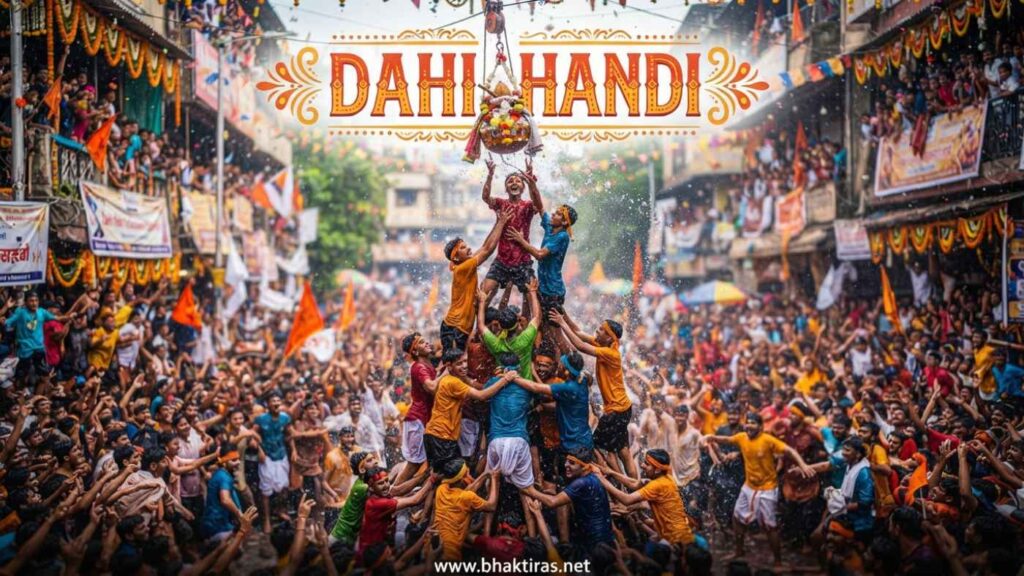
Dahi Handi, also called Gopalkala or Govinda, is the exuberant morning-after to Krishna Janmashtami. A clay pot filled with curd, butter and buttermilk is strung high above a street, and teams of young men and women, the govindas, clamber onto one another’s shoulders to form a swaying human tower and smash it open. The game recalls the mischievous child Krishna, the makhan chor or butter thief, who raided the gopis’ hanging pots. In Maharashtra it draws huge crowds, cash prizes and city-wide competition.
Dahi Handi 2026-2028: Dates & Calendar
Dahi Handi next falls on Saturday, 5 September 2026. Because it is fixed to the lunar Hindu calendar, the day after Janmashtami, the Gregorian date shifts each year.
| Year | Date | Day | Notes |
|---|---|---|---|
| 2026 | 5 September | Saturday | Next occurrence, day after Janmashtami |
| 2027 | 26 August | Thursday | Day after Janmashtami |
| 2028 | 15 August | Tuesday | Day after Janmashtami |
Janmashtami is observed the night before, marking Krishna’s midnight birth; Dahi Handi is the daytime celebration that follows.
Why Dahi Handi Is Celebrated
Dahi Handi celebrates the playful childhood of Krishna, who is said to have stolen curd and butter from pots hung out of reach.
The butter thief
As a boy in Gokul, Krishna and his friends raided the gopis’ dairy stores. To stop them, the women hung their pots of curd and butter from the ceiling. Undeterred, Krishna organised his companions into a human ladder to reach the loot. The pyramid ritual re-stages that clever raid.
A day of shared devotion
The pot’s contents, once broken, spill a mixture the same as the temple prasad gopalkala: beaten rice, curd, milk, butter and fruit. Sharing it stands for community, joy and Krishna’s easy closeness to ordinary people rather than distant grandeur.
Teamwork and courage
Building a tall, steady pyramid needs trust, balance and nerve from every layer. Over time the game became a test of a locality’s spirit, with mandals training for weeks and neighbourhoods cheering their own govinda teams.
Deities & Figures Worshipped
The festival honours Krishna in his childhood form, the mischievous cowherd of Gokul and Vrindavan.
Bal Krishna
The child Krishna, known as makhan chor or Gopala, is the heart of the day. Devotees celebrate his playful, human side rather than his later role as the divine charioteer of the Gita.
The gopis and gopas
Krishna’s cowherd friends and the milkmaids of Gokul feature in the story. The human pyramid mirrors the boys who lifted one another to reach the hanging pots.
Key Rituals, Step by Step
The celebration moves from the temple to the street over the course of the morning and afternoon.
- Gopalkala offering. Temples and homes prepare gopalkala, a mix of beaten rice, curd, milk, butter and fruit, and offer it to Krishna before sharing it as prasad.
- The handi is hung. An earthen pot filled with curd, butter and buttermilk is tied high on a rope strung between buildings or poles, often decorated with flowers and cash prizes.
- Govinda teams gather. Troupes of govindas arrive in matching outfits, singing ‘Govinda ala re’ and moving between handis set up across the neighbourhood.
- Building the pyramid. Team members climb onto one another’s shoulders, layer by layer, forming a human tower that sways as the base steadies it.
- Reaching the pot. The lightest, usually youngest, climber scales the top to reach the handi, while onlookers throw water to make the challenge harder.
- Breaking the handi. The top climber smashes the pot, spilling its contents over the team below in a burst of cheering and colour.
- Sharing the spoils. The broken curd and prize money are shared out, and teams move on to the next handi to repeat the feat.
Special Foods of Dahi Handi
The festival’s food centres on dairy, echoing Krishna’s love of curd and butter.
Gopalkala
The signature dish: beaten rice (poha) mixed with curd, milk, butter, cucumber, green chilli and fruit. Light and cooling, it is offered to Krishna and shared as prasad.
Dahi and makhan
Fresh curd and white butter, the very things Krishna is said to have stolen, are eaten and offered generously through the day.
Panjiri and sweets
Where the day overlaps with Janmashtami fasting foods, panjiri, milk sweets and fruit are also shared, especially by those who fasted the previous night.
Regional Names & Variations
The pyramid ritual is strongest in western India, with local names and styles.
Mumbai & Thane
The largest and most competitive events happen here, with tall multi-tier pyramids, big cash prizes and thousands of spectators. Localities such as Dadar, Worli and Ghatkopar are known for record-height attempts.
Pune & western Maharashtra
Neighbourhood mandals set up handis across the city, and the phrase Gopalkala is common. The mood blends sport, devotion and street festival.
Gujarat
Dahi Handi is celebrated alongside Janmashtami, particularly in Dwarka and among Krishna-devoted communities, though the pyramids are generally smaller than in Maharashtra.
Diaspora
Maharashtrian and Gujarati communities abroad recreate scaled-down handis at temples and community halls, keeping the singing and shared gopalkala central.
Dahi Handi Do's and Don'ts
The pyramids carry real risk, and rules now govern how they are built.
Do
- Follow the local height limits set by authorities and courts.
- Provide helmets and safety harnesses for climbers, and cushioning or mats at the base.
- Keep an ambulance or first-aid team on standby at large events.
- Ensure the top climbers are adults or meet the minimum-age rule; do not use young children.
- Share the gopalkala prasad and keep the spirit friendly and inclusive.
Avoid
- Do not exceed the permitted number of tiers or the sanctioned pyramid height.
- Do not let underage participants climb the upper layers.
- Do not attempt pyramids without safety gear, insurance cover or crowd control.
- Do not pressure untrained volunteers to climb; injuries from falls are serious.
- Do not block traffic or emergency routes without proper permission.
Frequently Asked Questions
When is Dahi Handi in 2026?
Dahi Handi in 2026 falls on Saturday, 5 September. It is celebrated the day after Krishna Janmashtami, on Bhadrapada Krishna Navami in the Hindu lunar calendar.
When is Dahi Handi in 2027 and 2028?
Dahi Handi is on Thursday, 26 August 2027 and on Tuesday, 15 August 2028. In both years it falls the day after Janmashtami, and the Gregorian date moves because it tracks the moon.
Why is Dahi Handi celebrated?
Dahi Handi is celebrated to honour the child Krishna, the makhan chor, who stole curd and butter from pots hung out of reach. Teams re-enact this by forming human pyramids to break a high-hung pot of curd and butter.
Which god is worshipped on Dahi Handi?
Dahi Handi honours Krishna in his childhood form as Bal Krishna or Gopala, the playful cowherd of Gokul. The festival celebrates his mischievous, human side rather than his role in the Bhagavad Gita.
What is the difference between Janmashtami and Dahi Handi?
Janmashtami marks Krishna’s midnight birth and is observed the night before with fasting and prayer. Dahi Handi is the daytime celebration that follows, centred on the human-pyramid pot-breaking game.
What is Gopalkala?
Gopalkala is both another name for the festival and the dish shared on it: a mix of beaten rice, curd, milk, butter and fruit. It is offered to Krishna and then distributed as prasad.
Are there safety rules for the human pyramids?
Yes. Authorities and courts in Maharashtra have set limits on pyramid height and enforce a minimum age for climbers. Organisers are expected to provide helmets, harnesses, cushioning and medical standby to reduce serious fall injuries.
Where is Dahi Handi celebrated most?
Dahi Handi is celebrated most fervently in Maharashtra, especially Mumbai, Thane and Pune, with the tallest and most competitive pyramids. It is also observed in Gujarat and by Maharashtrian communities abroad.
However you mark the day, may Krishna’s mischief and joy fill your home. Govinda ala re!