
Krishna Janmashtami 2026 – The Midnight Birth of Lord Krishna
कृष्ण जन्माष्टमी
When is Krishna Janmashtami in 2026?
Krishna Janmashtami falls on Friday, 4 September 2026. It marks the midnight birth of Lord Krishna, the eighth avatar of Vishnu, on the Ashtami of the dark fortnight of Bhadrapada. Many ISKCON and Vaishnava temples observe it a day later, on 5 September 2026, when Rohini Nakshatra aligns with the Ashtami tithi.
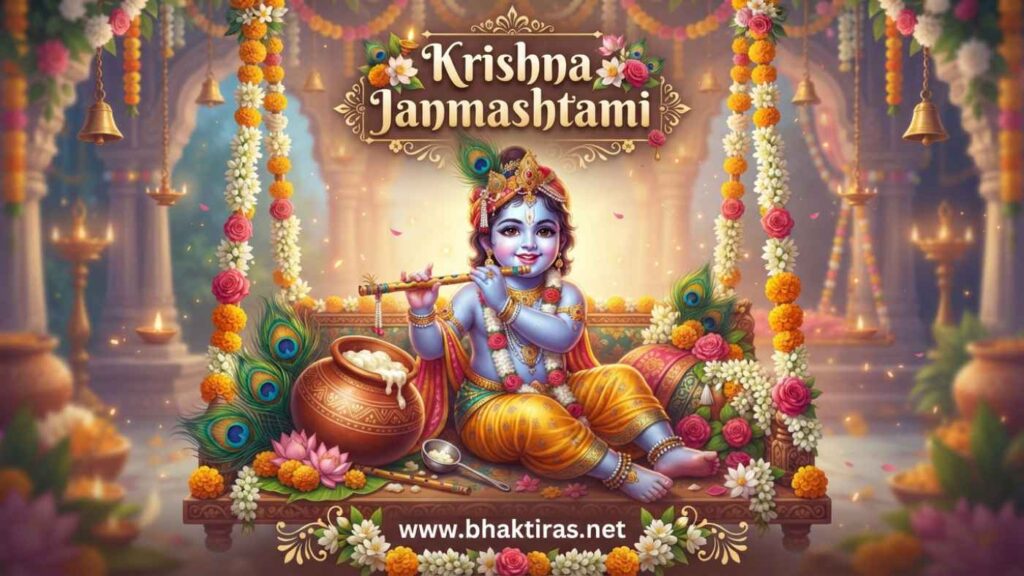
Krishna Janmashtami is the birthday of Lord Krishna, the eighth avatar of Vishnu, who Hindus believe was born at the stroke of midnight in a prison cell in Mathura to Devaki and Vasudeva, under the shadow of the tyrant king Kansa. Observed on the Ashtami of the waning moon in Bhadrapada, it falls on 4 September 2026. Devotees fast through the day, keep vigil until midnight, then bathe and cradle an image of the infant Krishna while temples fill with bhajans and the aarti of the newborn.
Krishna Janmashtami 2026-2028: Dates & Calendar
The next Krishna Janmashtami is on Friday, 4 September 2026. The date shifts each year because it is fixed by the Hindu lunar calendar – the eighth day of the dark half of Bhadrapada – rather than the Gregorian one.
| Year | Date | Day | Notes |
|---|---|---|---|
| 2026 | 4 September | Friday | Next occurrence (Smarta); many Vaishnava temples on 5 Sep |
| 2027 | 25 August | Wednesday | Bhadrapada Krishna Ashtami |
| 2028 | 13 August | Sunday | Bhadrapada Krishna Ashtami |
In several years the observance splits across two days: households following Smarta rules keep the day the Ashtami tithi covers midnight, while ISKCON and many Vaishnava temples wait for the day Rohini Nakshatra joins the Ashtami. Both are scripturally accepted. Always check a local panchang for exact fasting and paran (fast-breaking) times.
Why Krishna Janmashtami Is Celebrated
Krishna Janmashtami celebrates the birth of Lord Krishna, whom Hindus honour as the eighth avatar of Vishnu, born to end the cruelty of King Kansa and to restore dharma.
A birth in captivity
Krishna was born at midnight in a Mathura prison, where Kansa had jailed his parents Devaki and Vasudeva after a prophecy that their eighth child would kill him. The moment of his arrival, past midnight under Rohini Nakshatra, is the exact hour devotees keep vigil for.
The escape to Gokul
As Krishna was born, his father Vasudeva carried him across the flooded Yamuna to Gokul, exchanging him for the newborn daughter of Nanda and Yashoda. This night-time rescue is retold in kirtans and enacted in temple plays each year.
The restoration of dharma
Krishna’s life, from lifting Govardhan Hill to delivering the Bhagavad Gita on the battlefield of Kurukshetra, embodies the promise that divinity descends whenever righteousness declines. His birthday is a reminder of that assurance.
Devotion over ritual
For the Bhakti tradition, Janmashtami is less about grand ceremony than about love for a personal, playful God. The child Krishna, the cowherd, the flute-player and the charioteer are all held close on this night.
Deities & Figures Worshipped
The central figure is Lord Krishna, worshipped on this day especially in his form as the newborn Bal Gopal, along with his foster parents and childhood companions.
Lord Krishna
Krishna is worshipped as the eighth avatar of Vishnu and, in many traditions, as the Supreme Being himself. On Janmashtami he is adored chiefly as the infant Bal Gopal, cradled and bathed at the midnight birth hour.
Devaki & Vasudeva
Krishna’s birth parents, imprisoned by Kansa, are remembered in the story of his birth. Their courage in protecting the newborn is central to the night’s retellings.
Nanda & Yashoda
The cowherd chief Nanda and his wife Yashoda raised Krishna in Gokul and Vrindavan. Their joy at the arrival of the child is celebrated the following day as Nandotsav.
Radha
Radha, Krishna’s beloved, is worshipped alongside him in Vrindavan and across Vaishnava temples, where the pair are honoured together as Radha-Krishna.
Key Rituals, Step by Step
Janmashtami combines a day-long fast with a midnight birth ceremony. The order below reflects how most households and temples keep the observance.
- Sankalp and fasting. Devotees take a vow to fast, many keeping a nirjala (waterless) or phalahar (fruit-only) fast from sunrise until the midnight birth.
- Cleaning and decorating. Homes and temples are cleaned, and a cradle or throne is decorated for the infant Krishna, often with a jhanki – a tableau depicting scenes from his life.
- Preparing the idol. A small image of baby Krishna is readied for the abhishekam, along with new clothes, a flute, a peacock feather and ornaments.
- Evening bhajans and kirtan. As night falls, devotees gather to sing bhajans, recite the Bhagavata Purana and narrate Krishna’s birth story, building towards midnight.
- The midnight abhishekam. At the stroke of midnight, the birth hour, the idol is bathed with panchamrit – milk, curd, ghee, honey and sugar – then with water, and dressed anew.
- Rocking the cradle. The infant Krishna is placed in the cradle and gently rocked while conch shells and bells sound and the birth aarti is sung.
- Bhog and aarti. A feast of sweets and dishes, including Krishna’s favourite makhan-mishri, is offered and the aarti performed. Prasad is then shared.
- Paran. Devotees break their fast after the midnight worship, or the next morning, depending on family and regional custom.
Special Foods of Krishna Janmashtami
Because Krishna loved butter and milk, dairy sweets dominate the offerings, and many dishes are made fasting-friendly for the day-long vrat.
Makhan-mishri
Fresh white butter mixed with rock sugar is the signature bhog, honouring Krishna’s childhood love of stealing butter, which earned him the name Makhan Chor.
Panjiri
A roasted flour or dhaniya (coriander seed) preparation sweetened with sugar and enriched with ghee and dry fruits, offered as prasad and eaten after the fast.
Dhaniya panjiri
Made from ground coriander seeds rather than grain flour, this version is suitable for those keeping a strict vrat and is widely distributed as prasad.
Charnamrit
The panchamrit used to bathe the idol – milk, curd, ghee, honey and sugar, often with tulsi leaves – is sipped as a sacred drink after the abhishekam.
Kheer & shrikhand
Rice kheer and, in western India, saffron-scented shrikhand are common festive sweets served to family and guests.
Fasting dishes
Those breaking a lighter fast eat sabudana khichdi, kuttu (buckwheat) puris, singhare ke atte dishes and fruit, all permitted during a vrat.
Regional Names & Variations
The birth of Krishna is celebrated across India, but the mood and customs vary sharply from the temple towns of the north to the streets of Maharashtra.
Mathura & Vrindavan
Krishna’s birthplace and the land of his childhood host the grandest celebrations. Temples such as Krishna Janmabhoomi and Banke Bihari stay open through the night with elaborate jhankis, jhulan (swing) ceremonies and thousands of pilgrims.
Maharashtra
The day after Janmashtami brings Dahi Handi, where young men form human pyramids to reach and break a pot of curd hung high above the street, re-enacting Krishna’s butter-stealing pranks.
Gujarat & Dwarka
Dwarka, Krishna’s legendary kingdom, sees huge crowds at the Dwarkadhish temple. Across Gujarat the festival is marked with fasting, night vigils and folk performances.
Udupi & the south
In Udupi, Karnataka, Krishna Janmashtami and the following Vittal Pindi feature the drawing of Krishna’s footprints, mock butter-pot breaking and community feasts. In Tamil Nadu it is known as Gokulashtami, with kolam floor art marking the path of the infant into the home.
ISKCON temples worldwide
ISKCON centres across India and abroad hold day-long kirtan, dramatic re-enactments and the midnight abhishekam, often observing the festival on the Rohini-aligned day.
Eastern India
In Odisha, Bengal and Manipur, Janmashtami blends fasting and scripture recitation with local Gaudiya Vaishnava traditions and readings from the Bhagavata Purana.
Krishna Janmashtami Do's and Don'ts
A few simple guidelines help keep the fast and the worship in the right spirit.
Do
- Take a proper sankalp (vow) before starting your fast in the morning.
- Keep the vigil until midnight, the actual birth hour, before the main worship.
- Bathe and dress the infant Krishna idol with care and offer makhan-mishri.
- Sing bhajans, read the Bhagavata Purana and involve children in the cradle ceremony.
- Break the fast (paran) only after the midnight puja or the next morning, as your family observes.
Avoid
- Avoid grains, onion and garlic while keeping the vrat.
- Do not consume alcohol, tobacco or non-vegetarian food on this day.
- Avoid eating before the midnight worship if you have vowed a full-day fast.
- Do not rush the abhishekam; the birth aarti belongs at midnight.
- Avoid quarrels and harsh speech; keep the day devotional and calm.
Frequently Asked Questions
When is Krishna Janmashtami in 2026?
Krishna Janmashtami is on Friday, 4 September 2026. It marks the midnight birth of Lord Krishna on Bhadrapada Krishna Ashtami. Many ISKCON and Vaishnava temples observe it on 5 September 2026, the day Rohini Nakshatra aligns with the Ashtami tithi.
When is Krishna Janmashtami in 2027 and 2028?
Krishna Janmashtami falls on Wednesday, 25 August 2027 and on Sunday, 13 August 2028. The date changes each year because it follows the Hindu lunar calendar, always landing on the Ashtami of the dark fortnight of Bhadrapada.
Why is Krishna Janmashtami celebrated?
Krishna Janmashtami is celebrated to mark the birth of Lord Krishna, the eighth avatar of Vishnu, born at midnight in a Mathura prison to end the tyranny of King Kansa and restore dharma. It honours Krishna’s role as protector of the righteous and giver of the Bhagavad Gita.
Which god is worshipped on Krishna Janmashtami?
Lord Krishna is worshipped on Krishna Janmashtami, especially in his form as the newborn Bal Gopal. Devotees also honour his parents Devaki and Vasudeva, his foster parents Nanda and Yashoda, and his beloved Radha.
Why do some temples celebrate Janmashtami on a different day?
Some temples celebrate Janmashtami a day apart because two elements marked Krishna’s birth: the Ashtami tithi and Rohini Nakshatra. Smarta households keep the day the Ashtami covers midnight, while ISKCON and many Vaishnava temples wait for the day Rohini joins the Ashtami. Both dates are scripturally valid.
How is the Janmashtami fast observed?
The Janmashtami fast is observed from sunrise until the midnight birth ceremony, kept either without food and water (nirjala) or on fruit and dairy (phalahar). Grains, onion and garlic are avoided, and the fast is broken (paran) after the midnight puja or the following morning.
What is the connection between Janmashtami and Dahi Handi?
Dahi Handi is celebrated the day after Janmashtami, mostly in Maharashtra, where teams form human pyramids to break a high-hung pot of curd. It re-enacts the young Krishna’s habit of stealing butter and curd with his friends, earning him the name Makhan Chor.
What foods are prepared for Krishna Janmashtami?
Krishna Janmashtami foods centre on dairy in honour of Krishna’s love of butter and milk. Common offerings include makhan-mishri, charnamrit, panjiri, kheer and shrikhand, while those fasting eat sabudana khichdi, kuttu puris and fruit.
May the flute of the little cowherd bring joy to your home this Janmashtami. Jai Shri Krishna.