
Phoolon Ki Holi 2027 – Banke Bihari's Rain of Flowers
फूलों की होली
When is Phoolon Ki Holi at Banke Bihari in 2027?
Phoolon Ki Holi at the Banke Bihari temple in Vrindavan is expected on Thursday, 18 March 2027, on Phalguna Shukla Ekadashi (Amalaki or Rangbharni Ekadashi), roughly four days before the main Rangwali Holi. For a short window that afternoon the temple priests shower the crowd with tonnes of fresh flower petals instead of coloured powder. Dates follow the lunar calendar and the temple sets the exact time, so confirm with Shri Banke Bihari Mandir before you travel.
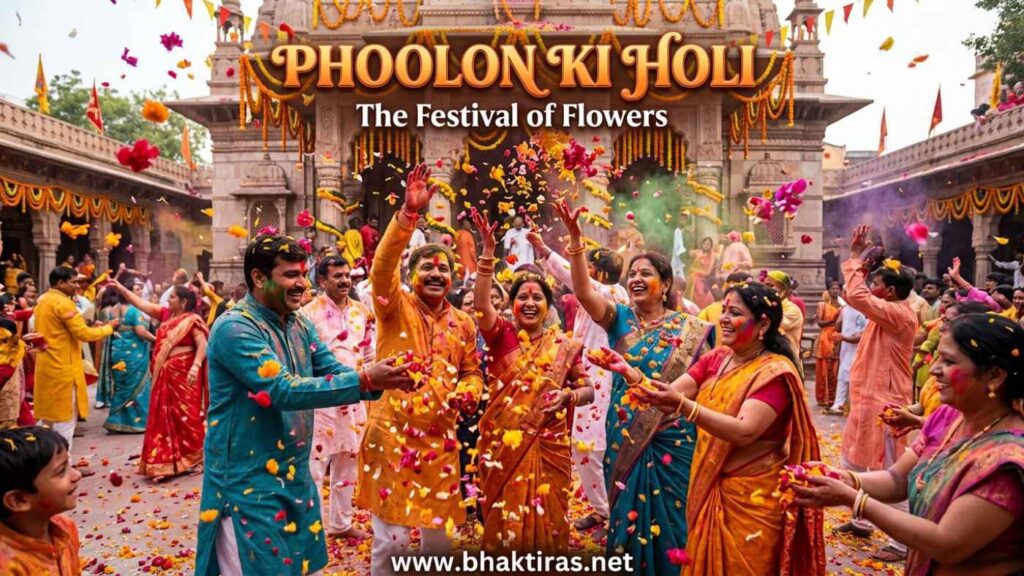
Phoolon Ki Holi is the flower Holi of Vrindavan, held each year at the Shri Banke Bihari temple on Phalguna Shukla Ekadashi, about four days before the main Holi. For a few unforgettable minutes the priests open the sanctum and rain baskets of marigold, rose and other petals down on the packed courtyard, as Banke Bihari is said to play Holi with his devotees. There is no coloured powder here, only flowers, singing and a crush of joyful people swaying under the falling petals. In 2027 it is expected on 18 March.
Phoolon Ki Holi 2026-2028: Dates & Timing
The next Phoolon Ki Holi at Banke Bihari is expected on 18 March 2027. Because it is tied to Phalguna Shukla Ekadashi on the lunar calendar, the date shifts each year and usually lands in late February or March.
| Year | Date | Day | Notes |
|---|---|---|---|
| 2026 | 27 February | Friday | Amalaki / Rangbharni Ekadashi (passed) |
| 2027 | 18 March | Thursday | Next occurrence – about 4 days before Holi |
| 2028 | 7 March | Tuesday | Amalaki / Rangbharni Ekadashi |
The flower shower itself lasts only a few minutes and is held once during the day, typically in the temple’s evening darshan window. Reach the temple well ahead of time, as the lanes of Vrindavan fill up hours before.
Why Phoolon Ki Holi Is Celebrated
Phoolon Ki Holi marks the moment Banke Bihari himself begins to play Holi with his devotees, opening the forty-day Braj Holi season on Phalguna Shukla Ekadashi.
In the Braj tradition, Holi is not a single day but a long season of play that begins around this Ekadashi and runs up to and beyond Rangwali Holi. Vrindavan, as the land of Krishna’s childhood, celebrates it with a tenderness you feel more than you see. Showering flowers rather than colour is a gesture of pure devotion, offering the Lord and his people the softest, most fragrant Holi of all.
Krishna's own Holi
The festival celebrates Radha and Krishna’s playful Holi in the groves of Braj. At Banke Bihari, the deity is treated as a living presence who joins the fun, so the petals are as much for him as for the crowd.
Rangbharni Ekadashi
The day is also called Rangbharni or Amalaki Ekadashi, the Ekadashi that fills the world with colour. It is the traditional signal that the Holi season in Braj has begun in earnest.
Flowers over powder
Using fresh petals instead of gulal turns a boisterous festival into something gentle and reverent. Devotees describe standing in the falling flowers as one of the most moving few minutes of their year.
Deities & Figures Worshipped
The festival centres on Krishna in his beloved Vrindavan form, Banke Bihari, worshipped alongside Radha.
Banke Bihari (Krishna)
The presiding deity of the temple, a form of Krishna as the enchanting cowherd of Braj. His darshan is famously brief and curtain-veiled, which makes the open flower shower feel especially rare and intimate.
Radha
Krishna’s eternal companion and the heart of Braj devotion. Holi in Vrindavan is above all a celebration of Radha and Krishna’s love, so her presence is felt throughout the day’s singing and play.
Key Rituals, Step by Step
The day builds slowly through kirtan and darshan toward one short, intense burst of flowers.
- Early arrival. Devotees reach the temple hours ahead, filling the courtyard and the narrow lanes of Vrindavan outside.
- Kirtan and bhajan. The crowd sings the names of Radha and Krishna, and the mood lifts as the wait grows.
- Special darshan. The sanctum’s curtain opens for a longer, more open darshan of Banke Bihari than the usual brief glimpses.
- The flower shower. Priests standing near the sanctum fling basket after basket of marigold, rose and other petals over the gathered devotees.
- Dancing in the petals. For a few minutes people raise their hands, sing and sway as flowers rain down and settle in their hair and clothes.
- Prasad and blessing. As the shower ends, devotees collect fallen petals to carry home and take prasad before making way for the next crowd.
Phoolon Ki Holi in the Braj Holi Season
The flower Holi is one of several distinctive Holi celebrations across Braj, each in its own town.
Banke Bihari, Vrindavan
The home of Phoolon Ki Holi, where the petal shower draws enormous crowds on Phalguna Ekadashi. This is the celebration most people picture when they hear of a Holi made of flowers.
Barsana & Nandgaon
A few days earlier, Barsana hosts the famous Lathmar Holi, where women playfully drive off men from Nandgaon with sticks. It is loud, colourful and very different in spirit from Vrindavan’s gentle petals.
Widow's Holi, Vrindavan
In recent years Vrindavan’s widows, long kept away from festivals, have played their own Holi with flowers and colour, a quiet reclaiming of joy that has touched people across India.
Phoolon Ki Holi Do's and Don'ts
A little planning turns a crowded day into a treasured memory.
Do
- Reach the temple well before the shower time, ideally hours ahead.
- Confirm the day and timing with the temple, as it shifts each year.
- Travel light and keep valuables secure in the dense crowd.
- Keep children and elderly companions close and hold hands.
- Sing along and simply enjoy the few minutes of falling flowers.
Avoid
- Do not carry powder colour, the temple flower Holi uses petals only.
- Do not push or climb barriers, the crowd is very tight.
- Do not bring bulky bags or large cameras that block others.
- Do not assume a fixed clock time, wait for the temple’s cue.
- Do not litter, gather your fallen petals rather than treading them.
Frequently Asked Questions
When is Phoolon Ki Holi in 2027?
Phoolon Ki Holi at Banke Bihari in Vrindavan is expected on Thursday, 18 March 2027, on Phalguna Shukla Ekadashi (Amalaki or Rangbharni Ekadashi). It falls about four days before the main Rangwali Holi. As the date follows the lunar calendar, confirm with the temple before travelling.
When was Phoolon Ki Holi in 2026 and when is it in 2028?
Phoolon Ki Holi was on 27 February 2026 and is expected on 7 March 2028. Both fall on Phalguna Shukla Ekadashi, which drifts between late February and March each year. The exact flower-shower window is set by the temple close to the day.
What is Phoolon Ki Holi?
Phoolon Ki Holi, the flower Holi, is a celebration at Vrindavan’s Banke Bihari temple where priests shower devotees with fresh flower petals instead of coloured powder. It lasts only a few minutes but is one of the most beloved moments of the Braj Holi season. It marks the day Banke Bihari begins to play Holi with his devotees.
Where does Phoolon Ki Holi take place?
Phoolon Ki Holi takes place at the Shri Banke Bihari temple in Vrindavan, Uttar Pradesh, in the Braj region near Mathura. The petal shower happens inside the temple courtyard around the deity’s sanctum. Vrindavan’s surrounding lanes fill with pilgrims for the occasion.
Which god is worshipped during Phoolon Ki Holi?
Phoolon Ki Holi honours Krishna in his Vrindavan form as Banke Bihari, worshipped alongside Radha. Holi in Braj is above all a celebration of Radha and Krishna’s playful love. The petals are offered as a gift both to the deity and to the devotees gathered before him.
How long does the flower shower last?
The actual flower shower lasts only a few minutes, though the day around it stretches across hours of kirtan, waiting and darshan. Priests fling baskets of petals over the crowd in one short, intense burst. Devotees often arrive many hours early to secure a place for those minutes.
Can anyone attend Phoolon Ki Holi at Banke Bihari?
Yes, Phoolon Ki Holi is open to all devotees and visitors, and it draws very large crowds. There is no ticket for the flower shower, but you should arrive early and be prepared for tight, crowded conditions. Keep valuables safe and stay with your group.
Why is it called Rangbharni Ekadashi?
The day is called Rangbharni Ekadashi, meaning the Ekadashi that fills the world with colour, because it traditionally opens the Holi season in Braj. It is also known as Amalaki Ekadashi. At Banke Bihari this colour comes in the form of flower petals rather than powder.
May Banke Bihari shower you with flowers and joy this Holi season. Radhe Radhe!