
Lathmar Holi 2027 – When Barsana's Women Rule the Streets
लठमार होली
When is Lathmar Holi in 2027?
Lathmar Holi 2027 falls around 15-16 March, roughly a week before the main countrywide Holi. It is a two-day celebration in the Braj towns of Barsana and Nandgaon (Mathura district, Uttar Pradesh), where the women playfully beat the visiting men with long wooden sticks. Exact days are fixed each year by the Radha Rani temple at Barsana, so treat them as approximate.
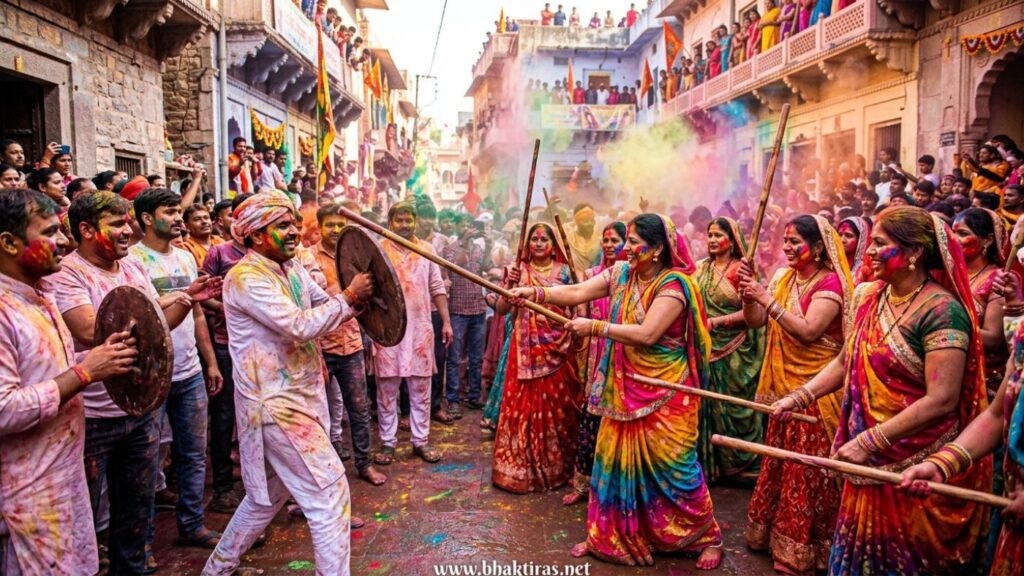
Lathmar Holi is the Braj region’s most theatrical version of Holi, played in the twin villages of Barsana and Nandgaon in Uttar Pradesh’s Mathura district about a week before the main festival. The name means “hit with sticks”: men from Nandgaon, Krishna’s village, arrive in Barsana, Radha’s village, to tease the women, who answer by chasing them off with long wooden lathis while the men crouch behind leather shields. It re-enacts the flirtatious play of Krishna and Radha, and few Holi customs in India draw more photographers.
Lathmar Holi 2026-2028: Dates & Calendar
The next Lathmar Holi is around 15-16 March 2027. Because it follows the lunar Hindu calendar and is scheduled by the Barsana temple, the exact days shift each year and are only announced locally.
| Year | Dates (approx) | Where | Notes |
|---|---|---|---|
| 2026 | 27-28 February | Barsana, then Nandgaon | Approximate; confirmed locally |
| 2027 | 15-16 March | Barsana, then Nandgaon | Next occurrence – approximate |
| 2028 | 4-5 March | Barsana, then Nandgaon | Approximate; confirmed locally |
These dates should be treated as a guide only. The play is held on Phalguna Shukla Navami and Dashami, but the precise days are announced by the Barsana Radha Rani temple close to the festival, so always confirm with the temple or local announcements before travelling.
Why Lathmar Holi Is Celebrated
Lathmar Holi celebrates the playful love between Radha and Krishna, and the unusual role-reversal that lets the women of Barsana take charge of the play.
According to Braj tradition, a young Krishna would visit Radha in Barsana and tease her and her friends. When his teasing went too far, the women drove him and his companions away. The festival stages that memory every year, turning a folk story into a living street drama.
A love story made public
The stick-play acts out the affectionate teasing between Krishna and the gopis of Barsana. Rather than a solemn ritual, it is a joyful re-enactment that keeps the Radha-Krishna leela alive in the very places the stories are set.
Women hold the upper hand
For these two days the women of Barsana and Nandgaon lead the play, wielding the lathis while the men defend themselves. This role-reversal is what sets Lathmar Holi apart from the colour-throwing Holi seen elsewhere.
The heart of Braj Holi
Barsana and Nandgaon are among the most important towns of the Braj Holi circuit. The celebration here begins the region’s extended Holi season, days before colours are thrown across the rest of India.
Deities & Figures Worshipped
Lathmar Holi centres on Radha and Krishna, honoured especially at the Radha Rani temple in Barsana.
Radha
Barsana is revered as Radha’s village, and the celebration begins at her hilltop Radha Rani temple. The women of Barsana are seen as standing in for Radha and her companions as they turn the men away.
Krishna
Nandgaon is honoured as Krishna’s home. The men who travel from Nandgaon to Barsana represent Krishna and his friends arriving to play Holi with Radha and the gopis.
Key Rituals, Step by Step
The two days follow a set pattern, opening with devotional singing before the stick-play spills into the streets.
- Holi samaj singing. The celebration opens at the Radha Rani temple in Barsana with traditional Holi songs, called samaj, sung by gathered devotees.
- The men arrive. Groups of men from Nandgaon, known as huriyare, travel to Barsana to play Holi and tease the local women.
- The teasing begins. The men sing provocative Holi verses aimed at the women, inviting the response the festival is famous for.
- Out come the lathis. The women of Barsana, the hurihaarin, chase the men with long wooden sticks in the open streets while onlookers cheer.
- Shields go up. The men crouch behind leather shields to absorb the blows, turning the exchange into a good-humoured contest rather than a fight.
- Colours and gulal. Dry gulal and coloured water drench the crowd, painting the lanes and rooftops of Barsana in pink and saffron.
- Thandai and sweets. Between rounds, participants share cups of thandai and plates of festive sweets.
- The play reverses. The next day the roles switch as men from Barsana visit Nandgaon, where Nandgaon’s women take up the sticks.
Special Foods of Lathmar Holi
Braj kitchens turn out fried sweets and cooling drinks for the crowds who fill Barsana and Nandgaon.
Pedakiya / Gujiya
The signature sweet of the season is the crescent-shaped gujiya, known locally as pedakiya, its crisp pastry stuffed with khoya, dried fruit and sugar. Plates of it appear in almost every home during the festival.
Thandai
A chilled milk drink flavoured with almonds, fennel, cardamom and pepper, thandai is passed around to cool players between rounds of the stick-play.
Laddoo
Round laddoos are shared as prasad and offered to guests, a fixture of temple offerings and household hospitality through the two days.
Mathri
Mathri, a flaky savoury cracker, balances the sweets and is served to visitors alongside tea and thandai.
Barsana and Nandgaon – the Two Days
Lathmar Holi is played across two neighbouring villages, with the action moving from one to the other on consecutive days.
Barsana – day one
The first day belongs to Barsana, Radha’s village. Men come up from Nandgaon to tease the women, who drive them back with lathis through the narrow lanes below the Radha Rani temple. This is the day that draws the largest crowds and most of the cameras.
Nandgaon – day two
The following day the play reverses at Nandgaon, Krishna’s village. Now the men of Barsana make the visit, and the women of Nandgaon take up the sticks, completing the exchange between the two towns.
The Radha Rani temple
Perched on a hill above Barsana, the Radha Rani temple is the ceremonial heart of the festival. The Holi samaj singing begins here, and the temple sets the dates for the play each year.
Lathmar Holi Do's and Don'ts
A little preparation makes the crowded, colourful days in Braj far more enjoyable.
Do
- Confirm the exact dates with the Barsana temple or local sources before travelling
- Reach Barsana early, as the lanes fill quickly on the first day
- Wear old clothes you do not mind staining with gulal
- Keep phones and cameras in waterproof covers
- Respect the play as a joyful tradition and follow local guidance
Avoid
- Do not assume the dates are fixed – they shift each year and are announced locally
- Do not step into the stick-play area unless you are part of it
- Do not use synthetic or harsh colours that can harm skin and eyes
- Do not bring valuables into the tightest crowds
- Do not photograph people, especially women, without their consent
Frequently Asked Questions
When is Lathmar Holi in 2027?
Lathmar Holi 2027 falls around 15-16 March, roughly a week before the main Holi. It is played in Barsana and then Nandgaon in the Mathura district of Uttar Pradesh. The exact days are set each year by the Barsana Radha Rani temple, so confirm locally before you travel.
When is Lathmar Holi in 2026 and 2028?
Lathmar Holi was around 27-28 February in 2026 and is expected around 4-5 March in 2028. These dates are approximate because the festival follows the lunar Hindu calendar. The Barsana temple announces the actual days close to the celebration.
Why are the dates only approximate?
The dates are approximate because Lathmar Holi is held on Phalguna Shukla Navami and Dashami in the lunar Hindu calendar, and the precise days are fixed each year by the Radha Rani temple at Barsana. They shift from year to year and are announced locally near the festival, so always confirm with the temple or local announcements before making plans.
Why is Lathmar Holi celebrated?
Lathmar Holi celebrates the playful love between Radha and Krishna. It re-enacts the story of Krishna visiting Radha’s village of Barsana to tease her and the gopis, who chase him away. The festival stages this folk memory in the streets, with women taking the lead.
What does "Lathmar" mean?
“Lathmar” means “hit with sticks”, from the Hindi word lath for a wooden staff. It refers to the central custom in which the women of Barsana strike the visiting men with long lathis while the men shield themselves with leather shields.
Which gods are worshipped at Lathmar Holi?
Radha and Krishna are the deities honoured at Lathmar Holi. Barsana is revered as Radha’s village and Nandgaon as Krishna’s, and the celebration begins with devotional singing at the Radha Rani temple in Barsana.
Where is Lathmar Holi celebrated?
Lathmar Holi is celebrated in the twin villages of Barsana and Nandgaon in the Mathura district of Uttar Pradesh, in the Braj region linked to Krishna. The first day’s play takes place at Barsana and the second at Nandgaon.
How is Lathmar Holi different from regular Holi?
Lathmar Holi is a regional Braj version of Holi held about a week before the main countrywide festival. Its defining feature is the stick-play, in which the women drive off the teasing men with wooden lathis, alongside the usual gulal and thandai. This role-reversal makes it one of the most distinctive and photographed Holi traditions in India.
May the colours of Barsana and Nandgaon bring you joy this Holi season. Happy Lathmar Holi!