
Dol Purnima 2027 – Bengal's Festival of Colours
দোল পূর্ণিমা
When is Dol Purnima in 2027?
Dol Purnima falls on Sunday, 21 March 2027. It is the eastern Indian form of Holi, celebrated on Phalguna Purnima, when idols of Krishna and Radha are placed on a decorated swing and devotees sing kirtan while throwing coloured powder (abir) and coloured water. The same night in the north is Holika Dahan.
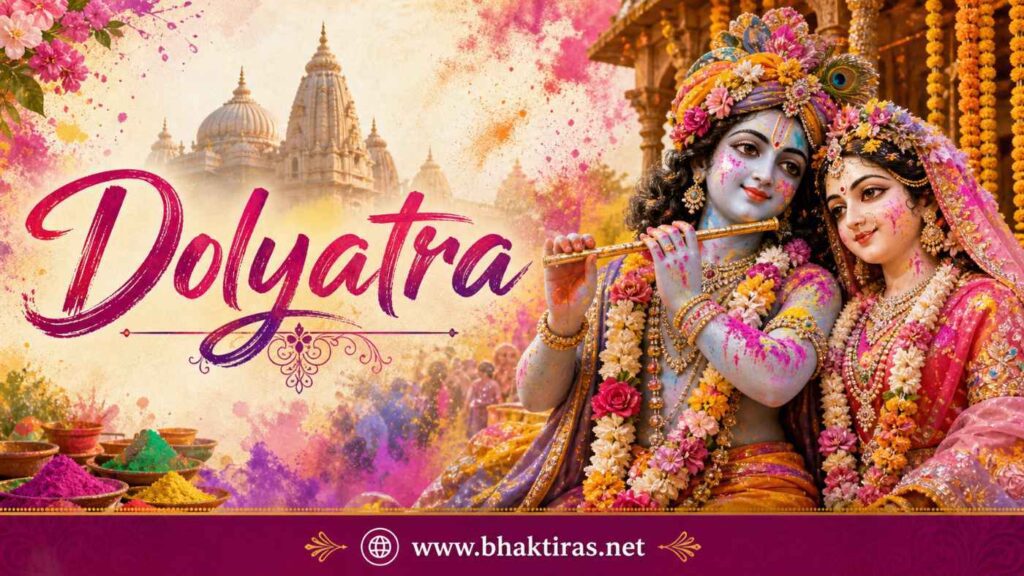
Dol Purnima is the eastern Indian counterpart of Holi, kept most warmly in West Bengal, Odisha and Assam by Vaishnav communities. On the full-moon day of Phalguna, small idols of Krishna and Radha are set on a decorated swing, or dol, and gently rocked while devotees sing kirtan and shower one another with abir and coloured water. The day carries a triple meaning: the love of Radha and Krishna, the arrival of spring, and, in Bengal, the birth of Chaitanya Mahaprabhu. In 2027 it falls on Sunday, 21 March.
Dol Purnima 2026-2028: Dates & Calendar
The next Dol Purnima is on Sunday, 21 March 2027. Because the festival is tied to the full moon of the lunar month Phalguna, the Gregorian date shifts by around eleven days each year.
| Year | Date | Day | Notes |
|---|---|---|---|
| 2026 | 3 March | Tuesday | Now passed |
| 2027 | 21 March | Sunday | Next occurrence |
| 2028 | 10 March | Friday | Phalguna Purnima |
The Purnima tithi in 2027 straddles 21-22 March, so some panchang almanacs list 22 March; most Bengali and Odia calendars observe the main Dol on 21 March. Confirm with your local panchang.
Why Dol Purnima Is Celebrated
Dol Purnima celebrates the divine love of Radha and Krishna, welcomes spring, and in Bengal marks the birth anniversary of Chaitanya Mahaprabhu.
The love of Radha and Krishna
The heart of the day is the play of colours that Krishna is said to have enjoyed with Radha and the gopis in Vrindavan. Placing the two on a shared swing and rocking it recalls that intimacy and joy, which is why the festival is centred on Vaishnav devotion rather than mischief alone.
Gaur Purnima and Chaitanya Mahaprabhu
In Bengal the same full moon is Gaur Purnima, the birth anniversary of Chaitanya Mahaprabhu, the fifteenth-century saint who spread congregational kirtan. Gaudiya Vaishnav temples keep the day with fasting, singing and processions, giving Dol a strong devotional flavour.
The turn of the season
Phalguna Purnima closes winter and opens spring, and the colours flung on this day are a welcome to the new season. At Shantiniketan the celebration is openly named Basanta Utsav, the spring festival, with students dressed in yellow and ochre.
Deities & Figures Worshipped
Dol Purnima centres on Krishna and Radha, with Chaitanya Mahaprabhu honoured in Bengal on the same day.
Krishna
The chief figure of the day. His idol, often the small Gopal or Bal Gopal form, is bathed, dressed and placed on the dol to be swung and offered abir. The colours evoke his springtime play with the gopis.
Radha
Radha shares the swing with Krishna as his eternal beloved. In Vaishnav thought their union stands for the soul’s love for God, and worshipping them together is the emotional core of Dol.
Chaitanya Mahaprabhu
Born on this full moon, Chaitanya is revered by Gaudiya Vaishnavs as an embodiment of Radha and Krishna together. Temples such as ISKCON Mayapur observe his appearance day alongside the Dol celebrations.
Key Rituals, Step by Step
Observances begin at dawn with worship of the idols and build through the day into processions and colour play.
- Morning bath and dressing. Devotees rise early, bathe, and clean the home shrine. The idols of Krishna and Radha are bathed, dressed in fresh clothes and adorned with flowers.
- Placing the deities on the dol. The idols are seated on a decorated swing or small palanquin, the dol, which is hung with garlands, coloured cloth and mango leaves.
- The first offering of abir. The presiding devotee offers abir (dry coloured powder) at the feet of the deities before anyone plays with colour, so the day’s colours begin with the divine couple.
- Swinging the deities. Family members and worshippers take turns gently rocking the swing while singing devotional songs, a rite that gives the festival its name.
- Kirtan and Vaishnav singing. Groups sing the names of Krishna and Radha, often moving through streets in nagar-kirtan processions, especially where Gaudiya Vaishnavs are strong.
- The procession, or jatra. In many places the swing is carried out in procession, in Odisha on a bimana palanquin, so the deity blesses the neighbourhood.
- Seeking blessings from elders. Younger people smear a little abir on the feet of parents and elders and touch their feet, receiving blessings in return.
- Playing with colour. Only after the worship do people play freely, throwing abir, gulal and coloured water among friends and family through the day.
Special Foods of Dol Purnima
The kitchen leans towards Bengali and Odia sweets, many of them offered first to Krishna and then shared.
Malpua
Soft, syrup-soaked fried pancakes of flour, milk and a little fennel, malpua (also written malpoa) is the classic Dol sweet, often served warm with a spoon of rabri.
Pitha
A family of rice-flour cakes filled with coconut and date-palm jaggery, steamed or fried. Pitha appear across eastern India whenever there is a festival to mark.
Sandesh
A delicate sweet of fresh chhena (curdled milk) lightly sweetened and pressed into shapes, sandesh is the everyday pride of Bengali confectionery and a natural offering for Krishna.
Kheersagar & payesh
Milk sweets for the day: Odisha’s kheersagar sets soft chhena balls in thickened milk, while Bengal’s payesh is a slow-cooked rice-and-milk pudding fragrant with cardamom.
Coconut naru
Small round laddus of grated coconut cooked with jaggery or sugar, naru are quick to make in quantity and passed around to visitors through the day.
Dol Across the East
Though the ritual core is shared, the mood and name of the day shift from state to state.
Shantiniketan (Basanta Utsav)
At Rabindranath Tagore’s Visva-Bharati the day is Basanta Utsav, the spring festival. Students in yellow saris and kurtas perform songs and dances Tagore wrote, then play with abir in a celebration that has become famous well beyond Bengal.
ISKCON Mayapur
In Nadia district, where Chaitanya was born, Gaur Purnima draws pilgrims from around the world. The day joins the Dol worship of Radha-Krishna with the celebration of Chaitanya’s appearance, marked by fasting, feasting and long kirtan.
Odisha (Dola Purnima)
Odisha keeps the day as Dola Purnima. The deity Dolagovinda is carried out on a decorated bimana palanquin and taken through villages over several days, receiving abir and offerings from each household.
Assam
Assamese Vaishnavs, in the tradition of the saint Sankardeva, observe the swinging of Krishna with naam-kirtan in namghars and satras, alongside the general play of colours that connects the day to Holi.
Dol Purnima Do's and Don'ts
A few simple courtesies keep the day joyful and respectful.
Do
- Worship and swing the idols of Radha and Krishna before starting colour play.
- Offer abir at the deities’ feet first, then to elders for their blessings.
- Use skin-safe, natural abir and gulal made from flowers or herbs.
- Join or listen to kirtan; the day is devotional as much as festive.
- Share sweets such as malpua and naru with neighbours and visitors.
Avoid
- Do not throw colour or water on anyone who has not agreed to play.
- Avoid harsh synthetic dyes, oil-based colours or anything that stains or harms skin.
- Do not confuse the swinging worship with rowdiness; keep the shrine area calm.
- Avoid wasting water; use it sparingly and thoughtfully.
- Do not force elders, the unwell or animals into the colour play.
Frequently Asked Questions
When is Dol Purnima in 2027?
Dol Purnima is on Sunday, 21 March 2027. It is observed on Phalguna Purnima, the full-moon day of the month Phalguna, which is the same night as Holika Dahan in northern India. Some panchang list 22 March because the Purnima tithi straddles the two dates.
When is Dol Purnima in 2026 and 2028?
Dol Purnima was on Tuesday, 3 March 2026, and will next fall on Friday, 10 March 2028. The date shifts each year because it follows the lunar full moon of Phalguna rather than a fixed Gregorian date.
Why is Dol Purnima celebrated?
Dol Purnima celebrates the love of Radha and Krishna, welcomes the arrival of spring, and in Bengal marks the birth of Chaitanya Mahaprabhu on the same full moon. Devotees swing the idols of Krishna and Radha, sing kirtan and play with coloured powder to honour all three.
How is Dol Purnima different from Holi?
Dol Purnima is the eastern Indian form of Holi, kept in West Bengal, Odisha and Assam by Vaishnav communities. Its distinctive rite is placing Krishna and Radha on a decorated swing and rocking it with kirtan, whereas north Indian Rangwali Holi, the day after, centres on public colour play. Both fall around the same Phalguna full moon.
Which god is worshipped on Dol Purnima?
Krishna is the chief deity of Dol Purnima, worshipped together with Radha, whose idols are placed on the swing. In Bengal, Chaitanya Mahaprabhu is also honoured on the same day as Gaur Purnima, since it is his birth anniversary.
What does the word Dol Jatra mean?
In Bengali, dol means swing or palanquin and jatra means procession, so Dol Jatra is the procession of the swing. The name comes from the central ritual of seating Krishna and Radha on a decorated swing and carrying it out among devotees.
What foods are made for Dol Purnima?
Traditional Dol Purnima foods are eastern Indian sweets such as malpua, pitha, sandesh, payesh, kheersagar and coconut naru. Many are offered to Krishna first and then shared among family and visitors through the day.
Where is Dol Purnima celebrated most grandly?
Dol Purnima is celebrated most grandly at Shantiniketan in West Bengal, where it is the Basanta Utsav spring festival, and at ISKCON Mayapur, which combines Dol worship with Gaur Purnima. Odisha keeps it as Dola Purnima with a bimana palanquin, and Assamese Vaishnavs mark it with naam-kirtan.
However you keep the day, may the colours of Dol bring the joy of Radha and Krishna to your home. Shubho Dol Utsav.