
Pongal 2027 – The Tamil Harvest Thanksgiving to the Sun
பொங்கல்
When is Pongal in 2027?
Thai Pongal falls on Friday, 15 January 2027, with the opening Bhogi day on 14 January. Pongal is a four-day Tamil harvest festival thanking Surya, the Sun, for the season’s crop. The main day is named after the dish of new rice boiled with milk and jaggery until it overflows.
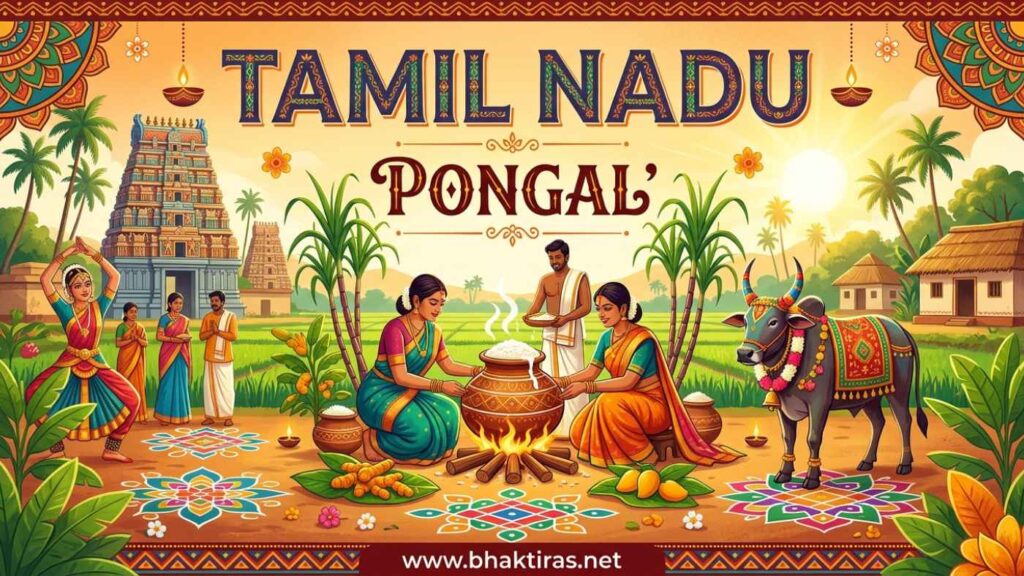
Pongal is the Tamil harvest festival, a four-day thanksgiving to Surya the Sun and to the land, cattle and rain that bring in the crop. It opens the Tamil month of Thai, usually around the middle of January, and is one of the few Hindu festivals fixed to the solar calendar rather than the moon. The name comes from the Tamil word pongu, to boil over: freshly harvested rice is cooked with milk and jaggery in a new pot and deliberately allowed to spill, a sign of plenty greeted with the cry “Pongalo Pongal!”.
Pongal 2026-2028: Dates & Calendar
Thai Pongal, the main day, next falls on Friday, 15 January 2027, with Bhogi the day before. Because Pongal follows the Sun’s entry into Capricorn rather than a lunar tithi, its date barely shifts from year to year.
| Year | Thai Pongal | Day | Bhogi (Day 1) |
|---|---|---|---|
| 2026 | 15 January | Thursday | 14 January |
| 2027 | 15 January | Friday | 14 January |
| 2028 | 15 January | Saturday | 14 January |
The four days run in sequence: Bhogi (14 Jan), Thai Pongal (15 Jan), Mattu Pongal (16 Jan) and Kaanum Pongal (17 Jan). Thai Pongal coincides with Makar Sankranti and other solar harvest festivals across India.
Why Pongal Is Celebrated
Pongal is celebrated as a harvest thanksgiving: farming families offer the first of the new rice back to Surya, the Sun, whose warmth ripened the crop, and honour the cattle and rain that made it possible.
The festival also opens the Tamil month of Thai, held to be the most auspicious month of the year for weddings and new beginnings. A common Tamil saying, Thai pirandhal vazhi pirakkum, means that when Thai is born, a way opens – the sense that better days follow.
Thanks to the Sun
The heart of Pongal is gratitude to Surya. The overflowing pot of rice cooked facing the rising sun is a direct offering, acknowledging that a good harvest depends on light and warmth rather than human effort alone.
The cycle of the land
As a harvest festival, Pongal marks the closing of one agricultural cycle and the hope for the next. Old and worn things are burned on Bhogi, and cattle that pulled the plough are thanked on Mattu Pongal.
A fresh, auspicious start
Falling on the first day of Thai, the festival is treated as a doorway into a lucky season. Many families choose this time to fix marriages, move house or begin new ventures.
Deities & Figures Worshipped
Surya, the Sun, is the central figure of Pongal, honoured on the main day. Cattle are given a place of their own on the third day, Mattu Pongal.
Surya (the Sun)
Surya receives the first offering of the harvest. The pot of sweet Pongal is cooked outdoors facing east so that it boils over as the sun rises, and turmeric-tied sugarcane and the fresh dish are offered to him.
Cattle
Cows and bulls are washed, their horns painted and tipped with brass caps, and garlands and bells hung on them. Farmers thank the animals whose labour made the harvest possible, and in some districts the bull-taming sport Jallikattu is held.
Key Rituals, Step by Step
Each of the four days carries its own observance, moving from clearing out the old to feasting and family visits.
- Bhogi bonfire. On the first day, households discard old and broken items and burn them in a dawn bonfire, cleaning and whitewashing the home to welcome the new season.
- Draw the kolam. Before sunrise on Thai Pongal, women clean the doorway with water and cow dung and lay a fresh kolam – a rice-flour design on the ground – often marked with a lump of cow dung topped by a pumpkin flower.
- Cook Pongal facing the Sun. Rice, milk and jaggery are set to boil in a new clay pot outdoors, decorated with turmeric plants and tied with a turmeric root, positioned to face the rising sun.
- Let it boil over. When the pot froths and spills, the family calls out “Pongalo Pongal!” – the overflow is the wished-for abundance, and no one interrupts it.
- Offer to Surya. The cooked sweet Pongal, along with sugarcane, bananas and coconut, is offered to the Sun before the family eats.
- Honour the cattle. On Mattu Pongal the cows and bulls are bathed, decorated with paint, garlands and bells, fed a share of the Pongal and worshipped.
- Visit and roam. On Kaanum Pongal families step out together, visit relatives, exchange the festive dish and spend the day by rivers, beaches or parks.
Special Foods of Pongal
The festival is named after its signature dish, and the table centres on the newly harvested rice cooked two ways.
Sakkarai Pongal
The festival’s namesake sweet: new rice and moong dal boiled with milk and jaggery, finished with ghee, cashews, raisins and cardamom. It is the dish offered to the Sun and shared as the day’s blessing.
Ven Pongal
A comforting savoury version of rice and moong dal tempered with black pepper, cumin, ginger, curry leaves and cashews in ghee. It is eaten for the festive breakfast, often with coconut chutney and sambar.
Sugarcane
Whole stalks of sugarcane are a Pongal staple, offered to the Sun and chewed through the day as a sweet marker of the harvest.
Vadai & payasam
Crisp medu vadai and a milky payasam round out the celebratory meal, alongside bananas and coconut used in the offering.
The Four Days of Pongal
Pongal unfolds over four connected days, each with a distinct focus – from clearing out the old to visiting family.
Day 1 – Bhogi
The eve of the festival. Old, unused belongings are thrown out and burnt in a bonfire at dawn, homes are cleaned and whitewashed, and doorways are decorated – a fresh start before the main day.
Day 2 – Thai Pongal
The principal day and the start of the Tamil month Thai. The Pongal dish is cooked outdoors and allowed to boil over as an offering to Surya, greeted with the shout “Pongalo Pongal!”.
Day 3 – Mattu Pongal
Dedicated to cattle. Cows and bulls are bathed, their horns painted and decorated, garlands and bells hung on them, and they are fed and worshipped; some places hold the Jallikattu bull-taming event.
Day 4 – Kaanum Pongal
A day for family and outings. People visit relatives, share the festive food and spend the day together at rivers, beaches, temples and parks, closing the celebration on a warm note.
Pongal Do’s and Don’ts
A few simple customs keep the spirit of the harvest festival intact.
Do
- Cook the Pongal in a fresh clay pot facing the rising sun
- Let the rice boil over and call out “Pongalo Pongal!”
- Lay a clean kolam at the doorway at dawn
- Thank and gently care for cattle on Mattu Pongal
- Visit and share the festive dish with family on Kaanum Pongal
Avoid
- Do not interrupt or move the pot while it is boiling over
- Do not use stale or leftover rice for the offering – use the new harvest
- Do not overwork or mistreat cattle on their day of honour
- Do not throw away the discarded Bhogi items carelessly near water sources
- Do not treat it as only a food festival – the thanksgiving to the Sun comes first
Frequently Asked Questions
When is Pongal in 2027?
Thai Pongal, the main day of Pongal, falls on Friday, 15 January 2027. The festival begins the day before with Bhogi on 14 January and runs for four days through to Kaanum Pongal on 17 January.
When is Pongal in 2026 and 2028?
Thai Pongal fell on Thursday, 15 January 2026 and will fall on Saturday, 15 January 2028. Because Pongal follows the solar calendar, the main day stays close to 15 January each year, with Bhogi on the 14th.
Why is Pongal celebrated?
Pongal is celebrated as a harvest thanksgiving. Tamil farming families thank Surya the Sun, along with cattle and rain, for the season’s crop, and mark the start of the auspicious Tamil month of Thai. The name means “to boil over”, after the dish of new rice cooked until it overflows.
Which god is worshipped on Pongal?
Surya, the Sun god, is worshipped on Pongal, especially on the main day, Thai Pongal. The freshly cooked sweet Pongal is offered to him as the rising sun is greeted. Cattle are separately honoured on the third day, Mattu Pongal.
What are the four days of Pongal?
The four days of Pongal are Bhogi, Thai Pongal, Mattu Pongal and Kaanum Pongal. Bhogi is for discarding old things in a bonfire, Thai Pongal is the main day of cooking rice to the Sun, Mattu Pongal honours cattle, and Kaanum Pongal is for family visits and outings.
What food is made on Pongal?
The signature dish is Pongal itself – newly harvested rice boiled with milk. It is made sweet as Sakkarai Pongal with jaggery, ghee, cashews and cardamom, and savoury as Ven Pongal with pepper and cumin. Sugarcane, vadai, payasam and bananas complete the feast.
What does “Pongalo Pongal” mean?
“Pongalo Pongal!” is the joyful cry raised when the pot of rice froths up and boils over during cooking. The overflow is seen as a sign of abundance and prosperity for the year ahead, so the moment of spilling is welcomed rather than stopped.
Is Pongal the same as Makar Sankranti?
Pongal and Makar Sankranti fall on the same solar date, both marking the Sun’s northward turn and the harvest. Pongal is the four-day Tamil form of the festival with its own rituals, while Makar Sankranti is the wider North and West Indian celebration of the same solar event.
However you mark the harvest this year, may the pot always boil over. Pongalo Pongal!