
Chaiti Chhath 2027 – The Spring Chhath to Surya
चैती छठ
When is Chaiti Chhath in 2027?
Chaiti Chhath in 2027 runs from 10 to 13 April, with the main Sandhya Arghya (offering to the setting sun) on Monday, 12 April 2027. It is the spring Chhath, kept in the month of Chaitra a few days after Ram Navami, and is the lesser-known twin of the great autumn Kartik Chhath. Devotees in Bihar, Jharkhand and eastern Uttar Pradesh keep a 36-hour waterless fast and thank Surya, the Sun, and Chhathi Maiya.
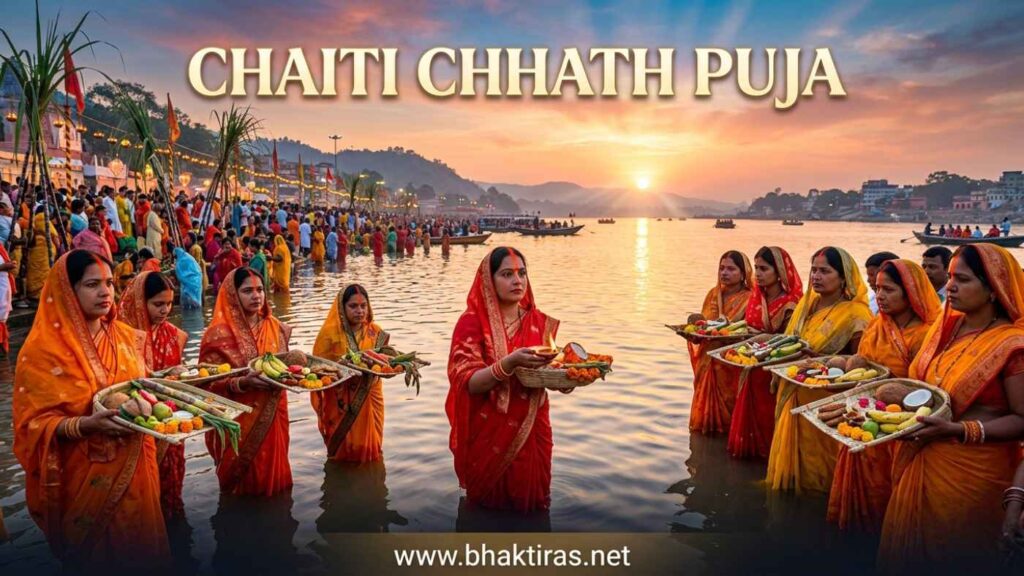
Chaiti Chhath is the spring face of Chhath – the same rigorous four-day worship of Surya, the Sun, and Chhathi Maiya, but kept in the Hindu month of Chaitra (March or April) instead of Kartik. Falling a few days after Ram Navami, it is far quieter than the famous autumn Chhath that fills the ghats of Bihar every November, yet the discipline is identical: a purifying meal, a day of sweet kheer, a 36-hour fast without even water, and arghya offered while standing waist-deep in a river first to the setting and then the rising sun. Because it arrives as the heat is climbing, many say the fast is the harder of the two.
Chaiti Chhath 2026-2028: Dates & Calendar
The next Chaiti Chhath is in 2027, with the main Sandhya Arghya on Monday, 12 April. The festival shifts each year because it is fixed to Chaitra Shukla Shashthi in the Hindu lunar calendar, not to a set English date.
| Year | Sandhya Arghya (main day) | Four-day span | Day |
|---|---|---|---|
| 2026 | 24 March | 22-25 March | Tuesday |
| 2027 | 12 April | 10-13 April | Monday |
| 2028 | 1 April | 30 Mar – 2 April | Saturday |
The 2026 Chaiti Chhath has already passed, so 2027 is the coming observance. Each year the span runs Chaturthi (Nahay Khay) to Saptami (Usha Arghya) of the bright half of Chaitra, with the third day – Sandhya Arghya on Shashthi – as the heart of the festival.
Why Chaiti Chhath Is Celebrated
Chaiti Chhath is a festival of thanksgiving to Surya, the visible source of life, health and the harvest, kept in spring as the days lengthen and the first summer crops ripen. Devotees vow the fast to ask for a child’s wellbeing, a family’s health or a wish fulfilled.
Where the Kartik Chhath thanks the sun after the monsoon and the paddy harvest, the spring Chhath honours the same sun as the wheat and gram of the rabi season come in. The worship is directed at the Sun as a living deity and at Chhathi Maiya, the folk goddess who guards children and is linked in belief with Usha and Pratyusha, the first and last light of the day.
It is deliberately austere. There is no idol, no priest and no temple procession – only clean water, the sun on the horizon and the sincerity of the fast. Many families keep Chaiti Chhath because of an old family vow, passing the observance down through generations.
The spring twin of Kartik Chhath
Chhath is kept twice a year. The autumn one in Kartik (November) is the huge, well-known festival; Chaiti Chhath in Chaitra is its smaller spring counterpart. The rituals are the same, but far fewer families keep the spring fast, which makes it more intimate and less crowded at the ghats.
Thanks for health and the harvest
The sun is honoured as the giver of health, energy and food. Coming as the rabi harvest arrives, Chaiti Chhath is a way of returning thanks for the season’s grain and asking the Sun for strength through the summer ahead.
A vow for the family
Most who keep Chaiti Chhath do so on a manauti, a personal vow – often for the birth or recovery of a child, or the wellbeing of the household. The severity of the fast is understood as the measure of the devotee’s faith.
Deities & Figures Worshipped
Chaiti Chhath is addressed to two: Surya, the Sun god, worshipped directly as he sets and rises, and Chhathi Maiya, the folk mother goddess of children and wellbeing.
Surya
The Sun is the central deity of Chhath. Unlike most Hindu worship, there is no image – the devotee offers arghya straight to the sun on the horizon, first at dusk and then at dawn. Surya is thanked as the source of life, light and health.
Chhathi Maiya
Chhathi Maiya is the folk goddess honoured alongside the Sun, believed to protect children and grant the wishes behind the fast. In tradition she is connected with Usha, the dawn, which is why the final arghya to the rising sun is so central.
Usha and Pratyusha
The consorts of the Sun, Usha (first light) and Pratyusha (last light), are remembered in the two arghyas: the evening offering greets Pratyusha as the sun sets, and the morning offering greets Usha as it rises.
Key Rituals, Step by Step
Chaiti Chhath unfolds over four days, each with its own name and discipline, building to the two arghyas offered standing in water.
- Nahay Khay (Day 1). The vratin (the person fasting) bathes in a river or pond, cleans the home and cooks a simple pure meal – usually rice, chana dal and lauki (bottle gourd) – eaten only once. This begins the ritual purity that must hold for the rest of the festival.
- Kharna (Day 2). A day-long fast is kept and broken after sunset with kheer (rice pudding made with jaggery) and roti, eaten in silence. Once this meal is over the hard fast begins – from here the vratin takes neither food nor water.
- The 36-hour nirjala fast. From the end of Kharna until the next morning’s arghya, the devotee keeps a waterless (nirjala) fast for about 36 hours. In the rising spring heat this is considered even harder than during the autumn Chhath.
- Preparing the prasad. Through Day 3 the household prepares thekua (a stiff wheat-and-jaggery biscuit), fruit, sugarcane and coconut, arranging them in daura and soop – bamboo baskets and winnowing fans – carried to the ghat.
- Sandhya Arghya (Day 3, main day). At dusk the vratin, family and neighbours walk to the river. Standing waist-deep in water, the devotee offers arghya – water and milk poured toward the setting sun – with the laden soop raised in offering. This is the emotional peak of the festival.
- Night vigil and Chhath songs. Many keep an overnight vigil, singing traditional Chhath geet in Bhojpuri and Maithili that address Chhathi Maiya and the Sun directly.
- Usha Arghya (Day 4). Before dawn everyone returns to the water to offer the final arghya to the rising sun. With this the vow is complete.
- Paran (breaking the fast). After the morning arghya the vratin takes a little of the offered water and prasad, ending the 36-hour fast. Thekua and fruit are shared widely as blessed food.
Special Foods of Chaiti Chhath
The food of Chhath is deliberately plain and pure – no onion or garlic, prepared in a clean kitchen kept apart for the festival.
Thekua
The signature prasad of Chhath: wheat flour kneaded with jaggery and a little ghee, pressed in wooden moulds and deep-fried until firm. It keeps for days and is the food most associated with the festival.
Kheer and roti
On the second evening the fast is broken with kheer cooked in jaggery rather than sugar, eaten with a plain roti. This single meal is taken quietly before the long waterless fast begins.
Rice, chana dal and lauki
The first day’s pure meal is a simple plate of rice, split chana dal and bottle gourd, cooked without onion or garlic and eaten once after the ritual bath.
Fruit and sugarcane
Whole fruit, sugarcane stalks, coconut and the local seasonal produce are arranged in the soop and offered to the Sun, then shared as prasad.
Where Chaiti Chhath Is Kept
Chaiti Chhath is a regional observance of the Bhojpuri, Maithili and Magahi belt, far more localised than the autumn Chhath.
Bihar
The heartland of Chaiti Chhath. Along the Ganga and its tributaries, and at Aurangabad’s famous Sun temple at Deo, families keep the spring fast, though in smaller numbers than at the November Chhath.
Jharkhand
Kept along the Subarnarekha and other rivers, especially in districts with strong Bihari and Bhojpuri roots, with the same four-day discipline and thekua offerings.
Eastern Uttar Pradesh
In the Purvanchal region – around Varanasi, Ballia and Gorakhpur – the spring Chhath is observed at the ghats, tied closely to the Bhojpuri culture of the area.
The diaspora
Migrant communities from this belt keep Chaiti Chhath wherever they have settled, from Delhi and Mumbai to Mauritius, Fiji and the Caribbean, improvising ghats at tanks, pools and riverbanks.
Chaiti Chhath Do's and Don'ts
Chhath is defined by strict physical and ritual purity throughout the four days.
Do
- Bathe and keep the body and home scrupulously clean before cooking any prasad.
- Cook the offerings in a separate, freshly cleaned kitchen using only clean water.
- Sweeten the kheer and thekua with jaggery, the traditional choice, not refined sugar.
- Offer both arghyas standing in clean water at the correct sunset and sunrise times.
- Share the thekua and fruit prasad widely with family and neighbours after paran.
Avoid
- Do not use onion, garlic or any non-vegetarian food during the four days.
- Do not taste or eat the prasad before it has been offered to the Sun.
- Do not break the nirjala fast early – not even water is taken until the Usha Arghya.
- Do not wear leather or footwear while handling the offerings or at the ghat.
- Do not use unclean or reused vessels for the prasad; new or freshly scoured ones are kept.
Frequently Asked Questions
When is Chaiti Chhath in 2027?
Chaiti Chhath in 2027 runs from 10 to 13 April, with the main Sandhya Arghya on Monday, 12 April 2027. The four days are Nahay Khay (10 April), Kharna (11 April), Sandhya Arghya (12 April) and Usha Arghya (13 April). It is fixed to Chaitra Shukla Shashthi in the Hindu calendar.
When is Chaiti Chhath in 2026 and 2028?
In 2026 Chaiti Chhath was kept from 22 to 25 March, with Sandhya Arghya on Tuesday, 24 March 2026, so it has already passed. In 2028 it falls from 30 March to 2 April, with Sandhya Arghya on Saturday, 1 April 2028.
What is the difference between Chaiti Chhath and Kartik Chhath?
Chaiti Chhath is the spring Chhath, kept in the month of Chaitra (March or April) a few days after Ram Navami, while the famous Kartik Chhath is kept in Kartik (October or November). The rituals are identical, but far fewer families keep the spring fast, and because it falls in rising heat the 36-hour fast is considered harder.
Which god is worshipped on Chaiti Chhath?
Chaiti Chhath is dedicated to Surya, the Sun god, and to Chhathi Maiya, the folk mother goddess of children and wellbeing. There is no idol – devotees offer arghya directly to the sun as it sets and rises, thanking it as the source of life and health.
What are the four days of Chaiti Chhath?
The four days are Nahay Khay (ritual bath and a single pure meal), Kharna (a day fast broken at night with jaggery kheer), Sandhya Arghya (offering to the setting sun, the main day) and Usha Arghya (offering to the rising sun). A waterless fast of about 36 hours runs from Kharna to the final morning.
How long is the Chaiti Chhath fast?
The main fast of Chaiti Chhath is a nirjala (waterless) fast of about 36 hours, kept from the end of the Kharna meal on the second evening until the Usha Arghya at dawn on the fourth day. During this time the vratin takes neither food nor water.
Why is Chaiti Chhath less known than Kartik Chhath?
Chaiti Chhath is less known because far fewer families keep the spring fast and it lacks the mass gatherings of the November Chhath. It falls in the growing summer heat and close to other spring festivals, so it stays a quieter, more personal observance in Bihar, Jharkhand and eastern Uttar Pradesh.
What food is offered on Chaiti Chhath?
The main offering is thekua, a firm wheat-and-jaggery biscuit, along with fruit, sugarcane, coconut and seasonal produce carried to the ghat in bamboo soop baskets. All food is cooked pure, without onion or garlic, and sweetened with jaggery rather than refined sugar.
May the spring sun bless every home that keeps this quiet, steadfast vow. Chhathi Maiya ki jai.