
Chhath Puja 2026 – Four Days of Thanks to the Sun
छठ पूजा
When is Chhath Puja in 2026?
Chhath Puja 2026 runs from Friday 13 November to Monday 16 November, with the main Sandhya Arghya (evening offering to the setting sun) on Sunday 15 November and Usha Arghya (offering to the rising sun) on Monday 16 November. It is a four-day festival of thanksgiving to Surya, the Sun god, and Chhathi Maiya, observed six days after Diwali on Kartik Shukla Shashthi.
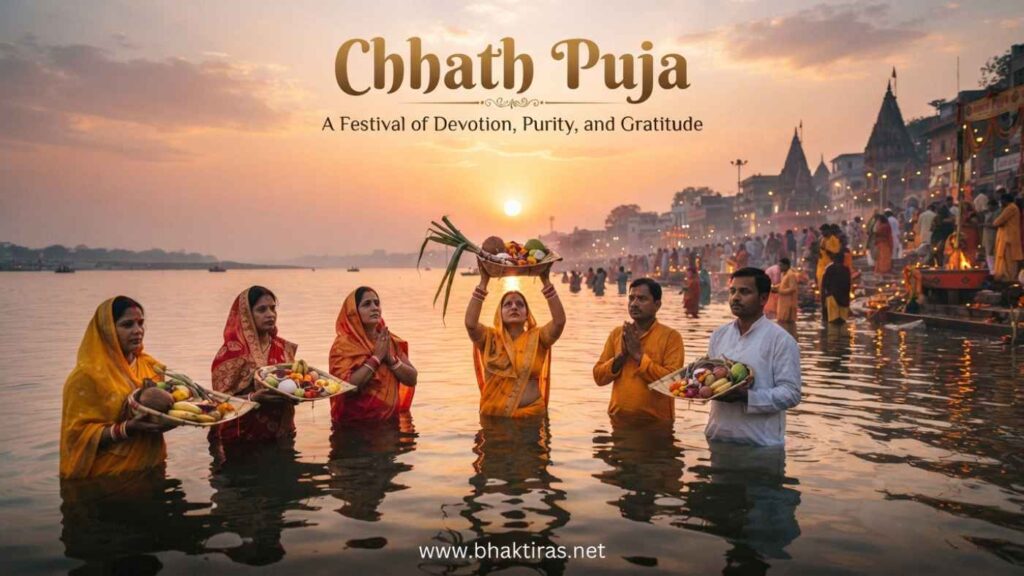
Chhath Puja is a four-day festival of thanksgiving to Surya, the Sun god, and his consort Chhathi Maiya, kept with unusual discipline across Bihar, Jharkhand, eastern Uttar Pradesh, Delhi and the Nepal Terai. It falls on Kartik Shukla Shashthi, six days after Diwali, and centres on a rigorous 36-hour waterless fast. Devotees, called vratis and most often women, wade into a river or pond to offer arghya to the setting sun and again to the rising sun the next morning. There are no idols and no priests, only water, sunlight and gratitude.
Chhath Puja 2026-2028: Dates & Calendar
In 2026 the main Sandhya Arghya falls on Sunday 15 November. The dates shift each year because Chhath follows the lunar Hindu calendar, always landing on Kartik Shukla Shashthi, six days after Diwali.
| Year | Sandhya Arghya (main day) | Day | Four-day span |
|---|---|---|---|
| 2026 | 15 November | Sunday | 13-16 November (next occurrence) |
| 2027 | 4 November | Thursday | 2-5 November |
| 2028 | 23 October | Monday | 21-24 October |
The four days always run in the same order: Nahay Khay, Kharna, Sandhya Arghya and Usha Arghya. The Sandhya Arghya day above is the festival’s principal day; Nahay Khay begins two days earlier and Usha Arghya, when the fast is broken, comes the morning after.
Why Chhath Puja Is Celebrated
Chhath Puja is celebrated to thank the Sun for sustaining life on earth and to seek health, prosperity and children in return. It is among the few Hindu observances that worship the Sun directly, without an image or a temple.
Gratitude to the Sun
The festival treats sunlight as the visible source of all energy and growth. By standing in water and facing the sun at dusk and dawn, devotees offer thanks for crops, health and the turning of the seasons rather than asking a favour in the usual sense.
Chhathi Maiya's blessing
Chhathi Maiya, associated with Usha (the dawn) and Shashthi, is invoked as the protector of children and family wellbeing. Many families keep the vrat as a vow made when a wish, often for a child’s health, was fulfilled.
Discipline and purity
The 36-hour fast without food or water, the cleaning of the house and the strictly sattvik cooking mark Chhath as a test of self-control. Purity of body, food and intention is considered as important as the offering itself.
Faith without intermediaries
There is no priest, no idol and no elaborate temple ritual. Each vrati offers arghya personally at the ghat, which gives the festival its reputation as one of the most direct and equalising acts of worship in the Hindu calendar.
Deities & Figures Worshipped
Chhath Puja is addressed to two linked figures: Surya, the Sun god, and Chhathi Maiya, the goddess of the sixth day who guards children and family life.
Surya
Surya is worshipped as the source of light, warmth and life. Arghya is offered to him twice, to the setting sun on the third evening and to the rising sun on the fourth morning, marking the sun’s daily death and rebirth.
Chhathi Maiya
Chhathi Maiya is regarded as a sister or consort of Surya and is identified with Usha, the dawn, and with Shashthi Devi, protector of newborns. Prayers to her seek the health and long life of children and the wellbeing of the household.
Key Rituals, Step by Step
Chhath unfolds over four fixed days, moving from a purifying meal to a strict fast and finally to the two arghyas at the water’s edge.
- Nahay Khay (Day 1). The vrati bathes, ideally in a river, and cleans the home. Only one pure, sattvik meal is eaten, commonly lauki (bottle gourd) with rice and chana dal, cooked without onion or garlic.
- Kharna (Day 2). A day-long fast is broken after sunset with kheer made of rice and jaggery, along with roti and fruit, offered first to the deity. From this moment the 36-hour waterless fast begins.
- Preparing the prasad. Families prepare thekua, a stiff wheat-and-jaggery biscuit, and arrange soop and daura (bamboo winnows and baskets) with fruit, sugarcane, coconut and sweets for the offering.
- Procession to the ghat. In the afternoon of Day 3 the family walks to the riverbank or a pond, often singing traditional Chhath songs, carrying the loaded baskets on their heads.
- Sandhya Arghya (Day 3 evening). The vrati stands in the water and offers arghya, water and milk poured toward the setting sun, holding up the soop of thekua and fruit as the sun goes down.
- Night vigil. Many devotees keep watch through the night with lamps and songs at the ghat, the fast continuing unbroken without food or water.
- Usha Arghya (Day 4 dawn). Before sunrise the family returns to the same spot and offers arghya to the rising sun, completing the worship of the sun’s setting and rising.
- Paran. After the morning arghya the vrati finally breaks the 36-hour fast, sharing the prasad with family, neighbours and passers-by.
Special Foods of Chhath Puja
Chhath food is strictly sattvik, prepared with great care and always without onion, garlic or leftover ingredients. A few items are central to the offering.
Thekua
Thekua is the defining sweet of Chhath: wheat flour kneaded with jaggery and ghee, sometimes flavoured with fennel or coconut, pressed in wooden moulds and deep-fried until firm. It keeps for days and forms the heart of the arghya basket.
Kheer and roti
On Kharna night the fast is broken with kheer cooked from rice, milk and jaggery, eaten with plain roti. This is the last food and water the vrati takes before the 36-hour fast.
Seasonal fruit and sugarcane
Baskets are loaded with whole seasonal produce: bananas, coconut, sweet lime, water chestnut (singhara) and lengths of sugarcane. The fruit is offered uncut, as a symbol of natural, unspoiled abundance.
Rice-flour laddu and rasiao
Some households add rasiao-kheer (jaggery rice pudding), sweet rice-flour laddus and puri to the prasad. Every item is cooked on a fresh clay or dedicated stove, kept apart from everyday cooking.
Regional Names & Variations
Chhath is strongest across the eastern Gangetic plain and travels with its people wherever they settle.
Bihar & Jharkhand
This is Chhath’s heartland, where it is the biggest festival of the year. Rivers such as the Ganga at Patna draw enormous crowds, and cities build and light artificial ghats for those far from a natural bank.
Eastern Uttar Pradesh
In Purvanchal districts around Varanasi, Gorakhpur and Ballia, Chhath is observed on the ghats of the Ganga and its tributaries with the same four-day rigour and songs sung in Bhojpuri.
Delhi & the diaspora
Large migrant communities from Bihar and UP have made Chhath a major event in Delhi, Mumbai and other cities, where the Yamuna banks and specially prepared ponds fill with devotees. It is now marked far beyond India by Indian communities abroad.
Nepal Terai
In the Madhesh region of southern Nepal, Chhath is a public festival kept with the same rituals along the rivers of the Terai plains, sharing the culture of the neighbouring Indian districts.
Chhath Puja Do's and Don'ts
Chhath is defined by purity and discipline, so its observances are followed closely.
Do
- Keep the fasting person, food and utensils scrupulously clean throughout the four days.
- Cook all prasad fresh, on a dedicated stove, without onion or garlic.
- Offer arghya at the correct times, to the setting sun on Day 3 and the rising sun on Day 4.
- Use bamboo soop and daura and natural, whole ingredients for the offering.
- Share the prasad widely with family, neighbours and strangers after the fast is broken.
Avoid
- Do not take food or water once the 36-hour fast has begun on Kharna night.
- Do not taste or eat any of the prasad before it has been offered to the Sun.
- Do not wear footwear near the puja area or the loaded baskets.
- Do not use onion, garlic or non-vegetarian food anywhere in the household during the festival.
- Do not pollute the river or ghat; keep the water and its banks clean.
Frequently Asked Questions
When is Chhath Puja in 2026?
Chhath Puja 2026 runs from Friday 13 November to Monday 16 November. The main Sandhya Arghya, the evening offering to the setting sun, is on Sunday 15 November, and the Usha Arghya to the rising sun is on Monday 16 November. It is celebrated on Kartik Shukla Shashthi, six days after Diwali.
When is Chhath Puja in 2027 and 2028?
In 2027 the main Sandhya Arghya day falls on Thursday 4 November, with the four-day festival running 2-5 November. In 2028 it moves earlier to Monday 23 October, with the span 21-24 October. The dates shift each year because Chhath follows the lunar Hindu calendar.
Why is Chhath Puja celebrated?
Chhath Puja is celebrated to thank Surya, the Sun god, for sustaining life and to seek health, prosperity and the wellbeing of children through Chhathi Maiya. It is one of the few festivals that worships the Sun directly, without idols or priests, and many families keep it as a vow fulfilled.
Which god is worshipped on Chhath Puja?
Chhath Puja worships Surya, the Sun god, and Chhathi Maiya, the goddess of the sixth day associated with Usha (the dawn) and Shashthi. Arghya is offered to the setting sun on the third day and to the rising sun on the fourth, honouring the sun’s daily setting and rising.
What are the four days of Chhath Puja?
The four days of Chhath Puja are Nahay Khay, Kharna, Sandhya Arghya and Usha Arghya. Nahay Khay begins with a purifying bath and one pure meal, Kharna ends with kheer at sunset before the fast, Sandhya Arghya is the evening offering to the setting sun, and Usha Arghya is the dawn offering to the rising sun when the fast is broken.
How long is the Chhath fast?
The main Chhath fast lasts about 36 hours without food or water. It begins after the Kharna meal on the second evening and is broken only after the Usha Arghya on the fourth morning, making it one of the most demanding vrats in the Hindu calendar.
What is thekua and why is it made for Chhath?
Thekua is the signature prasad of Chhath, a firm biscuit of wheat flour, jaggery and ghee, moulded and deep-fried. It is made because it is pure, keeps well and forms the central offering in the soop presented to the Sun during the arghya.
Where is Chhath Puja mainly celebrated?
Chhath Puja is celebrated most widely in Bihar, Jharkhand, eastern Uttar Pradesh, Delhi and the Nepal Terai. Migrant communities have carried it to cities across India and abroad, where riverbanks and specially built ponds host the arghya rituals.
May the Sun that rises over the ghat bring health and light to your home. Happy Chhath Puja, Chhathi Maiya ki jai.