
Magh Bihu 2027 – Assam's Harvest Feast of Fire
মাঘ বিহু / ভোগালী বিহু
When is Magh Bihu in 2027?
Magh Bihu falls on 15-16 January 2027, with the feast night (Uruka) on the eve of 14 January. Also called Bhogali Bihu, it is Assam’s harvest-end festival, marked by community feasting and the dawn burning of bamboo-and-straw huts called Meji as an offering to Agni, the fire god.
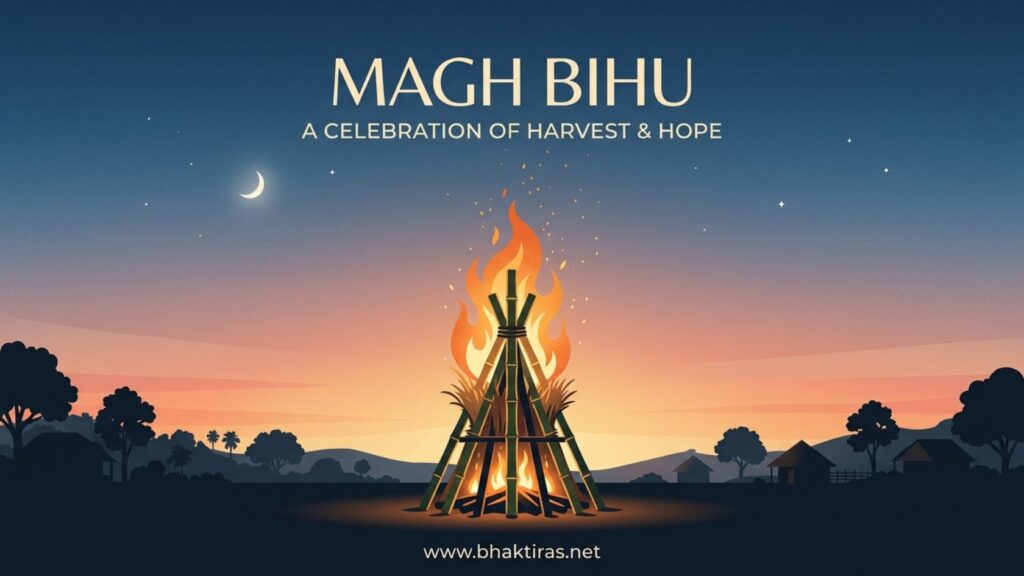
Magh Bihu, known warmly as Bhogali Bihu, is the harvest-end festival of Assam and the most food-centred of the region’s three Bihus. Its name comes from bhog, meaning feasting and enjoyment, and that is exactly what it delivers: two days in mid-January when granaries are full, the hard work of the paddy season is done, and whole communities eat together. It coincides with Makar Sankranti and centres on Uruka, the great feast night, followed at dawn by the burning of the Meji fire as thanks to Agni.
Magh Bihu 2026-2028: Dates & Calendar
The next Magh Bihu is 15-16 January 2027, with Uruka (the feast night) on 14 January. Because it is tied to the sun’s entry into Capricorn (Makar Sankranti), the date barely moves year to year.
| Year | Uruka (feast night) | Magh Bihu | Notes |
|---|---|---|---|
| 2026 | 14 January | 15-16 January | Passed |
| 2027 | 14 January | 15-16 January | Next occurrence |
| 2028 | 14 January | 15-16 January | Coincides with Makar Sankranti |
The festival unfolds over two linked stages: Uruka on the eve is the night of cooking and eating together in the fields, and Magh Bihu itself begins the next morning with the lighting of the Meji.
Why Magh Bihu Is Celebrated
Magh Bihu is celebrated as a thanksgiving for the completed harvest – a moment to enjoy the year’s plenty and offer part of it to Agni, the fire god.
Thanks for the harvest
By mid-January the paddy is in and the granaries are full. Magh Bihu marks the close of the harvest with open-handed feasting, a communal way of saying the year’s labour has paid off and there is enough to share.
The season of bhog
The word Bhogali comes from bhog, feasting and enjoyment. Where the October Kongali (Kati) Bihu is austere and the fields still young, Magh Bihu is its opposite: abundant, warm and social, the reward at the end of the agricultural cycle.
An offering to fire
At dawn the Meji is set alight and the year’s plenty – rice, pitha and other foods – is offered into the flames for Agni. It is a gesture of gratitude to the fire that cooks the food and to the forces that granted a good crop.
One of Assam's three Bihus
Assam keeps three Bihus a year: Rongali (Bohag) in April marks the new year and spring, Kongali (Kati) in October is a lean, prayerful season, and Bhogali (Magh) in January is the harvest feast. Together they trace the farming year.
Deities & Figures Worshipped
Magh Bihu centres on Agni, the fire god, to whom the Meji is offered at dawn.
Agni
Agni, the Vedic god of fire, receives the festival’s central offering. When the Meji is lit on Magh Bihu morning, people cast rice, pitha and other harvest foods into the flames, thanking fire for cooking their food and carrying their gratitude upward. The rising smoke is treated as the offering reaching the divine.
Key Rituals, Step by Step
The festival runs from the Uruka feast night into the Meji burning at dawn, followed by a day of food and games.
- Building the Meji and Bhelaghar. In the days before, young people gather bamboo, thatch and dried straw and build a tall conical Meji and makeshift huts called Bhelaghar in the harvested fields.
- Uruka, the feast night. On the eve (14 January in 2027), neighbours pool ingredients, cook a huge communal meal over open fires and eat together late into the night.
- The night in the Bhelaghar. Groups spend the night in and around the huts, singing Bihu songs, telling stories and keeping the fires going until morning.
- Lighting the Meji at dawn. On Magh Bihu morning the Meji is set alight. People gather around it, warm themselves and offer rice, pitha and other foods into the fire for Agni.
- The offering and blessings. As the Meji burns, elders offer prayers of thanks for the harvest; half-burnt bamboo and ash are sometimes carried to fields and gardens as a blessing for the coming crop.
- Feasting and sweets. The rest of the day is given to eating – pitha, laru, jolpan with curd and jaggery – shared freely among families and visitors.
- Traditional games. Villages hold games and contests such as tekeli bhonga (pot-breaking), egg fights and, historically, buffalo fights, rounding off the harvest celebration.
Special Foods of Magh Bihu
Magh Bihu is the most food-focused of Assam’s festivals, built around rice-based sweets and hearty communal cooking.
Pitha
Rice-flour cakes are the signature treat. Til pitha is rolled around a sesame-and-jaggery filling, while ghila pitha is a fried, disc-shaped cake. They are made fresh in large batches for the feast.
Laru
Round laddoo-style sweets made from coconut or sesame bound with jaggery. Easy to make in quantity, laru is offered to guests and shared through the two days of celebration.
Jolpan
A traditional Assamese breakfast of flattened or puffed rice (chira or muri) mixed with curd and jaggery. Simple, filling and central to Bihu mornings.
Curd and cream
Fresh curd and thick cream from the season’s milk are eaten with jolpan and pitha, adding richness to the harvest table.
Sunga saul
Rice cooked inside a length of green bamboo (sunga) over fire, which lends it a smoky, earthy flavour. It is a rustic delicacy tied to the outdoor, field-side cooking of Uruka.
Where Magh Bihu Is Celebrated
Magh Bihu is celebrated across Assam and by the Assamese diaspora, and it sits within a wider mid-January harvest season observed under different names elsewhere in India.
Across Assam
From the Brahmaputra valley villages to towns and cities, the pattern is the same: Meji and Bhelaghar in the fields, the Uruka feast, and the dawn fire. Rural areas keep the older forms – buffalo and egg fights, tekeli bhonga – most fully.
The three-Bihu context
Magh Bihu is one of Assam’s three Bihus alongside Rongali (April) and Kongali (October). It is the harvest feast of the set, distinguished by its emphasis on food and fire rather than dance or prayer.
Alongside Makar Sankranti
Because it falls with the sun’s entry into Capricorn, Magh Bihu shares the calendar with Makar Sankranti, Pongal in Tamil Nadu and Lohri in Punjab – all harvest and solstice-season festivals of mid-January.
Magh Bihu Do's and Don'ts
A few simple courtesies keep the celebration warm and safe.
Do
- Join the Uruka feast and contribute food or ingredients if invited.
- Make and share pitha, laru and jolpan with neighbours and guests.
- Gather at the Meji at dawn and offer rice or pitha to the fire.
- Take part in traditional games like tekeli bhonga in good spirit.
- Greet others with warmth and share a Bihu song.
Avoid
- Do not light or leave the Meji unattended – keep water and helpers nearby.
- Avoid wasting the harvest food; the spirit of the day is generosity, not excess for its own sake.
- Do not encourage cruel animal contests; many communities have retired buffalo fights.
- Avoid treating it as only a private meal – Bihu is a community celebration.
- Do not build Meji or Bhelaghar near homes, dry thatch or power lines.
Frequently Asked Questions
When is Magh Bihu in 2027?
Magh Bihu is on 15-16 January 2027, with Uruka, the feast night, on the eve of 14 January. It is Assam’s harvest festival, also called Bhogali Bihu, and coincides with Makar Sankranti.
When is Magh Bihu in 2026 and 2028?
Magh Bihu falls on 15-16 January in both 2026 and 2028, with Uruka on 14 January each year. The date is stable because the festival is tied to the sun’s entry into Capricorn in mid-January rather than the moon.
Why is Magh Bihu celebrated?
Magh Bihu is celebrated as a thanksgiving for the completed harvest. With the granaries full, communities feast together, build and burn the Meji fire, and offer part of the year’s plenty to Agni, the fire god.
Which god is worshipped on Magh Bihu?
Agni, the god of fire, is honoured on Magh Bihu. On the festival morning the Meji – a tall structure of bamboo, thatch and straw – is set alight and rice, pitha and other foods are offered into the flames as thanks.
What is Uruka in Magh Bihu?
Uruka is the eve of Magh Bihu, falling on 14 January, and it is the great feast night. Communities cook and eat a large meal together in the fields and spend the night in makeshift bamboo-and-straw huts called Bhelaghar, singing and keeping fires lit until dawn.
What is the Meji in Bhogali Bihu?
The Meji is a tall conical structure of bamboo, thatch and dried straw built in the harvested fields before Magh Bihu. At dawn on the festival it is set alight as an offering to Agni, and people gather round it to warm themselves, pray and cast in harvest foods.
What foods are eaten during Magh Bihu?
Magh Bihu is a feast of rice-based treats: pitha (til pitha and ghila pitha), laru (coconut or sesame laddoo), and jolpan – flattened or puffed rice with curd and jaggery. Curd, cream and sunga saul (rice cooked in bamboo) also feature.
What is the difference between the three Bihus of Assam?
Assam keeps three Bihus a year. Rongali or Bohag Bihu in April is the spring and new-year festival, Kongali or Kati Bihu in October is a lean, prayerful season, and Bhogali or Magh Bihu in January is the harvest feast of eating and fire.
May your granaries stay full and your Meji burn bright – Bhogali Bihur Anek Xubhessa.