
Mysore Dasara 2026 – Karnataka's Royal Nadahabba
मैसूरु दसरा
When is Mysore Dasara in 2026?
Mysore Dasara 2026 runs from 11 October to 20 October, spanning the ten days of Sharadiya Navratri and closing with Vijayadashami on Tuesday, 20 October. It is the official state festival of Karnataka, honouring Goddess Chamundeshwari, and is famous for the illuminated Mysore Palace and the Jumboo Savari elephant procession.
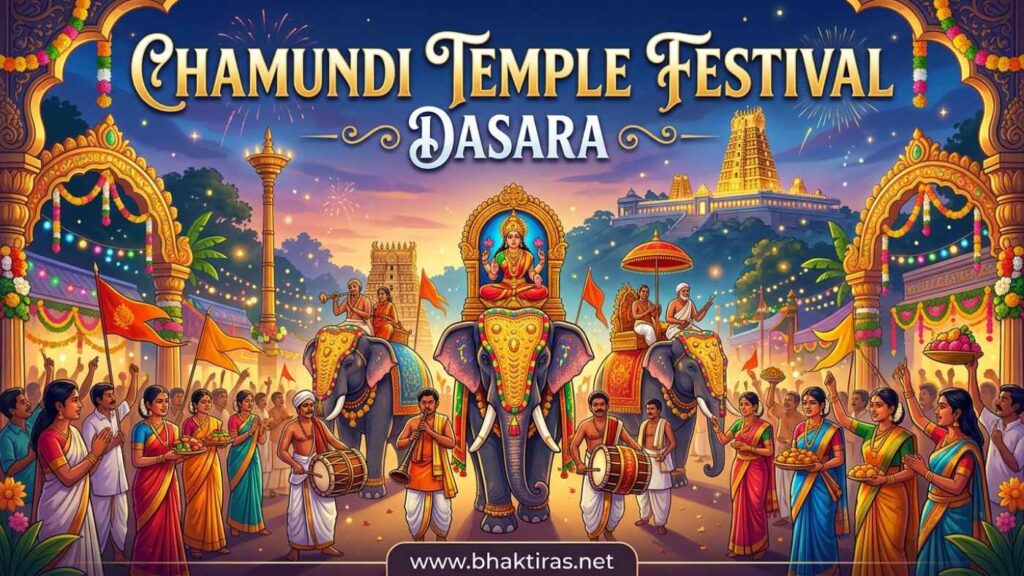
Mysore Dasara, known in Kannada as Nadahabba (the state festival), is Karnataka’s grandest celebration and its official festival. Held over the ten days of Sharadiya Navratri and ending on Vijayadashami, it honours Goddess Chamundeshwari, who slew the buffalo demon Mahishasura on Chamundi Hill above the city. The Wadiyar dynasty has staged it since the Vijayanagara era, and today it means a palace lit by nearly a lakh bulbs, a torchlight parade, a royal durbar and the golden Jumboo Savari elephant procession.
Mysore Dasara 2026-2028: Dates & Calendar
Mysore Dasara 2026 begins on 11 October and closes on Vijayadashami, 20 October. Because it follows the lunar month of Ashwin, the ten days shift each year against the Gregorian calendar.
| Year | Dates (Navratri to Vijayadashami) | Vijayadashami Day | Notes |
|---|---|---|---|
| 2026 | 11 – 20 October | Tuesday | Next occurrence |
| 2027 | 30 September – 9 October | Saturday | Navratri begins 30 Sep |
| 2028 | 19 – 27 September | Wednesday | Falls entirely in September |
The public spectacle peaks on the final two days: the torchlight parade and the Jumboo Savari procession both take place on Vijayadashami, while the palace is illuminated every evening across all ten nights.
Why Mysore Dasara Is Celebrated
Mysore Dasara marks the victory of good over evil, celebrating Goddess Chamundeshwari’s slaying of the demon Mahishasura and the wider triumph of dharma commemorated on Vijayadashami.
Slaying of Mahishasura
The festival recalls how Chamundeshwari, a fierce form of Durga, killed the buffalo demon Mahishasura after a long battle on Chamundi Hill. The city’s name, Mysuru, is derived from Mahishasura, tying the local legend directly to the land.
Victory on Vijayadashami
The tenth day, Vijayadashami, celebrates the goddess’s decisive victory and, across India, Rama’s defeat of Ravana. It is regarded as a highly auspicious day for new beginnings, learning and undertakings.
A royal tradition
The Mysuru royals began holding Dasara durbars in the Vijayanagara era, and the Wadiyar dynasty carried the pageantry forward for centuries. The custom of the royal family presiding over the festivities continues symbolically to this day.
Deities & Figures Worshipped
The central deity of Mysore Dasara is Goddess Chamundeshwari, the guardian goddess of the Mysuru royal family and a form of Durga.
Chamundeshwari
Chamundeshwari, enshrined in the temple atop Chamundi Hill, is the tutelary goddess of Mysuru and a fierce form of Durga. She is worshipped through the ten days as the slayer of Mahishasura, and her temple sees vast crowds during the festival.
Durga in her nine forms
As part of Navratri, the nine nights honour the Navadurga – the nine aspects of Goddess Durga – with special worship on each day, building towards the goddess’s victory celebrated on the tenth.
Key Rituals, Step by Step
Mysore Dasara blends temple worship with royal ceremony, moving from private puja to the grand public procession over ten days.
- Inauguration on Chamundi Hill. The festival is traditionally opened with worship of Goddess Chamundeshwari at her temple atop Chamundi Hill above the city.
- Navratri worship. Through the nine nights, devotees worship the nine forms of Durga, with fasting, prayer and temple visits across Mysuru and Karnataka.
- Nightly palace illumination. Every evening the Mysore Palace is lit with close to a lakh bulbs, drawing enormous crowds to the palace grounds.
- Cultural programmes. Music, dance and folk performances are held at the palace and across the city throughout the ten days.
- The royal durbar. A ceremonial durbar is held in keeping with the Wadiyar tradition, with the head of the royal family presiding.
- Jumboo Savari procession. On Vijayadashami, a golden howdah carrying the idol of Chamundeshwari is borne on a caparisoned elephant through the streets in the grand Jumboo Savari.
- Torchlight parade. The celebrations close on Vijayadashami evening with the Panjina Kavayatthu, a spectacular torchlight parade at the Bannimantap grounds.
Special Foods of Mysore Dasara
Karnataka households and the festival crowds enjoy a spread of Mysuru sweets and traditional festive fare during Dasara.
Mysore Pak
The rich gram-flour and ghee sweet said to have originated in the Mysuru palace kitchens is the signature treat of the season, sold everywhere during Dasara.
Obbattu (Holige)
A sweet flatbread stuffed with a jaggery and lentil or coconut filling, obbattu is a festive staple served at family meals during the celebration.
Chitranna & festive rice
Lemon rice (chitranna), tamarind rice and other flavoured rice dishes are prepared for the festival, often offered as naivedya and shared with family.
Kosambari & sweets
Light lentil salads (kosambari) and an assortment of sweets and savoury snacks round out the Dasara table across Karnataka homes.
Where It's Celebrated
While Dasara is observed across India, its royal Mysuru form is distinct, and Karnataka celebrates it as the state festival.
Mysuru city
The heart of the celebration, where the lit palace, Jumboo Savari, torchlight parade and durbar draw visitors from across India and abroad.
Chamundi Hill
The Chamundeshwari temple above the city becomes a major pilgrimage point through the ten days, with long queues of devotees.
Across Karnataka
As Nadahabba, the state festival, Dasara is marked statewide with Navratri worship, cultural events and public holidays.
Mysore Dasara Do's and Don'ts
A few simple pointers help visitors and devotees make the most of the festival respectfully.
Do
- Book accommodation and Jumboo Savari viewing well in advance, as Mysuru fills up.
- Visit the Chamundeshwari temple early to avoid the heaviest crowds.
- See the palace illumination in the evening for the full effect.
- Follow crowd-management and security instructions during the procession.
- Try local Mysuru sweets and festive dishes from trusted vendors.
Avoid
- Do not expect easy last-minute travel or hotels during the festival week.
- Avoid carrying prohibited items into the palace grounds or procession route.
- Do not block or push at barricades during the Jumboo Savari.
- Avoid littering at the palace, temple and Bannimantap grounds.
- Do not attempt to photograph restricted ceremonial areas without permission.
Frequently Asked Questions
When is Mysore Dasara in 2026?
Mysore Dasara 2026 runs from 11 October to 20 October, covering the ten days of Sharadiya Navratri. It concludes with Vijayadashami on Tuesday, 20 October 2026, when the famous Jumboo Savari procession and torchlight parade take place.
When is Mysore Dasara in 2027 and 2028?
Mysore Dasara falls from 30 September to 9 October in 2027, with Vijayadashami on Saturday, 9 October. In 2028 it is held from 19 September to 27 September, with Vijayadashami on Wednesday, 27 September. The dates shift each year because the festival follows the lunar month of Ashwin.
Why is Mysore Dasara celebrated?
Mysore Dasara celebrates the victory of Goddess Chamundeshwari over the demon Mahishasura, symbolising the triumph of good over evil. The city of Mysuru is named after Mahishasura, and the festival has been staged by the Mysuru royal family since the Vijayanagara era.
Which goddess is worshipped during Mysore Dasara?
Goddess Chamundeshwari, a fierce form of Durga, is the central deity of Mysore Dasara. She is the guardian goddess of the Mysuru royal family, enshrined in the temple atop Chamundi Hill overlooking the city.
What is the Jumboo Savari?
The Jumboo Savari is the grand procession held on Vijayadashami, the final day of Mysore Dasara. A golden howdah carrying the idol of Goddess Chamundeshwari is carried through the streets on a decorated elephant, followed by tableaux, dancers and mounted contingents.
Why is Mysore Dasara called Nadahabba?
Nadahabba means state festival in Kannada, and Mysore Dasara is the official festival of Karnataka. It carries this title because of its royal heritage and its scale, drawing visitors from across the country to Mysuru each year.
What is special about the Mysore Palace during Dasara?
During Dasara the Mysore Palace is illuminated with nearly a lakh bulbs every evening across the ten nights, becoming the visual centrepiece of the festival. The palace also hosts the royal durbar and cultural programmes throughout the celebration.
How long does Mysore Dasara last?
Mysore Dasara lasts ten days, spanning the nine nights of Sharadiya Navratri and ending on the tenth day, Vijayadashami. The public spectacle peaks on the final day with the Jumboo Savari and the evening torchlight parade.
May Goddess Chamundeshwari bless you this Dasara – a joyful Nadahabba to you and your family.