
Ambubachi Mela 2027 – The Great Tantric Fair of Kamakhya
अम्बुवाची मेला
When is Ambubachi Mela in 2027?
Ambubachi Mela 2027 is expected from 22 to 26 June, held at the Kamakhya Temple on Nilachal Hill in Guwahati, Assam. The temple stays closed for the first three days to mark the goddess Kamakhya’s annual menstruation, then reopens on the fourth day, around 26 June, for darshan. Official dates are confirmed by the Kamakhya Devalaya nearer the festival.
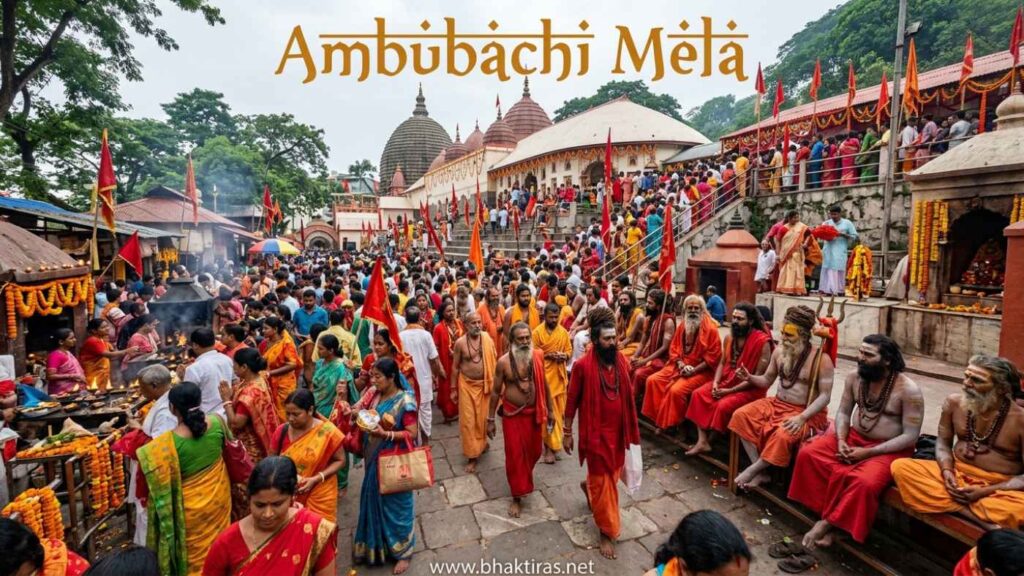
Ambubachi Mela is one of eastern India’s largest Tantric gatherings, held each year at the Kamakhya Temple on Nilachal Hill above Guwahati, Assam. It marks the annual menstruation of the goddess Kamakhya, understood as the earth-mother’s yearly cycle of fertility. For three days the temple doors stay shut and no worship takes place; on the fourth day they reopen for darshan, and sadhus, tantrics and lakhs of pilgrims arrive to receive the goddess’s blessing. It usually falls in the second half of June, when the Sun enters Ardra nakshatra during the month of Ashadha.
Ambubachi Mela 2026-2028: Dates & Calendar
The next Ambubachi Mela is expected from 22 to 26 June 2027. The dates shift slightly each year because the mela is fixed to the Sun entering Ardra nakshatra in mid-June, not to a set civil date.
| Year | Closure begins | Doors reopen | Notes |
|---|---|---|---|
| 2026 | 22 June (Mon) | 26 June (Fri) | Sanctum closed 22-24 June; darshan resumes 26 June |
| 2027 | 22 June (Tue) | 26 June (Sat) | Next occurrence (approximate) |
| 2028 | 22 June (Thu) | 25-26 June | Approximate; Sun enters Ardra in mid-June |
The exact opening and closing times each year are announced by the Kamakhya Devalaya as the festival approaches, since they depend on the precise moment the Sun transits into Ardra nakshatra. Please treat the 2027 and 2028 dates above as approximate until officially confirmed.
Why Ambubachi Mela Is Celebrated
Ambubachi Mela celebrates the annual menstruation of the goddess Kamakhya, a Shakta belief that the earth-mother goes through her own yearly cycle of fertility.
At Kamakhya there is no idol in the sanctum. The goddess is worshipped as a natural stone yoni-shaped cleft kept moist by an underground spring. During the monsoon the water is said to turn red, taken as a sign that the goddess is in her menstrual period, and this is when the temple closes.
The earth as mother
Shakta tradition treats the earth and the goddess as one living, fertile body. Just as the monsoon renews the land after summer, the goddess’s cycle is read as the source from which all creation is renewed. Farming and sowing are traditionally paused during these days out of respect for the resting earth.
A Shakti Peetha
Kamakhya is counted among the most powerful Shakti Peethas, the sites where parts of the goddess Sati are believed to have fallen. Assamese and pan-Indian tradition holds that her yoni fell here, which is why the temple is so closely tied to fertility, creation and the feminine principle.
Tantric heart of the east
For centuries Kamakhya has been a centre of Tantric practice. During the mela, sadhus, aghoris and tantrics who otherwise stay in seclusion come down to the temple, making it a rare public gathering of ascetics from across India.
Deities & Figures Worshipped
The central deity is the goddess Kamakhya, a form of the Mother Goddess (Shakti) worshipped as the source of desire, fertility and creation.
Kamakhya
Kamakhya is the presiding goddess of Nilachal Hill, worshipped not as a carved image but as a stone yoni fed by a natural spring. She is revered as a form of Durga and Shakti, the giver of fertility and fulfilled desire.
The Dasa Mahavidya
Kamakhya is surrounded on Nilachal Hill by temples to the ten Mahavidyas, the ten wisdom-goddesses of Tantra, including Kali, Tara, Bhairavi and Kamala. Pilgrims often visit these shrines during their time at the mela.
Key Rituals, Step by Step
The mela follows a fixed rhythm of closure, rest and reopening, mirroring the traditional seclusion and return of a menstruating woman.
- Pravritti (closure). On the first evening, when the Sun enters Ardra nakshatra, the temple doors are shut. Regular worship stops and the goddess is considered to be resting.
- Three days of rest. For three days there is no cooking of ritual food, no idol worship and no farming in the surrounding tradition. Devotees observe restraint, and many sadhus practise their sadhana quietly on the hill.
- Nivritti (reopening). On the fourth morning, after the goddess is ceremonially bathed and purified, the doors reopen. This is the moment the waiting crowds have gathered for.
- Darshan and queues. Pilgrims form long lines for darshan of the sanctum. The wait can stretch for hours as lakhs of visitors pass through over the following days.
- Distribution of prasad. Small pieces of the red cloth (angabastra) that covered the stone during the closure are given to devotees as a highly prized blessing, along with the moist earth (raktabastra) considered sacred.
- Gathering of ascetics. Throughout the fair, sadhus, tantrics and aghoris camp on the hillside, and visitors seek their darshan and blessings.
Where It Is Celebrated
Ambubachi Mela is centred entirely on the Kamakhya Temple, but its meaning echoes in similar observances across the east.
Nilachal Hill, Guwahati
The mela belongs to the Kamakhya Temple on Nilachal Hill in Guwahati, Assam. This is the only place the fair is held, and it draws pilgrims from across India and Nepal.
Bengal and the east
In parts of Bengal and Odisha the same belief in the earth’s menstruation is marked as Ambubachi or Raja Parba, with farming paused and the soil left to rest during the monsoon days.
Tantric circuits
For Tantric practitioners across northern and eastern India, Ambubachi is one of the key dates of the year, and many time their pilgrimage specifically to be at Kamakhya for the reopening.
Ambubachi Mela Do's and Don'ts
A few simple points help visitors respect the customs and manage the very large crowds.
Do
- Plan travel and stay in Guwahati well in advance, as the city fills up.
- Be ready for long darshan queues on the reopening day and after.
- Dress modestly and follow the temple’s instructions.
- Respect the sadhus and ascetics camped on the hill.
- Keep water and essentials with you in the June monsoon heat and rain.
Avoid
- Do not expect darshan of the sanctum during the three-day closure.
- Do not photograph sadhus or rituals without permission.
- Avoid carrying valuables in the dense crowds.
- Do not litter on Nilachal Hill or near the shrines.
- Avoid rushing the queues; the crowd is managed in order.
Frequently Asked Questions
When is Ambubachi Mela in 2027?
Ambubachi Mela 2027 is expected from 22 to 26 June, at the Kamakhya Temple in Guwahati, Assam. The temple closes on the first evening and reopens on the fourth morning, around 26 June. Exact dates are confirmed by the Kamakhya Devalaya nearer the festival.
When is Ambubachi Mela in 2026 and 2028?
In 2026 Ambubachi Mela was held from 22 to 26 June, and in 2028 it is expected around 22 to 26 June. The dates move slightly each year because the mela is tied to the Sun entering Ardra nakshatra in mid-June rather than a fixed civil date.
Why is Ambubachi Mela celebrated?
Ambubachi Mela is celebrated to mark the annual menstruation of the goddess Kamakhya, seen in Shakta tradition as the earth-mother’s yearly cycle of fertility. The temple closes for three days while the goddess rests, then reopens for darshan on the fourth day.
Which goddess is worshipped at Ambubachi Mela?
The goddess Kamakhya is worshipped at Ambubachi Mela. She is a form of the Mother Goddess and Shakti, revered at Kamakhya not as a carved idol but as a natural stone yoni kept moist by an underground spring.
Why does the Kamakhya Temple close during Ambubachi?
The Kamakhya Temple closes for three days during Ambubachi because the goddess is believed to be menstruating and resting, mirroring the traditional seclusion of a menstruating woman. During this time worship stops and, by tradition, farming and cooking of ritual food are paused.
Where is Ambubachi Mela held?
Ambubachi Mela is held at the Kamakhya Temple on Nilachal Hill in Guwahati, Assam. It is one of the largest Tantric fairs in eastern India and draws sadhus, tantrics and lakhs of pilgrims each year.
What is given as prasad at Ambubachi Mela?
At Ambubachi Mela devotees receive pieces of the red cloth that covered the sacred stone during the closure, along with the moist sacred earth, both considered powerful blessings from the goddess. These are distributed after the temple reopens on the fourth day.
What is the tithi or basis of Ambubachi Mela?
Ambubachi Mela is based on the Sun entering Ardra nakshatra in the Hindu month of Ashadha, in the second half of June. Because it follows this solar-nakshatra transit, the dates shift by a day or two each year.
May Maa Kamakhya bless all who make the journey to Nilachal Hill. Jai Maa Kamakhya.