
Durga Puja 2026 – Bengal's Great Festival of the Goddess
दुर्गा पूजा
When is Durga Puja in 2026?
Durga Puja 2026 runs from Maha Shashthi on 16 October to Vijaya Dashami on 21 October. The five main days are Shashthi (16 Oct), Saptami (18 Oct), Ashtami (19 Oct), Navami (20 Oct) and Dashami (21 Oct). It celebrates Goddess Durga’s victory over the buffalo-demon Mahishasura and is the biggest annual festival of Bengal.
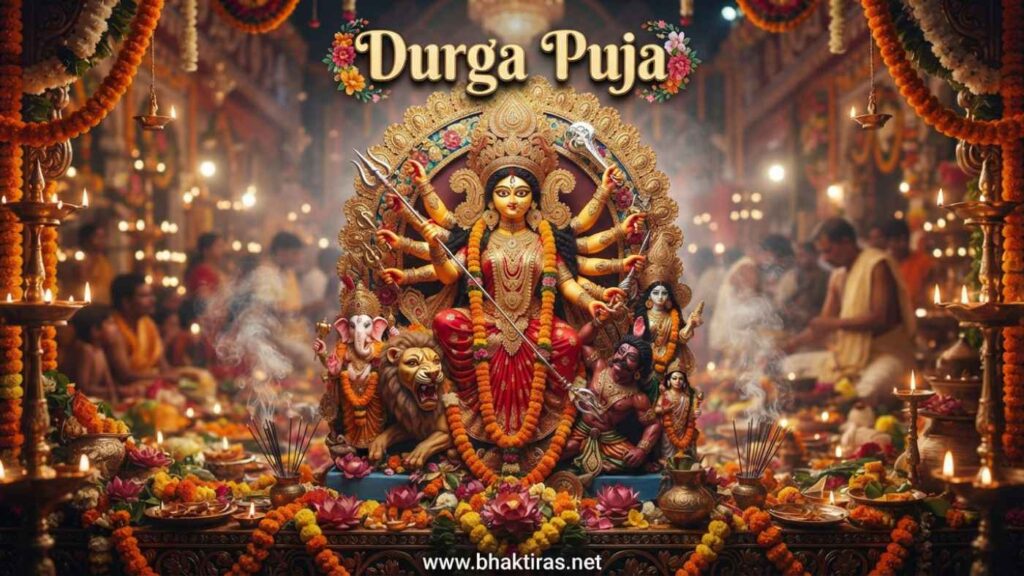
Durga Puja, also called Durgotsav, is the largest festival of Bengal and one of the most spectacular celebrations in the Hindu calendar. Held in the lunar month of Ashwin, it honours Goddess Durga’s slaying of the shape-shifting buffalo-demon Mahishasura. Over five main days, from Shashthi to Vijaya Dashami, cities fill with themed pandals, hand-painted clay idols from Kumartuli, the beat of the dhak drum, and processions that end with the idols carried to the river for immersion. In 2026 it falls between 16 and 21 October.
Durga Puja 2026-2028: Dates & Calendar
The next Durga Puja begins on 16 October 2026. Because it follows the lunar month of Ashwin, the Gregorian dates shift by roughly ten to eleven days each year, landing in late September or October.
| Year | Shashthi | Saptami | Ashtami | Navami | Vijaya Dashami |
|---|---|---|---|---|---|
| 2026 | Fri 16 Oct | Sun 18 Oct | Mon 19 Oct | Tue 20 Oct | Wed 21 Oct |
| 2027 | Tue 5 Oct | Wed 6 Oct | Thu 7 Oct | Fri 8 Oct | Sat 9 Oct |
| 2028 | Sat 23 Sep | Sun 24 Sep | Tue 26 Sep | Wed 27 Sep | Thu 28 Sep |
The heart of the festival is the four days from Saptami to Dashami. Ashtami is the most sacred, when Sandhi Puja is performed at the junction of the Ashtami and Navami tithis, and Dashami closes the celebration with the immersion, known in Bengali as Bisorjon.
Why Durga Puja Is Celebrated
Durga Puja marks the triumph of Goddess Durga over the buffalo-demon Mahishasura, a story of divine feminine power defeating an enemy that no god could subdue alone.
The defeat of Mahishasura
Mahishasura had won a boon that no man or god could kill him, and he terrorised the three worlds. The gods pooled their energies to create Durga, a warrior goddess riding a lion and armed by every deity. After a long battle she slew the demon, which is why she is worshipped as Mahishasuramardini, the slayer of Mahishasura.
The homecoming of the Goddess
In Bengali belief Durga is a married daughter who returns each autumn to her parental home with her children, Lakshmi, Saraswati, Ganesha and Kartikeya. The festival’s warmth comes from this idea of a beloved daughter visiting for a few short days, which is why Dashami feels tender as well as triumphant.
Akal Bodhon, the untimely awakening
The autumn Durga Puja is called an akal bodhon, an out-of-season invocation. The Ramayana tradition holds that Rama worshipped Durga in autumn to seek her blessing before battling Ravana, breaking the usual spring worship cycle and setting the pattern for Sharadiya (autumn) Durga Puja.
UNESCO recognition
In 2021 UNESCO inscribed Kolkata’s Durga Puja on its Representative List of the Intangible Cultural Heritage of Humanity. The listing recognised the festival’s blend of art, craft, community organisation and public devotion.
Deities & Figures Worshipped
The central figure is Goddess Durga in her ten-armed Mahishasuramardini form, worshipped alongside four accompanying deities in the traditional Bengali idol grouping.
Durga
The ten-armed warrior goddess, shown astride her lion and spearing Mahishasura. Each hand carries a weapon gifted by a different god, symbolising the combined power of the divine.
Lakshmi & Saraswati
Durga’s daughters flank her in the ekchala (single-frame) idol. Lakshmi represents wealth and wellbeing, Saraswati knowledge, music and the arts.
Ganesha & Kartikeya
Her sons complete the family group. Ganesha, remover of obstacles, and Kartikeya, the commander of the divine army, stand on either side of the tableau.
Key Rituals, Step by Step
The festival unfolds as a fixed sequence of daily rites, from the awakening of the Goddess to her farewell at the river.
- Bodhon (Shashthi). The Goddess is ceremonially awakened and her face unveiled. Priests perform the invocation and the pandal opens to visitors.
- Navapatrika Puja (Saptami). Nine plants bound together, popularly called Kola Bou, are bathed at dawn and installed beside Ganesha as a living symbol of the Goddess’s power over nature.
- Sandhi Puja (Ashtami-Navami junction). The most sacred rite, performed in the 48-minute window spanning the end of Ashtami and the start of Navami, when Durga is believed to have taken her fiercest form to kill the demon.
- Kumari Puja. A young girl is worshipped as a living embodiment of the Goddess, most famously at Belur Math, a tradition begun by Swami Vivekananda.
- Maha Navami. The final full day of worship, with the maha aarti and, in some places, homa (fire offerings). Devotees offer anjali (flower prayers) in the mornings.
- Dhunuchi dance. Worshippers dance before the idol holding a clay censer of burning coconut husk and incense, swaying to the rhythm of the dhak.
- Sindoor Khela (Dashami). Married women smear vermilion on the Goddess and on each other in a joyful farewell before the idol leaves.
- Bisorjon (immersion). The idols are carried in procession and immersed in a river or pond, sending the Goddess back to her celestial home until next year.
Special Foods of Durga Puja
The festival is as much a food carnival as a religious event, mixing temple offerings with street-side feasting.
Khichuri bhog
A soft rice-and-lentil khichuri served with fried vegetables, labra (mixed vegetable curry) and chutney, offered to the Goddess and then shared as prasad, especially on Ashtami and Navami.
Luchi & alur dom
Puffy deep-fried luchi with a spiced potato curry is the classic festive breakfast during the puja days.
Sandesh & rosogolla
No Bengali celebration is complete without milk sweets. Sandesh, rosogolla and mishti doi (sweet yoghurt) are eaten and gifted through the week.
Bhog and community feasts
Community pandals cook large-scale bhog for visitors, while street stalls sell rolls, phuchka (pani puri) and biryani late into the night during pandal-hopping.
Regional Names & Variations
While Bengal sets the tone, Durga Puja is celebrated with distinct customs across eastern and northeastern India and among diaspora communities worldwide.
West Bengal
The grandest observance, centred on Kolkata, with thousands of theme pandals, competitive idol art from Kumartuli, dhak drumming and all-night pandal-hopping.
Assam
Celebrated with great fervour across the state, blending community pujas with local music and cuisine; the days overlap with the wider Navratri and Dussehra season.
Bihar & Jharkhand
Durga Puja is a major public festival, with large pandals in Patna and Ranchi and immersion processions on Dashami.
Odisha
Marked by elaborate medha (idol backdrops) and community pujas, with Cuttack famous for its silver-filigree (tarakasi) idol decorations.
Tripura
One of the biggest festivals of the state, observed by both community organisers and royal-heritage temples, with immersion on Dashami.
Diaspora
Bengali associations in the UK, USA, Canada and the Gulf hold weekend pujas that recreate the pandal, bhog and Sindoor Khela far from home.
Durga Puja Do's and Don'ts
A few simple courtesies help you enjoy the festival respectfully, especially inside pandals.
Do
- Dress modestly when visiting pandals and the idol area.
- Join the morning anjali (flower offering) if you wish to participate.
- Try the community bhog; it is offered freely as prasad.
- Keep to the queue during pandal-hopping, which draws huge crowds.
- Take photographs where permitted and thank the organisers.
Avoid
- Do not touch the idol or step past barricades near the deity.
- Do not wear footwear inside the worship enclosure.
- Avoid loud or disruptive behaviour during aarti and Sandhi Puja.
- Do not litter; use the bins provided around pandals.
- Do not obstruct the immersion procession on Dashami.
Frequently Asked Questions
When is Durga Puja in 2026?
Durga Puja 2026 runs from Maha Shashthi on Friday 16 October to Vijaya Dashami on Wednesday 21 October. Saptami is on 18 October, Ashtami on 19 October and Navami on 20 October. These are the five main days of the festival in West Bengal.
When is Durga Puja in 2027 and 2028?
In 2027 Durga Puja falls from 5 October (Shashthi) to 9 October (Vijaya Dashami). In 2028 it moves earlier, running from 23 September (Shashthi) to 28 September (Vijaya Dashami). The dates shift each year because the festival follows the lunar month of Ashwin.
Why is Durga Puja celebrated?
Durga Puja celebrates Goddess Durga’s victory over the buffalo-demon Mahishasura, whom no god could defeat alone. In Bengali tradition it is also the annual homecoming of Durga as a married daughter visiting her parents. It affirms the triumph of good over evil and of dharma over adharma.
Which goddess is worshipped during Durga Puja?
Goddess Durga is worshipped, chiefly in her ten-armed Mahishasuramardini form, shown slaying the demon while riding a lion. In the traditional Bengali idol she is accompanied by her children Lakshmi, Saraswati, Ganesha and Kartikeya.
What is Sindoor Khela?
Sindoor Khela is a ritual on Vijaya Dashami in which married women apply vermilion (sindoor) to the Goddess and then to one another as a joyful farewell. It takes place just before the idol is taken for immersion and has become one of the most photographed moments of the festival.
What is the difference between Durga Puja and Navratri?
Durga Puja and Sharadiya Navratri overlap in the same Ashwin period but differ in emphasis. Navratri spans nine nights honouring nine forms of the Goddess, popular across western and northern India, while Durga Puja focuses on the five days Shashthi to Dashami and the elaborate pandal-and-idol worship of Bengal and eastern India.
What happens on Vijaya Dashami?
Vijaya Dashami is the tenth day, when the worship concludes and the clay idols are carried in procession for immersion in a river or pond, known in Bengali as Bisorjon. Married women perform Sindoor Khela beforehand, and people exchange greetings and sweets to mark Durga’s departure.
Why is Kolkata's Durga Puja special?
Kolkata’s Durga Puja is famous for its themed art pandals, the clay idols crafted in the Kumartuli potters’ quarter, and its scale as a citywide street festival. In 2021 UNESCO added it to the Representative List of the Intangible Cultural Heritage of Humanity.
May the Goddess bless your home with courage and joy this Sharadiya season. Shubho Durga Puja!