
Mahalaya 2026 – The Dawn That Calls Durga Home
মহালয়া
When is Mahalaya in 2026?
Mahalaya falls on Saturday, 10 October 2026. It is the Amavasya (new moon) that closes Pitru Paksha, the fortnight of ancestral offerings, and marks the day Bengalis believe Goddess Durga begins her journey to earth. Across the rest of India the same day is observed as Sarva Pitru Amavasya, the final round of tarpan for all ancestors.
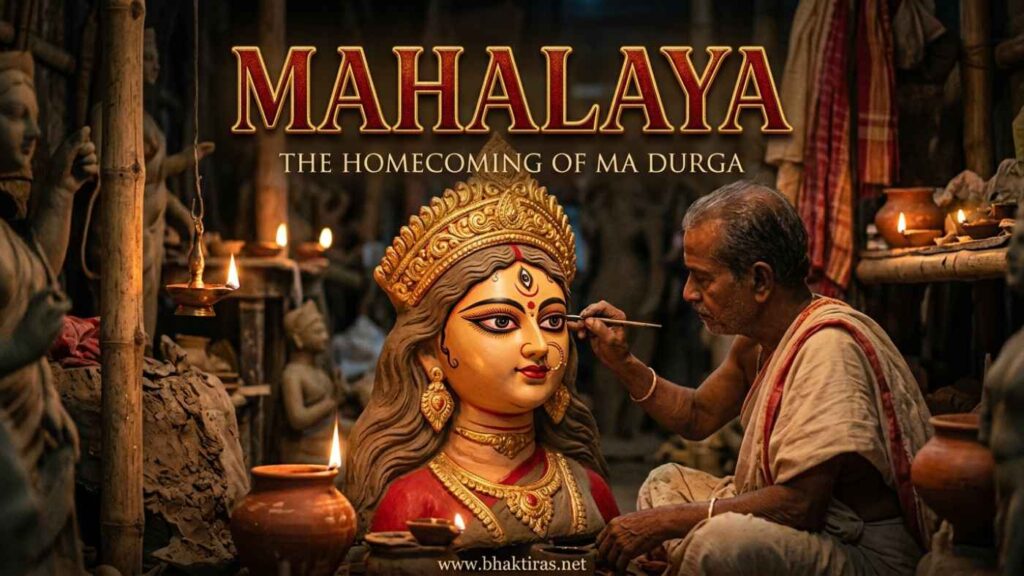
Mahalaya is the hinge of the Bengali autumn – the single dawn that turns mourning into welcome. Falling on the Ashwin new moon (10 October in 2026), it ends Pitru Paksha, the dark fortnight when families offer water and rice to their dead, and opens Devi Paksha, the bright fortnight of the Goddess. For millions of Bengalis the day is inseparable from a voice on the radio before sunrise, chanting the story of how Durga was born from the gods’ combined fury to destroy the demon Mahishasura. Elsewhere in India the same Amavasya is Sarva Pitru Amavasya, the last chance to honour every ancestor at once.
Mahalaya 2026-2028: Dates & Calendar
Mahalaya next falls on Saturday, 10 October 2026. Because it is fixed to the Ashwin Amavasya (new moon) of the Hindu lunar calendar, its Gregorian date shifts by around eleven days each year.
| Year | Date | Day | Notes |
|---|---|---|---|
| 2026 | 10 October | Saturday | Next occurrence – Sarva Pitru Amavasya |
| 2027 | 27 September | Monday | Ashwin Amavasya |
| 2028 | 18 September | Monday | Ashwin Amavasya |
In Bengal, Mahalaya usually falls about a week before Durga Puja Shashthi, so the count of days between the two can vary slightly year to year depending on the lunar month. In 2026 Durga Puja follows within the same week, with Vijayadashami around 21 October.
Why Mahalaya Is Observed
Mahalaya carries two meanings on one day: it closes the fortnight of the ancestors and announces the arrival of the Goddess. The word itself comes from maha (great) and alaya (abode), the great gathering where the departed are honoured together.
The end of Pitru Paksha
The fifteen days before Mahalaya are Pitru Paksha, when Hindus offer tarpan – water mixed with sesame and rice – to three generations of ancestors. Mahalaya Amavasya is the final and most powerful day of these rites, when even ancestors whose exact death anniversary is forgotten receive their due.
The invocation of Durga
For Bengalis, Mahalaya is the moment Durga is called down from Mount Kailash to her parental home on earth. It opens Devi Paksha, the bright fortnight leading to Durga Puja, turning the mood of the season from remembrance to festive anticipation.
The Mahishasuramardini legend
The day retells how the gods, unable to defeat the buffalo demon Mahishasura, pooled their energies into a single radiant Goddess. Durga, armed by each deity, battled the demon for days and slew him – the story chanted before dawn on Mahalaya morning.
Sarva Pitru Amavasya
Beyond Bengal, the same Amavasya is Sarva Pitru Amavasya, literally the new moon of all ancestors. Families who missed a shraddh earlier in the fortnight, or who do not know a relative’s death tithi, perform the ritual on this day so no ancestor is left unremembered.
Deities & Figures Honoured
Mahalaya faces two directions at once – towards the ancestors who are being bid farewell and towards the Goddess who is being welcomed.
Durga
The warrior mother-goddess who rides a lion and carries the weapons of all the gods. Mahalaya is the day she is ritually summoned to earth, and the whole of Devi Paksha builds towards her worship during Durga Puja.
The Pitru (ancestors)
The departed forebears of the family, believed to descend to the world of the living during Pitru Paksha. On Mahalaya they receive their last offerings of water and food before returning satisfied to their own realm.
Mahishasura
The shape-shifting buffalo demon whose defeat by Durga is the heart of the Mahishasuramardini chant. His slaying represents the triumph of divine order over arrogance and brute force.
Key Rituals, Step by Step
The day moves from the pre-dawn dark of the ancestors’ farewell to the first light of the Goddess’s arrival.
- The pre-dawn broadcast. Long before sunrise, Bengali households tune in to Mahishasuramardini, the recitation and songs first aired in 1931 in Birendra Krishna Bhadra’s unmistakable voice, narrating Durga’s birth and victory.
- Tarpan at the water’s edge. Men of the family, and increasingly women too, gather at rivers, ponds and ghats at first light to offer tarpan – handfuls of water with black sesame and rice – to their ancestors.
- Pind daan and shraddh. Where a fuller rite is due, families offer pindas (rice balls) and feed Brahmins or the needy, completing the shraddh cycle of Pitru Paksha on this final Amavasya.
- Chokkhudaan. In the idol-makers’ workshops of Kumartuli and beyond, artisans paint the eyes of the Durga idols on Mahalaya morning – the ritual of chokkhudaan that is believed to bring the image to life.
- Welcoming Devi Paksha. With the ancestors sent off, attention turns to the Goddess; homes and pandals begin the countdown to Durga Puja, and the festive preparations of Bengal shift into high gear.
- Community and charity. Many mark the day by giving food, clothing or donations in the ancestors’ name, treating the debt to the dead as a debt to the living poor as well.
Foods Associated with Mahalaya
Mahalaya food is quiet and ritual rather than feast – the offerings are for the ancestors, and the household meal is kept simple.
Kheer and rice
Sweet rice kheer and plain cooked rice are among the foods offered during shraddh, prepared without onion or garlic and shared as prasad after the rite.
Til and sesame
Black sesame (til) is central to tarpan, mixed into the water offered to the ancestors and considered especially pleasing to the departed.
Vegetarian shraddh meal
The day’s cooking on Sarva Pitru Amavasya is typically sattvic and vegetarian – seasonal vegetables, dal and rice – offered first to the ancestors and then to Brahmins or guests.
Luchi and simple Bengali fare
Once the solemn morning passes, many Bengali homes ease into the festive mood with familiar dishes like luchi and vegetable curries as the Puja season begins.
Regional Names & Variations
The same Amavasya wears different names and moods across India, from Bengal’s Durga-welcome to the pan-Indian rite for ancestors.
West Bengal
Here it is Mahalaya proper – the dawn of Devi Paksha, the Mahishasuramardini broadcast and chokkhudaan, the emotional overture to Durga Puja rather than a day of mourning alone.
North & West India
Observed mainly as Sarva Pitru Amavasya, the concluding day of Pitru Paksha, when families perform shraddh for all ancestors, especially those whose death tithi is unknown.
Odisha & the East
Marked as Mahalaya Amavasya with tarpan at rivers and the sea, alongside the same anticipation of Durga Puja that grips neighbouring Bengal.
South India
Known as Mahalaya Amavasya or Sarvapitri Amavasya, it is a major day for pitru tarpanam and offerings at temple tanks and sacred rivers.
Mahalaya Do's and Don'ts
The morning is solemn and ancestor-focused; observing it with care is part of the day’s spirit.
Do
- Wake before dawn to listen to or recite the Mahishasuramardini
- Offer tarpan with clean water, sesame and rice at a river or pond
- Keep the day’s cooking simple, sattvic and vegetarian
- Give food or donations to the poor in your ancestors’ name
- Remember all ancestors, including those whose death dates are forgotten
Avoid
- Do not begin new, celebratory ventures until the shraddh rites are done
- Do not eat onion, garlic or non-vegetarian food where you observe shraddh
- Do not treat the tarpan casually – perform it with attention and cleanliness
- Do not turn away someone seeking food on this day
- Do not confuse the solemn morning of the ancestors with the festivity that follows
Frequently Asked Questions
When is Mahalaya in 2026?
Mahalaya in 2026 falls on Saturday, 10 October. It is the Ashwin Amavasya that ends Pitru Paksha, and in Bengal it opens Devi Paksha and the countdown to Durga Puja.
When is Mahalaya in 2027 and 2028?
Mahalaya falls on Monday, 27 September 2027 and again on Monday, 18 September 2028. The date moves each year because it is tied to the Ashwin new moon of the Hindu lunar calendar rather than a fixed Gregorian day.
Why is Mahalaya observed?
Mahalaya is observed to close Pitru Paksha with a final round of offerings to the ancestors, and to invoke Goddess Durga’s descent to earth. In Bengal it turns the mood from remembrance to festive welcome, while across India the same day is Sarva Pitru Amavasya for all ancestors.
What is the difference between Mahalaya and Sarva Pitru Amavasya?
They are the same Amavasya seen through two lenses. In Bengal it is Mahalaya, the dawn that welcomes Durga; in the rest of India it is Sarva Pitru Amavasya, the last day of Pitru Paksha for honouring every ancestor, including those whose death tithi is unknown.
What is the Mahishasuramardini broadcast?
Mahishasuramardini is a pre-dawn radio programme of hymns and narration recounting Durga’s birth and her slaying of the demon Mahishasura. First aired in 1931 and famed for Birendra Krishna Bhadra’s chant, it is played across Bengal on Mahalaya morning.
What is Chokkhudaan on Mahalaya?
Chokkhudaan is the ritual of painting the eyes on the Durga idol, performed by artisans on Mahalaya morning. It is believed to give the image life and formally begins the visual preparation for Durga Puja.
Which god is worshipped on Mahalaya?
Goddess Durga is invoked on Mahalaya as she is called from Kailash to earth. The same day also honours the family’s ancestors (pitru) through tarpan and shraddh rituals.
How is tarpan performed on Mahalaya?
Tarpan is performed at a river, pond or ghat, usually at first light, by offering handfuls of water mixed with black sesame and rice to three generations of ancestors. It is done facing the water with a calm, focused mind, often after a ritual bath.
Whether you rise for the pre-dawn chant or stand at the water’s edge for your forebears, may Mahalaya bring peace to the departed and welcome the Goddess home. শুভ মহালয়া.