
Dussehra 2026 – Vijayadashami, the Day Good Defeats Evil
दशहरा / विजयादशमी
When is Dussehra in 2026?
Dussehra (Vijayadashami) falls on Tuesday, 20 October 2026. It lands on Ashwin Shukla Dashami, the tenth day right after the nine nights of Sharad Navratri. The day marks two victories of good over evil: Rama’s defeat of Ravana in the north and west, and Durga’s slaying of the buffalo-demon Mahishasura in the east.
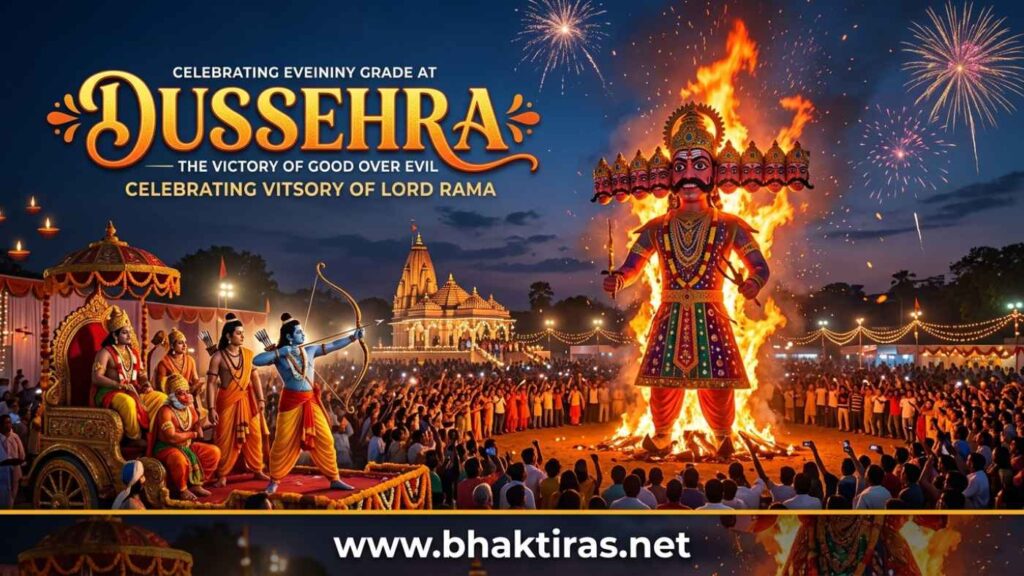
Dussehra, also called Vijayadashami, is the tenth-day festival that closes Sharad Navratri and celebrates the triumph of good over evil. It falls on Ashwin Shukla Dashami, in October by the Gregorian calendar. Two great stories share the day: in northern and western India it marks Rama’s victory over the demon king Ravana, dramatised in Ramlila plays that end with towering effigies going up in flames; in Bengal and among Shaktas it honours Goddess Durga’s defeat of the buffalo-demon Mahishasura. Warriors, students and craftspeople also worship their tools and weapons.
Dussehra 2026-2028: Dates & Calendar
The next Dussehra is on 20 October 2026. Because it follows the lunar Hindu calendar, the Gregorian date shifts each year, usually landing in late September or October.
| Year | Date | Day | Notes |
|---|---|---|---|
| 2026 | 20 October | Tuesday | Next occurrence |
| 2027 | 9 October | Saturday | Ashwin Shukla Dashami |
| 2028 | 27 September | Wednesday | Falls in late September |
The exact effigy-burning and Shami Puja timings vary by locality, so check a regional panchang for the Vijaya Muhurat and Aparahna window in your city.
Why Dussehra Is Celebrated
Dussehra celebrates the victory of righteousness over wickedness, told through two parallel traditions that fall on the same day.
Rama defeats Ravana
In the northern and western tradition, the day marks the moment Lord Rama killed the ten-headed demon king Ravana, who had abducted Sita. After a long battle in Lanka, dharma prevails. The nine days before, spent readying for war, echo in Navratri, and the tenth day is the victory.
Durga defeats Mahishasura
For Shaktas and across eastern India, Vijayadashami is when Goddess Durga slew the buffalo-demon Mahishasura after a nine-night duel. It is the joyful, tearful close of Durga Puja, when the clay idols are carried out for immersion.
The tenth day of victory
The name Vijayadashami joins vijaya (victory) with dashami (the tenth day). Both legends teach that arrogance and cruelty, however mighty, eventually fall to courage, patience and truth. It is considered one of the most auspicious days to begin new ventures.
Deities & Figures Worshipped
Dussehra centres on two victorious figures, along with the goddess of learning in the south.
Lord Rama
The seventh avatar of Vishnu, whose triumph over Ravana is re-enacted through Ramlila and the burning of effigies. Devotees see him as the model of duty, restraint and moral courage.
Goddess Durga
The warrior form of the Divine Mother, riding a lion and armed by all the gods, who ended Mahishasura’s terror. Her victory is the climax of the Durga Puja pandals of Bengal, Odisha and Assam.
Goddess Saraswati
In much of South India the day is tied to Saraswati Puja and Vidyarambham, when children are first guided to write letters and students and artists worship their books and instruments.
Key Rituals, Step by Step
Observance blends worship, drama and community spectacle, and differs by region. A common sequence looks like this.
- Close of Navratri. The nine nights of fasting and Devi worship end, and families prepare for the tenth-day celebration.
- Morning puja. Households perform a morning worship of the deity, and many visit temples before the day’s main events.
- Shastra and Aayudha Puja. Tools, weapons, vehicles and instruments of trade are cleaned, decorated and worshipped, honouring the means of one’s livelihood.
- Shami / Aparajita worship. In many regions people worship the Shami tree and the goddess Aparajita, and exchange its leaves as a token of victory and goodwill.
- Saraswati Puja and Vidyarambham. In the south, students and craftspeople worship their books and tools, and young children are initiated into writing.
- Ramlila climax. In northern towns the multi-day Ramlila reaches its final act, showing Rama’s battle with Ravana.
- Ravana Dahan. At dusk, giant effigies of Ravana, his brother Kumbhakarna and son Meghnad, stuffed with firecrackers, are set alight before large crowds.
- Durga immersion. In eastern India the Durga idols are taken in procession for visarjan (immersion), with sindoor khela and farewell to the goddess.
Special Foods of Dussehra
Sweets and festive dishes mark the day, varying widely by region.
Jalebi
Crisp, coiled sweets soaked in syrup are a Dussehra favourite in the north, often eaten fresh from fair stalls after the effigy burning.
Fafda-jalebi
In Gujarat, savoury gram-flour fafda paired with sweet jalebi is the classic Dussehra breakfast, sold at every sweet shop that morning.
Shami leaves & apta
Maharashtrians exchange leaves of the apta tree as symbolic gold (sonu) and share ghee-rich sweets like puran poli after the Simollanghan ritual.
Bengali sweets
As Durga Puja closes, families share sandesh, rasgulla and other milk sweets, and elders offer them alongside sindoor during the farewell rituals.
Ayudha Puja feast
In the south, festive meals with sweets and rice preparations follow the worship of tools and books, celebrating both learning and craft.
Regional Names & Variations
Few festivals shift form as dramatically across India as Dussehra.
Mysore Dasara
Karnataka’s royal festival lights up Mysore Palace and ends with a grand Jamboo Savari procession, an elephant carrying the golden howdah of Goddess Chamundeshwari through the city.
Kullu Dussehra
In Himachal Pradesh, the celebration begins when others end and runs for about a week, as village deities are carried to Dhalpur ground to pay homage to Lord Raghunath.
Bastar Dussehra
In Chhattisgarh, the tribal Dussehra of Bastar stretches over many weeks and honours the local goddess Danteshwari rather than the Rama-Ravana story.
North Indian Ramlila
Across the Gangetic plains, especially Varanasi and Delhi, the day is defined by Ramlila theatre and the evening burning of Ravana effigies.
Eastern Vijaya Dashami
In West Bengal, Odisha and Assam it is the last day of Durga Puja, marked by idol immersion, sindoor khela and the emotional farewell to the goddess.
Dussehra Do's and Don'ts
A few simple customs help you observe the day with respect.
Do
- Begin new ventures, studies or purchases, as the day is considered highly auspicious.
- Clean and worship your tools, books, vehicle or instruments of work.
- Visit a temple or attend the local Ramlila and effigy burning with family.
- Exchange Shami or apta leaves and greetings of goodwill with neighbours.
- Share sweets and help those in need to mark the victory of good.
Avoid
- Avoid quarrels, harsh words or dishonesty on a day that celebrates dharma.
- Do not treat the effigy burning carelessly – keep a safe distance from firecrackers.
- Avoid non-vegetarian food and alcohol if your family keeps the day satvik.
- Do not skip cleaning and respecting the tools you plan to worship.
- Avoid littering fairgrounds and immersion sites; use eco-friendly idols and materials where you can.
Frequently Asked Questions
When is Dussehra in 2026?
Dussehra (Vijayadashami) is on Tuesday, 20 October 2026. It falls on Ashwin Shukla Dashami, the tenth day after Sharad Navratri, and marks the victory of good over evil.
When is Dussehra in 2027 and 2028?
Dussehra is on Saturday, 9 October 2027, and on Wednesday, 27 September 2028. The date moves each year because it follows the lunar Hindu calendar, always landing on Ashwin Shukla Dashami in late September or October.
Why is Dussehra celebrated?
Dussehra celebrates the triumph of good over evil through two stories on the same day. In the north and west it marks Lord Rama’s victory over the demon king Ravana; in the east and among Shaktas it marks Goddess Durga’s defeat of the buffalo-demon Mahishasura.
What is the difference between Dussehra and Vijayadashami?
Dussehra and Vijayadashami are two names for the same festival on Ashwin Shukla Dashami. Vijayadashami literally means the tenth day of victory, while Dussehra (from Dashahara) refers to the defeat of the ten-headed Ravana.
Which god is worshipped on Dussehra?
Dussehra centres on Lord Rama in the north and west and on Goddess Durga in the east. In much of South India the day is also devoted to Goddess Saraswati and to Ayudha Puja, the worship of tools and weapons.
What is Ravana Dahan?
Ravana Dahan is the burning of towering effigies of Ravana, along with his brother Kumbhakarna and son Meghnad, at dusk on Dussehra. Stuffed with firecrackers, the effigies go up in flames to symbolise the destruction of evil, usually after the final act of the Ramlila.
What is the connection between Navratri and Dussehra?
Dussehra is the tenth day that immediately follows the nine nights of Sharad Navratri. Navratri commemorates the nine-night duel between Durga and Mahishasura, and Vijayadashami is the day of her victory, so the two are one continuous celebration.
How is Mysore Dasara different?
Mysore Dasara is Karnataka’s royal form of the festival, centred on Goddess Chamundeshwari. It ends with the Jamboo Savari, a grand procession in which a decorated elephant carries the goddess’s golden howdah through an illuminated Mysore.
However you mark the day, may truth and courage win over every darkness. Shubh Vijayadashami!