
Kedara Gauri Vratam 2026 – The 21-Day Vrat Ending on Diwali
केदार गौरी व्रतम्
When is Kedara Gauri Vratam in 2026?
Kedara Gauri Vratam concludes on Sunday, 8 November 2026, the Deepavali Amavasya (new-moon of Diwali). It is a 21-day vrat to Lord Shiva as Kedareshwara and Goddess Gauri (Parvati) that begins around 19 October 2026 and ends on this Amavasya, observed mainly in Andhra Pradesh, Telangana and Karnataka.
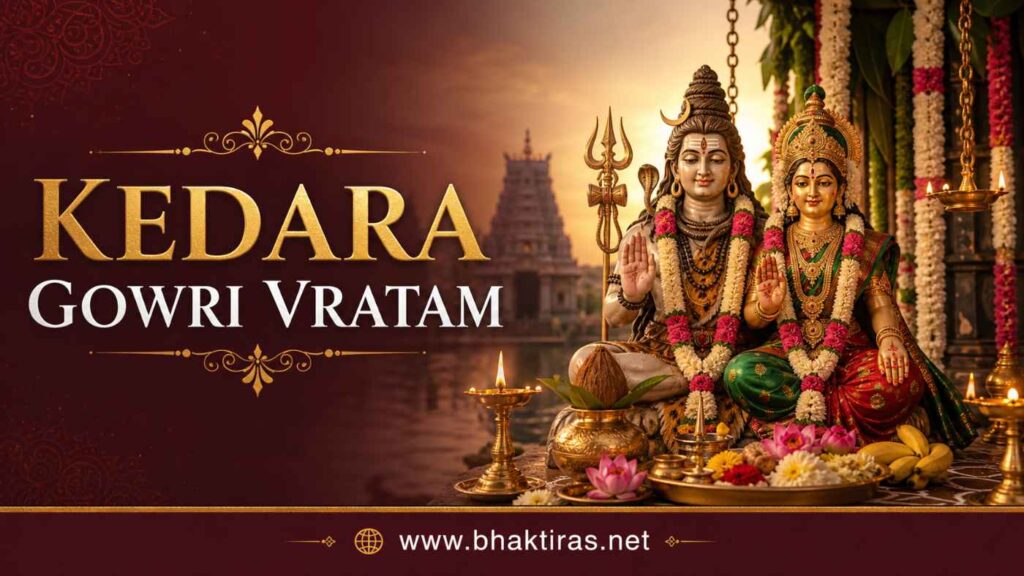
Kedara Gauri Vratam, also called Kedareshwara Vratam, is a 21-day vow kept mostly by women across Andhra Pradesh, Telangana and Karnataka to honour Lord Shiva as Kedareshwara and Goddess Gauri (Parvati). Worshippers count off 21 days with a sacred thread of 21 knots and offer 21 kinds of naivedyam, finishing on Deepavali Amavasya, the darkest night of Diwali. The vrat carries the story of Parvati’s vow to become one half of Shiva’s body as Ardhanarishvara, and families keep it for marital harmony, health and prosperity.
Kedara Gauri Vratam 2026-2028: Dates & Calendar
The next Kedara Gauri Vratam concludes on Sunday, 8 November 2026. The date shifts each year because it is fixed to Deepavali Amavasya, the new-moon of the Ashwin/Kartik lunar month, not to a fixed calendar day.
| Year | Concluding Date | Day | Notes |
|---|---|---|---|
| 2026 | 8 November | Sunday | Next occurrence – Deepavali Amavasya |
| 2027 | 29 October | Friday | Deepavali Amavasya |
| 2028 | 17 October | Tuesday | Deepavali Amavasya |
The 21-day count runs backwards from the concluding day, so in 2026 the vrat opens around 19 October. Many families who cannot keep the full 21 days observe a single fast on the final Amavasya itself.
Why Kedara Gauri Vratam Is Celebrated
Kedara Gauri Vratam is kept to seek the united blessing of Shiva and Parvati for a harmonious marriage, family wellbeing and long life. Its story explains how Parvati earned her place as the left half of Shiva.
Parvati's vow for union
One well-loved account tells of a devotee who worshipped Shiva alone, leaving Parvati out. Hurt, the Goddess sought the guidance of Sage Gautama, who advised a strict 21-day Kedara vrat. Pleased by her devotion, Shiva gave her the left half of his own body – the origin of the Ardhanarishvara form in which the two are a single being.
The 21-knot symbolism
The number 21 threads through the whole vrat: 21 days of observance, a thread of 21 strands tied in 21 knots, and 21 kinds of offerings. Devotees traditionally aim to complete the vrat 21 times over the years, after which the udyapana (formal conclusion) is performed.
Marital harmony and prosperity
Because the vrat celebrates the joining of Shiva and Gauri, married women keep it chiefly for the wellbeing of their husbands and homes, and unmarried women for a good match. It is also believed to bring health, wealth and the removal of obstacles.
Why it ends on Diwali
The final day falls on Deepavali Amavasya, when Lakshmi Puja is also performed. Concluding a long fast of Shiva and Gauri on the same new-moon that welcomes Lakshmi ties together devotion, light and prosperity in one household observance.
Deities & Figures Worshipped
The vrat is addressed jointly to Lord Shiva in his Kedareshwara form and to Goddess Parvati as Gauri, worshipped together and often visualised as Ardhanarishvara.
Kedareshwara (Shiva)
Shiva is worshipped here as Kedareshwara, the lord invoked through the Kedara vrat. He is honoured in the kalasha and the sacred thread, and it is his grace that grants Parvati her place as half of his form.
Gauri (Parvati)
Gauri is Parvati, the consort whose steadfast vow the festival remembers. Worshipping her alongside Shiva is the heart of the vrat, and the thread tied at the close carries her blessing for a happy married life.
Key Rituals, Step by Step
The observance combines a long daily fast with a detailed puja on the concluding Amavasya. The steps below follow the common South Indian practice.
- Open the vrat. Around 21 days before Diwali (about 19 October in 2026), take a resolve (sankalpa) to keep the fast, and prepare the Kedaragauri thread of 21 cotton strands with 21 knots.
- Keep the daily observance. Through the 21 days, bathe early, keep a light or partial fast, and offer simple daily worship to Shiva and Gauri at home.
- Set up the kalasha. On the concluding day, install a kalasha (sacred pot) representing Kedareshwara, decorate it, and place the 21-knot thread beside or around it.
- Perform the Gauri puja. Invoke Gauri and Shiva together, offer flowers, turmeric, kumkum, incense and lamps, and recite the Kedareshwara vrat katha (story).
- Offer the 21 naivedyam. Present 21 kinds of offerings – coconut, banana, appam, betel leaves, areca nut, jaggery sweets and fruit – arranged before the deities.
- Tie the sacred thread. The blessed thread (nombu thread) is tied on the wrist, usually by the husband or an elder married woman (sumangali), as a mark of the completed worship.
- Break the fast with prasad. After the puja and aarti, the family shares the naivedyam as prasad and breaks the day’s fast.
- Complete with udyapana. A visarjan (farewell) puja on the following day closes the vrat; the formal udyapana is done in the year the devotee finishes 21 rounds of the vow.
Special Foods of Kedara Gauri Vratam
Food centres on the 21 naivedyam offered to Shiva and Gauri, followed by festive sweets shared as prasad on Diwali Amavasya.
The 21 naivedyam
The signature offering is a set of 21 items – coconut, bananas, betel leaves, areca nut, appam, fruit and small sweets – presented together to the deities before being shared.
Appam and rice sweets
Sweet appam (rice-and-jaggery fritters) and other rice-based sweets are common prasad, prepared fresh for the concluding puja.
Jaggery and coconut sweets
Sweets bound with jaggery and grated coconut, such as coconut burfi or sundal-style preparations, feature among the offerings and the meal that breaks the fast.
Diwali festive dishes
As the day coincides with Deepavali, homes also make classic Diwali snacks and sweets, so the vrat meal blends into the wider festival spread.
Regional Names & Variations
Kedara Gauri Vratam is chiefly a Deccan and southern practice, kept largely by women, with small differences in name and emphasis by region.
Andhra Pradesh & Telangana
Known widely as Kedareshwara Vratam or Kedara Gauri Nomu, it is a well-kept women’s vrat here, with the 21-day count, the knotted thread and the concluding puja on Diwali Amavasya.
Karnataka
Kept as Kedareshwara Vrata, often observed in groups at homes and temples, with the kalasha worship and the 21 offerings central to the day.
Tamil Nadu
The same vrat is observed as a Deepavali-linked nombu to Shiva; some keep the full 21 days while many observe a single fast on the Amavasya.
Kedara Gauri Vratam Do's and Don'ts
A few simple points help keep the vrat with the right discipline and intent.
Do
- Take a clear sankalpa (resolve) when you begin the 21-day vow.
- Bathe early and keep the daily worship simple but regular.
- Prepare the 21-strand, 21-knot thread with clean hands and care.
- Offer the 21 naivedyam and recite the Kedareshwara vrat katha.
- Share the prasad with family after the concluding puja and aarti.
Avoid
- Do not break the vow midway once the sankalpa is taken.
- Do not skip the daily observance during the 21 days without reason.
- Avoid onion, garlic and tamasic food while keeping the fast.
- Do not fabricate muhurat times – follow a trusted local panchang.
- Avoid quarrels and harsh speech on the vrat and puja day.
Frequently Asked Questions
When is Kedara Gauri Vratam in 2026?
Kedara Gauri Vratam concludes on Sunday, 8 November 2026, the Deepavali Amavasya. The 21-day vrat begins around 19 October 2026 and ends on this new-moon day, which also coincides with Lakshmi Puja during Diwali.
When is Kedara Gauri Vratam in 2027 and 2028?
Kedara Gauri Vratam falls on Friday, 29 October 2027 and on Tuesday, 17 October 2028. In both years the concluding day is the Deepavali Amavasya, so the exact date shifts with the lunar calendar.
Why is Kedara Gauri Vratam celebrated?
Kedara Gauri Vratam is celebrated to seek the joint blessing of Shiva and Gauri for marital harmony, health and prosperity. It recalls Parvati’s 21-day vow, after which Shiva granted her the left half of his body as Ardhanarishvara, the union the vrat honours.
Which god is worshipped in Kedara Gauri Vratam?
The vrat is dedicated to Lord Shiva as Kedareshwara and to Goddess Parvati as Gauri, worshipped together. They are often visualised as Ardhanarishvara, the single form in which Shiva and Parvati are joined as one.
What is the significance of the 21 knots and 21 offerings?
The number 21 runs through the whole vrat: 21 days of fasting, a thread of 21 strands with 21 knots, and 21 kinds of naivedyam. Devotees traditionally aim to complete the vrat 21 times, after which the formal udyapana is performed.
Who observes Kedara Gauri Vratam?
It is kept mainly by women in Andhra Pradesh, Telangana and Karnataka, and also in Tamil Nadu. Married women observe it for the wellbeing of their husbands and homes, while unmarried women keep it seeking a good marriage.
How long does the Kedara Gauri vrat last?
The full vrat lasts 21 days, ending on Deepavali Amavasya. Those who cannot keep the entire period often observe a single fast and puja on the concluding day itself.
Why does Kedara Gauri Vratam end on Diwali?
It ends on Deepavali Amavasya, the new-moon day of Diwali on which Lakshmi Puja is also done. Closing a long vow to Shiva and Gauri on the same auspicious new-moon links the household’s devotion to the light and prosperity of Diwali.
May Kedareshwara and Gauri bless your home with harmony and light this Diwali. Kedara Gauri Vratam subhakankshalu!