
Avani Moolam 2026 – Sundareswarar's Coronation at Madurai
ஆவணி மூலம்
When is Avani Moolam in 2026?
Avani Moolam falls on Tuesday, 1 September 2026. It is the day of Moolam (Moola) nakshatra in the Tamil month of Avani, marked chiefly at the Meenakshi Amman Temple in Madurai with the Pattabhishekam (coronation) of Lord Sundareswarar. The single main day sits inside a longer Avani temple festival of about eighteen days.
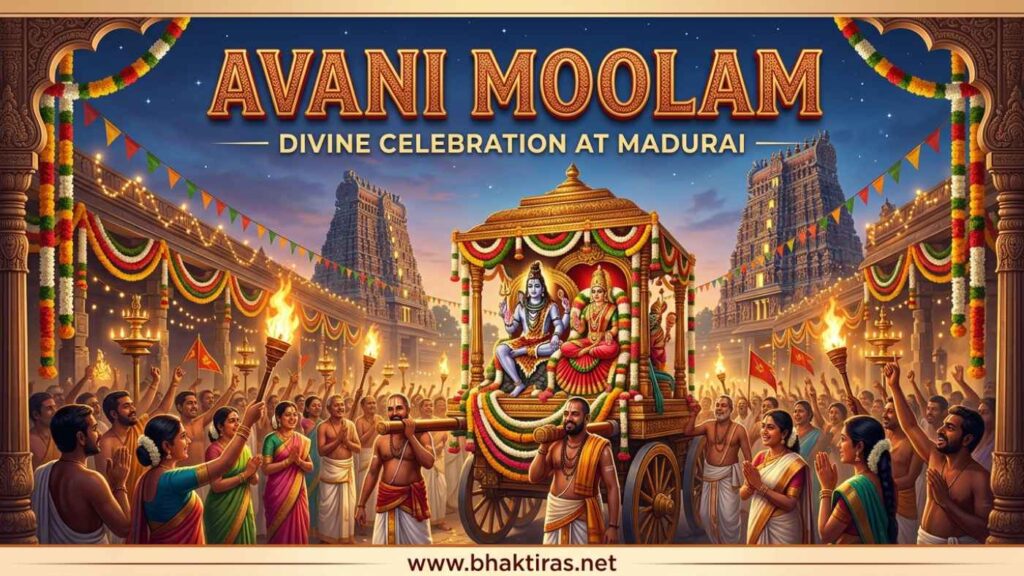
Avani Moolam is the Moolam nakshatra day in the Tamil month of Avani, when the Meenakshi Amman Temple in Madurai crowns Lord Sundareswarar – Shiva as Chokkanathar – king of the city. In 2026 it is observed on 1 September, the high point of a roughly eighteen-day Avani festival built around the Thiruvilaiyadal legends, the sixty-four divine plays Shiva is said to have performed in Madurai. Coronation, procession and the memory of Meenakshi’s wedding all fold into this one crowded temple day.
Avani Moolam 2026-2028: Dates & Calendar
The next Avani Moolam is on 1 September 2026. The date shifts each year because it tracks the Moolam (Moola) nakshatra within the solar Tamil month of Avani, so it lands anywhere from late August to mid-September.
| Year | Date | Day | Nakshatra / Month |
|---|---|---|---|
| 2026 | 1 September | Tuesday | Moolam in Avani – next occurrence |
| 2027 | 9 September | Thursday | Moolam in Avani |
| 2028 | 29 August | Tuesday | Moolam in Avani |
At Madurai the coronation day sits within a longer sequence: a flag-hoisting (kodiyetram) opens the Avani festival more than a week earlier, and daily enactments of the Thiruvilaiyadal plays run alongside processions until the festival closes.
Why Avani Moolam Is Celebrated
Avani Moolam marks the day Lord Sundareswarar is crowned king of Madurai, tying together Madurai’s founding legends, the Thiruvilaiyadal divine plays, and the memory of his marriage to Goddess Meenakshi.
In the Madurai tradition, Meenakshi is born a warrior-princess and rules the Pandya land in her own right before her wedding to Sundareswarar. After the celestial marriage the god takes up kingship of the city, and Avani Moolam remembers that moment of coronation – the sceptre passing to Shiva as ruler of Madurai.
The coronation (Pattabhishekam)
The heart of the day is the Pattabhishekam, a formal crowning of Sundareswarar as sovereign of Madurai. Priests carry out a ceremonial handing over of the royal sceptre, honouring Shiva not only as a god but as the king who governs the city and its people.
The Thiruvilaiyadal plays
Madurai holds that Shiva performed sixty-four Thiruvilaiyadals, playful acts to guide and test his devotees. During the Avani festival a set of these episodes is enacted day by day, so the coronation caps a season of retelling how the god walked among the citizens of Madurai.
Wedding of Meenakshi and Sundareswarar
The kingship of Sundareswarar follows directly from the Thirukalyanam, the divine wedding of Meenakshi and Sundareswarar. That marriage is celebrated on its own in the Chithirai season, but Avani Moolam carries its consequence: the married god assuming the throne.
Grace to the devotee
One strand of the tradition links the day to Shiva revealing his purpose to the saint-poet Manikkavasagar. The festival is read as a reminder that the divine ruler stays approachable, mixing kingly majesty with tenderness towards ordinary worshippers.
Deities & Figures Worshipped
Avani Moolam centres on the divine couple of Madurai: Goddess Meenakshi and Lord Sundareswarar, the presiding form of Shiva.
Sundareswarar
Sundareswarar, also called Chokkanathar, is the Madurai form of Shiva and the figure crowned on Avani Moolam. His name means the beautiful lord, and on this day he is honoured specifically as the king of the city rather than only as an ascetic god.
Meenakshi
Meenakshi, the fish-eyed goddess and a form of Parvati, is the reigning deity of Madurai and Sundareswarar’s queen. Because his kingship flows from their marriage, her presence frames the coronation even though the crown is placed on him.
Manikkavasagar
The ninth-century Shaiva saint-poet Manikkavasagar is remembered on the day in one local tradition, honoured for the grace he received at Madurai. His hymns of the Thiruvasagam are woven into the temple’s devotional life.
Key Rituals, Step by Step
At Madurai the day unfolds as a temple sequence of bathing rites, coronation and procession; here is the usual order.
- Kodiyetram (flag hoisting). Days before Avani Moolam, the festival flag is raised over the temple to formally open the Avani celebration and invite devotees.
- Thiruvilaiyadal enactments. On the run-up days, episodes from Shiva’s sixty-four divine plays are performed inside the temple, retelling how he acted among the people of Madurai.
- Abhishekam. On the coronation day the deity is bathed in a sequence of sacred offerings – water, milk, sandal, honey and more – accompanied by Vedic and Tamil chanting.
- Alankaram. After the bathing rite Sundareswarar is dressed in royal silks, garlands and jewels befitting a king about to be crowned.
- Pattabhishekam (coronation). The formal crowning takes place, with priests performing the rites that install Sundareswarar as sovereign of Madurai.
- Handing over of the sceptre. The royal sceptre is ceremonially presented to Sundareswarar, the visual centre of the day, symbolising his authority over the city.
- Procession. The crowned deity is taken in procession through the temple prakarams and the surrounding streets, letting the wider public receive darshan of the king.
- Deepa aradhanai and prasadam. The day closes with the waving of lamps before the deity and the giving out of consecrated food to those gathered.
Special Foods of Avani Moolam
Food on Avani Moolam is largely temple prasadam and simple Tamil offerings shared among devotees.
Puttu
Steamed rice-and-coconut puttu is closely tied to the Avani season in Madurai, where a linked Puttu Thiruvizha recalls Shiva labouring for a bowl of it. It is offered and shared as a soft, mildly sweet dish.
Sweet pongal and sarkarai pongal
Rice cooked with jaggery, ghee, cashews and cardamom is a common temple offering on festival days. It is prepared in large vessels and distributed warm as prasadam.
Kozhukattai
Steamed rice-flour dumplings with a jaggery-coconut filling are made at home and offered to the deity, especially where the festival overlaps with wider Avani observances.
Annadhanam
Free community meals, annadhanam, are a central part of the day. A simple rice meal with sambar, rasam and vegetables is served to pilgrims and the poor as an act of devotion.
Where Avani Moolam Is Celebrated
The festival is above all a Madurai event, though the Moolam-in-Avani day is observed at other Shiva temples and by Tamil communities elsewhere.
Madurai
The Meenakshi Amman Temple is the main stage for Avani Moolam, with the full coronation, Thiruvilaiyadal enactments and street processions. The city’s older streets around the temple are named for Tamil months, and the Avani Moola Veedhi carries this festival’s name.
Other Tamil Nadu Shiva temples
Several Shaiva temples across Tamil Nadu keep the Moolam nakshatra of Avani with special abhishekams and worship, treating it as an auspicious day for the deity even without a full coronation drama.
Tamil diaspora
Tamil communities and Murugan and Shiva temples abroad, from Malaysia to Australia, observe Aavani Moolam with pujas and cultural gatherings, keeping the calendar link to Madurai alive.
Avani Moolam Do's and Don'ts
Simple observances help you take part respectfully, whether at Madurai or a local temple.
Do
- Check the local temple’s panchangam timing, as the Moolam nakshatra window can start the evening before.
- Visit a Shiva temple for the abhishekam and the coronation procession if you can.
- Wear clean, modest, traditional clothing for the temple.
- Share or receive prasadam and support the annadhanam meals.
- Read or listen to a Thiruvilaiyadal episode to understand the day’s stories.
Avoid
- Do not treat it only as the coronation while ignoring its link to the Meenakshi wedding.
- Do not photograph inside sanctums where the temple forbids it.
- Do not push through the procession crowds; keep to temple guidance.
- Do not confuse Avani Moolam with the Chithirai-season Thirukalyanam, which is a separate festival.
- Do not assume a fixed calendar date; the day moves with the nakshatra each year.
Frequently Asked Questions
When is Avani Moolam in 2026?
Avani Moolam is on Tuesday, 1 September 2026. It is the Moolam (Moola) nakshatra day in the Tamil month of Avani, and it is the coronation day of Lord Sundareswarar at the Meenakshi Amman Temple in Madurai.
When is Avani Moolam in 2027 and 2028?
Avani Moolam falls on Thursday, 9 September 2027 and on Tuesday, 29 August 2028. The date changes yearly because it follows the Moolam nakshatra within the solar month of Avani, keeping it between late August and mid-September.
Why is Avani Moolam celebrated?
Avani Moolam is celebrated to mark the coronation of Lord Sundareswarar as king of Madurai. It ties together the city’s founding legends, the sixty-four Thiruvilaiyadal divine plays of Shiva, and the aftermath of his marriage to Goddess Meenakshi.
Which god is worshipped on Avani Moolam?
The main deity is Sundareswarar, the Madurai form of Shiva, who is crowned on the day. Goddess Meenakshi, his consort and the presiding deity of Madurai, is honoured alongside him because his kingship follows from their divine wedding.
What is the Pattabhishekam on Avani Moolam?
The Pattabhishekam is the formal crowning of Sundareswarar as sovereign of Madurai. Priests perform sacred bathing rites and dress the deity in royal attire, then present the royal sceptre, installing Shiva as the king of the city.
How is Avani Moolam different from Meenakshi Thirukalyanam?
Avani Moolam marks Sundareswarar’s coronation and falls in the Tamil month of Avani, usually late August to mid-September. Meenakshi Thirukalyanam, the divine wedding of Meenakshi and Sundareswarar, is celebrated in the Chithirai season around April to May, so the two are separate festivals though closely linked in story.
What are the Thiruvilaiyadal plays linked to the festival?
The Thiruvilaiyadal are the sixty-four divine plays Shiva is said to have performed in Madurai to guide and test his devotees. During the Avani festival a set of these episodes is enacted day by day at the Meenakshi temple, so the coronation caps a season of retelling them.
Where is Avani Moolam mainly celebrated?
Avani Moolam is centred on the Meenakshi Amman Temple in Madurai, Tamil Nadu, where the coronation, enactments and processions take place. Other Shiva temples in Tamil Nadu and Tamil communities abroad also keep the Moolam nakshatra of Avani with special worship.
May the crowned lord of Madurai bless your home this Avani Moolam – Vazhga Meenakshi Sundareswarar.