
Baneshwar Fair 2027 – Rajasthan's Great Tribal Gathering
बानेश्वर मेला
When is the Baneshwar Fair in 2027?
The Baneshwar Fair reaches its peak on Magha Purnima, which falls on 20 February 2027. The gathering runs for about five days beforehand, from around Magha Shukla Ekadashi to the full moon. It is held at Baneshwar Dham in Dungarpur district, Rajasthan, where the Som and Mahi rivers meet.
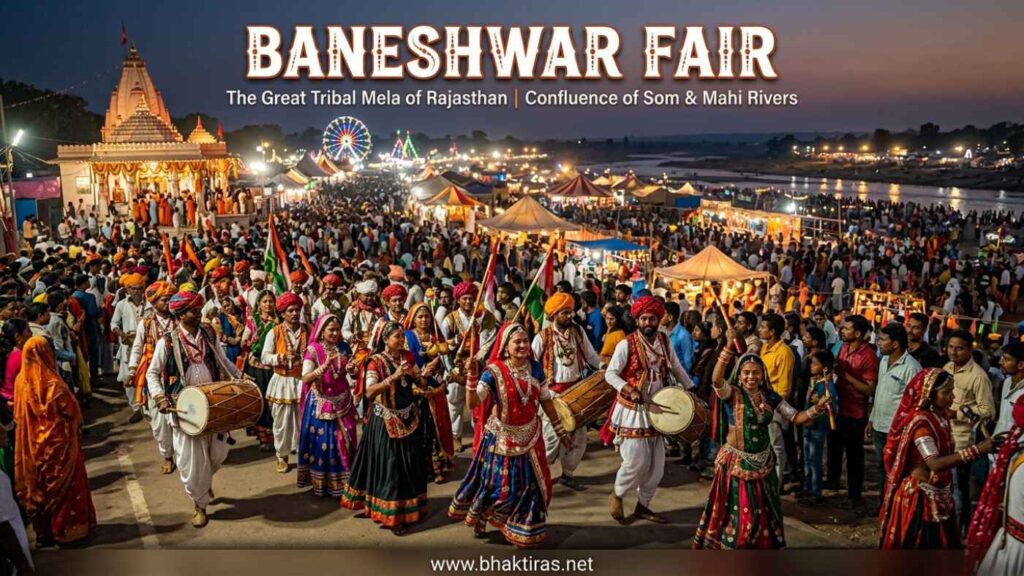
The Baneshwar Fair is the biggest tribal fair in Rajasthan, often called the Kumbh of the Bhils. Held over roughly five days each year at Baneshwar Dham in the Vagad region of Dungarpur district, it ends on Magha Purnima, the full-moon night of the Hindu month of Magha (usually January or February). Thousands of Bhil families camp on the sandy delta where the Som and Mahi rivers meet, bathe at the sangam, worship the Baneshwar Mahadev lingam, honour their saint Mavji Maharaj, and fill the fairground with dance, trade and song.
Baneshwar Fair 2026-2028: Dates & Calendar
The Baneshwar Fair closes on Magha Purnima, which lands on 20 February in 2027. The date shifts each year because it follows the Hindu lunar calendar, not the Gregorian one.
| Year | Magha Purnima (peak) | Day | Notes |
|---|---|---|---|
| 2026 | 1 February | Sunday | Fair ran roughly 27 Jan-1 Feb |
| 2027 | 20 February | Saturday | Next occurrence; fair runs about 16-20 Feb |
| 2028 | 10 February | Thursday | Fair runs approximately 6-10 Feb |
The fair opens on Magha Shukla Ekadashi and builds towards the full moon. Local administration usually confirms the exact programme a few weeks in advance, so travellers should check district tourism notices before planning a visit.
Why the Baneshwar Fair Is Held
The Baneshwar Fair is held to worship Lord Baneshwar Mahadev at the sacred river confluence and to bring the scattered Bhil communities of the Vagad region together once a year. It blends Shaiva pilgrimage, ancestor rites and a living tribal culture.
The tri-river sangam
The fairground sits on a delta where the Som and Mahi rivers join, with the waters of the Jakham feeding the Som a little upstream. Bathing at a river meeting-point is considered deeply purifying in Hindu tradition, and this confluence gives the whole gathering its spiritual pull.
The Kumbh of the Bhils
For the Bhil people of Rajasthan, Gujarat and Madhya Pradesh, this is the year’s great meeting. Families who live far apart across the hills come down to the same sandbank to bathe, pray, arrange marriages and trade. That is why it is popularly described as their Kumbh.
Baneshwar, master of the delta
The name Baneshwar means lord or master of the delta, and refers to the Shiva lingam enshrined here. The Bhil community holds this ancient lingam as one of its most sacred objects, and its worship is the devotional heart of the fair.
The Mavji Maharaj thread
Alongside the Shaiva shrine stands a Vaishnav temple linked to Mavji Maharaj, a revered local saint whom the Bhils honour as an incarnation of Vishnu. His teachings and prophecies remain woven into the fair, giving it a second devotional current beside the worship of Shiva.
Deities & Figures Worshipped
Worship at Baneshwar centres on two figures: Lord Shiva as Baneshwar Mahadev, and the saint Mavji Maharaj, revered as an avatar of Vishnu.
Baneshwar Mahadev (Shiva)
The presiding deity is Shiva in the form of the Baneshwar Mahadev lingam. Pilgrims offer water, bel leaves and prayers here, and the fair itself is named after this shrine. The lingam is regarded as self-manifest and very old, which adds to its standing among the Bhils.
Mavji Maharaj
Mavji Maharaj was a saint of the Vagad region whom devotees consider an incarnation of Vishnu. The Lakshmi Narayan temple near the fairground is tied to his memory, and his devotees gather here to read from his writings and keep his teachings alive.
Key Rituals, Step by Step
For most pilgrims the day follows a clear order: bathe at the sangam first, then worship, then the ancestral and community rites.
- Sangam snan. Pilgrims begin with a holy dip at the meeting of the Som and Mahi rivers, believed to wash away impurity before worship. The full-moon bath on Magha Purnima is considered the most auspicious.
- Lingam worship. After bathing, devotees visit the Baneshwar Mahadev temple to offer water, bel leaves, flowers and prayers to the Shiva lingam.
- Homage to Mavji Maharaj. Many also stop at the nearby Vaishnav temple to honour the saint Mavji Maharaj, reading or listening to passages linked to his teachings.
- Ash immersion. Families carry the ashes of relatives who died during the year and immerse them at the confluence, releasing the departed at this sacred water. This solemn rite is a major reason many attend.
- Gair and folk dance. Bhil men and women perform the gair dance in wide circles, often carrying sticks and swords, along with ghoomar and other regional dances, filling the evenings with drums and colour.
- Cultural fair and shows. The fairground hosts folk performances, magic shows, giant wheels and open-air entertainment that run through the nights of the gathering.
- Trade and marketplace. Families barter and buy cattle, farm tools, cloth, ornaments and household goods, turning the sandbank into a large seasonal market before they head home.
Food at the Baneshwar Fair
Since most visitors camp for several days, the fair runs on simple, filling Rajasthani and tribal cooking made over open fires.
Dal-baati
Hard wheat baati balls baked in coals and dunked in ghee, served with a spiced lentil dal, are the staple that keeps families fed through the long days on the riverbank.
Maize rotla and bhakri
Thick unleavened breads of maize or millet, cooked on iron griddles, form the everyday base of the Bhil diet and are eaten with garlic chutney, chillies or a simple vegetable.
Local sweets and jaggery treats
Stalls fry up jalebi, ghevar and jaggery-based sweets, a treat that many families only enjoy on such gathering days.
Temple prasad
Devotees receive and share simple prasad from the Baneshwar Mahadev and Mavji shrines, taken as a blessing after worship.
Region & Community Context
The fair belongs to the Vagad region of southern Rajasthan and the Bhil communities who live across three neighbouring states.
Dungarpur & Vagad
Baneshwar Dham lies in Dungarpur district, part of the hilly Vagad region of southern Rajasthan. The fair is the largest annual event on the district calendar and a point of pride for the whole area.
The Bhil people
The Bhils are one of the largest Adivasi communities of India, spread across Rajasthan, Gujarat and Madhya Pradesh. Baneshwar is their gathering, where dress, dialect, song and dance from far-flung villages come together in one place.
A three-state draw
Because the Som and Mahi flow through the border country of Rajasthan, Gujarat and Madhya Pradesh, pilgrims from all three states converge here, making the fair a meeting of communities that share the same rivers and roots.
Baneshwar Fair Do's and Don'ts
A little courtesy and care go a long way at a crowded riverside gathering that is, above all, a community’s own festival.
Do
- Treat the fair as the Bhil community’s own event and behave as a respectful guest.
- Ask before photographing people, dancers or private family rites.
- Take special care near the river, especially with children, as currents and crowds mix.
- Carry your own water, sun protection and cash for the fairground stalls.
- Support local artisans and food sellers by buying from them.
Avoid
- Do not intrude on ash-immersion or private mourning rituals for photos.
- Do not treat tribal dress, dance or customs as a spectacle or a costume.
- Do not enter deep or fast-moving water at the confluence.
- Do not litter the riverbank or leave plastic behind after camping.
- Do not haggle disrespectfully or mock local prices and goods.
Frequently Asked Questions
When is the Baneshwar Fair in 2027?
The Baneshwar Fair peaks on Magha Purnima, which falls on 20 February 2027. The gathering runs for about five days before that, roughly from 16 to 20 February, ending on the full-moon night at Baneshwar Dham in Dungarpur, Rajasthan.
When was the Baneshwar Fair in 2026 and when is it in 2028?
In 2026 the fair closed on Magha Purnima on 1 February, and in 2028 it will close on 10 February. The dates change every year because the fair follows the Hindu lunar month of Magha rather than a fixed Gregorian date.
Where is the Baneshwar Fair held?
The Baneshwar Fair is held at Baneshwar Dham in Dungarpur district in the Vagad region of southern Rajasthan. The site sits on a delta where the Som and Mahi rivers meet, with the Jakham feeding the Som a short way upstream.
Why is the Baneshwar Fair celebrated?
The Baneshwar Fair is celebrated to worship Lord Baneshwar Mahadev, a Shiva lingam, at the sacred river confluence and to gather the Bhil community once a year. Pilgrims bathe at the sangam, immerse the ashes of the departed, honour the saint Mavji Maharaj, and share dance, trade and song.
Which god is worshipped at the Baneshwar Fair?
The main deity is Lord Shiva in the form of the Baneshwar Mahadev lingam, whose name means master of the delta. The nearby Vaishnav temple honours Mavji Maharaj, a local saint the Bhils revere as an incarnation of Vishnu, giving the fair both a Shaiva and a Vaishnav side.
Why is it called the Kumbh of the Bhils?
It is called the Kumbh of the Bhils because it is the largest annual gathering of Bhil tribal families, who come from Rajasthan, Gujarat and Madhya Pradesh to bathe at the river confluence, worship and reunite. Like the Kumbh Mela, the draw is a holy dip at a sacred meeting of rivers on an auspicious date.
What happens at the Baneshwar Fair?
Pilgrims take a holy dip at the Som-Mahi confluence, worship the Baneshwar Mahadev lingam and Mavji Maharaj, and immerse the ashes of relatives who died that year. Alongside the rituals, the Bhils camp, perform gair and other folk dances, watch cultural shows, and trade cattle and goods at a large fairground market.
Who can attend the Baneshwar Fair?
The Baneshwar Fair is open to all visitors, including travellers who want to see one of India’s great tribal gatherings. It remains first of all a devotional and community event for the Bhil people, so guests are asked to be respectful, seek permission before photographing rituals, and take care near the river.
May your visit to Baneshwar Dham bring quiet blessings from the delta. Har Har Mahadev.