
Maha Shivaratri 2027 – The Great Night of Shiva
महाशिवरात्रि
When is Maha Shivaratri in 2027?
Maha Shivaratri 2027 falls on Saturday, 6 March. It is the Great Night of Shiva, observed on the 14th night (Chaturdashi) of the dark fortnight in the month of Magha/Phalguna. Unlike most Hindu festivals, it is a solemn night of fasting, all-night vigil and worship rather than feasting.
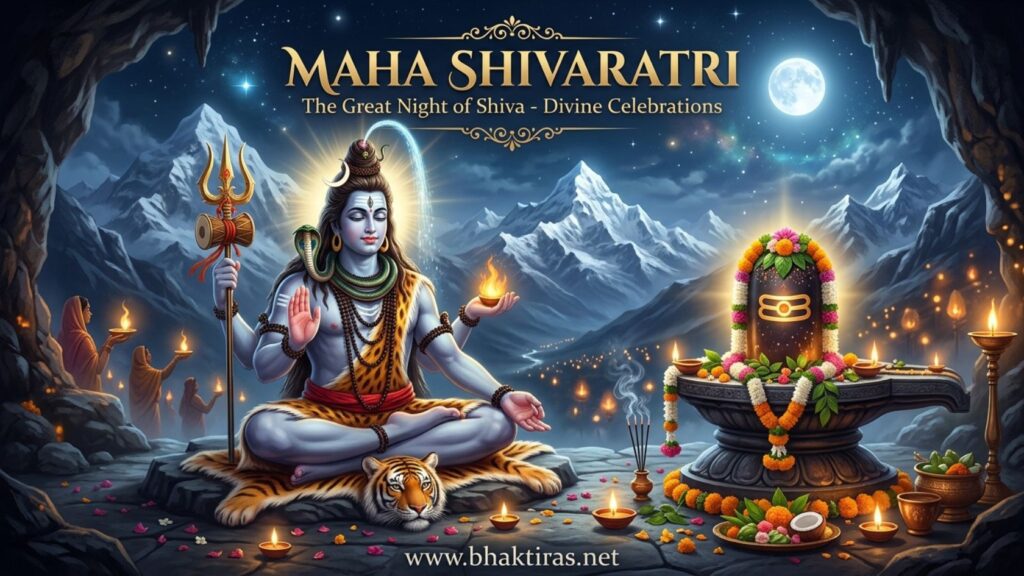
Maha Shivaratri, the Great Night of Shiva, is one of the few Hindu observances kept through the night rather than the day. It falls on the fourteenth night of the waning moon in Magha or Phalguna, when devotees fast, pour water and milk over the Shiva lingam, offer bel leaves, and stay awake in vigil chanting the name of Shiva. Where other festivals bring feasting and lamps, this one turns inward: a quiet, disciplined night given over to devotion and the remembrance of Shiva.
Maha Shivaratri 2026-2028: Dates & Calendar
The next Maha Shivaratri is on Saturday, 6 March 2027. The date shifts each year because it follows the lunar Chaturdashi of the dark fortnight, not a fixed solar day.
| Year | Date | Day | Notes |
|---|---|---|---|
| 2026 | 15 February | Sunday | Observed |
| 2027 | 6 March | Saturday | Next occurrence |
| 2028 | 23 February | Wednesday | Following year |
Because it is a nocturnal observance, the main worship spans the night into the early hours, with the fast usually broken the next morning.
Why Maha Shivaratri Is Celebrated
Maha Shivaratri marks the overcoming of darkness and ignorance through devotion, self-discipline and the remembrance of Shiva. Several sacred stories are tied to this single night.
The marriage of Shiva and Parvati
One tradition holds that this is the night Shiva and Parvati were united in marriage. Devotees, especially unmarried women seeking a good partner, keep the fast and vigil in the hope of Shiva’s blessing on their household.
The Tandava, the cosmic dance
The night is also linked to the Tandava, Shiva’s dance of creation, preservation and dissolution. Keeping vigil is understood as honouring the rhythm by which the universe is renewed.
Lingodbhava, the pillar of light
In the Lingodbhava story, Shiva appeared as an endless column of light whose beginning and end neither Brahma nor Vishnu could reach. The Shiva lingam worshipped on this night recalls that boundless, formless presence.
Neelkanth, drinking the poison
During the churning of the ocean, Shiva swallowed the halahala poison to save creation, and Parvati held his throat so it would not spread, leaving it blue. The night vigil is kept partly in gratitude for that act, which earned him the name Neelkanth.
Deities & Figures Worshipped
The night belongs to Shiva, worshipped chiefly in the aniconic form of the lingam, with Parvati honoured alongside him.
Shiva
Shiva is worshipped as the lingam and bathed in an abhishekam of water, milk, honey, curd and ghee. Devotees offer bel leaves and repeat Om Namah Shivaya and the Mahamrityunjaya mantra through the night.
Parvati
As Shiva’s consort, Parvati is remembered especially in the story of their union. Married and unmarried women alike invoke her for a harmonious home.
Key Rituals, Step by Step
The observance is built around a day-long fast and a night of worship divided into four quarters, or prahars.
- Keep the fast. Devotees observe a day-long fast, either nirjala (without water) or on fruit and light phalahar food, holding it through the night.
- Bathe and prepare. Many bathe before sunrise, wear clean clothes and set out the offerings for the lingam.
- Abhishekam of the lingam. The Shiva lingam is bathed in water, milk, honey, curd and ghee, often panchamrit, poured over it with devotion.
- Offer bel and other items. Bel (bilva) leaves are placed on the lingam, along with dhatura and, in some places, bhang, which are traditionally associated with Shiva.
- Four-prahar puja. Worship is repeated in each of the four quarters of the night, with a fresh round of abhishekam and offerings at each prahar.
- Chant through the night. Devotees recite Om Namah Shivaya and the Mahamrityunjaya mantra and sing bhajans as part of the vigil.
- Keep the jagaran. Staying awake all night, the jagaran, is central; many spend it in temples or at community gatherings.
- Visit a Shiva temple. Where possible, devotees visit a Jyotirlinga or local Shiva temple, and break the fast the following morning.
Special Foods of Maha Shivaratri
Because it is a fasting day, the food is vrat (fasting) fare – light, grain-free and satvik – with the fast broken only the next morning.
Sabudana khichdi
Tapioca pearls cooked with peanuts, potato and mild spices are a staple of the fasting kitchen, filling without breaking the vrat rules.
Singhare & kuttu dishes
Flours from water chestnut (singhara) and buckwheat (kuttu) are used for puris, pakoras and rotis, since ordinary grains are avoided during the fast.
Fruit & thandai
Fresh fruit and thandai, a cooling milk drink flavoured with nuts and spices, help sustain those keeping a strict fast through the night.
Bhang
In some regions bhang, associated with Shiva, is prepared and shared, though this is a regional custom rather than a universal one.
Regional Names & Variations
Maha Shivaratri is kept across India and in Nepal, with the great Shiva shrines drawing the largest crowds.
The twelve Jyotirlingas
The twelve Jyotirlinga temples, from Somnath to Kedarnath to Rameshwaram, see the year’s heaviest footfall on this night, with continuous abhishekam and queues stretching for hours.
Ujjain & Varanasi
At Mahakaleshwar in Ujjain and along the ghats of Varanasi, the night is marked by special aartis, processions and dense throngs of pilgrims at the Shiva shrines.
Srisailam
The Mallikarjuna Jyotirlinga at Srisailam in Andhra Pradesh holds a major Shivaratri observance, drawing pilgrims from across the south.
Isha Yoga Center, Coimbatore
At the Isha Yoga Center near Coimbatore, a large all-night gathering keeps the vigil with meditation and music, one of the best-known modern Shivaratri events.
Mandi Shivaratri fair
In Mandi, Himachal Pradesh, Shivaratri is a week-long fair when deities from surrounding villages are carried in procession to honour the town’s presiding Shiva.
Pashupatinath, Nepal
The Pashupatinath temple in Kathmandu is a focal point of the festival in Nepal, drawing sadhus and pilgrims for the four-prahar worship and night vigil.
Maha Shivaratri Do’s and Don’ts
A few simple points help keep the observance in the right spirit.
Do
- Keep the fast sincerely, choosing nirjala or fruit based on your health.
- Offer bel leaves and perform abhishekam of the lingam with a calm mind.
- Stay awake for the jagaran and chant Om Namah Shivaya.
- Visit a Shiva temple if you can, or worship at home.
- Break the fast gently the next morning with light food.
Avoid
- Do not eat grains, onion, garlic or non-vegetarian food during the fast.
- Do not force a nirjala fast if you are unwell, pregnant or elderly.
- Do not treat the night as an ordinary celebration; it is meant to be solemn.
- Do not offer tulsi leaves to Shiva, which tradition reserves for Vishnu.
- Do not skip the intent (sankalp) – the vigil is about devotion, not just staying awake.
Frequently Asked Questions
When is Maha Shivaratri in 2027?
Maha Shivaratri 2027 falls on Saturday, 6 March. It is observed on the fourteenth night (Chaturdashi) of the dark fortnight in Magha/Phalguna, and the main worship runs through the night rather than the day.
When is Maha Shivaratri in 2026 and 2028?
Maha Shivaratri was on Sunday, 15 February 2026, and will next fall on Wednesday, 23 February 2028. The date moves each year because it follows the lunar Chaturdashi rather than a fixed solar date.
Why is Maha Shivaratri celebrated?
Maha Shivaratri is celebrated as the Great Night of Shiva, marking the overcoming of darkness and ignorance through devotion and discipline. It is linked to the marriage of Shiva and Parvati, the cosmic Tandava dance, and the appearance of Shiva as an infinite pillar of light.
Which god is worshipped on Maha Shivaratri?
Shiva is the deity worshipped on Maha Shivaratri, chiefly in the form of the lingam. Parvati, his consort, is honoured alongside him, especially in the story of their union on this night.
What is the best time for Maha Shivaratri puja?
The most auspicious time is the Nishita Kaal, the deep-midnight window, when Shiva is believed to be most present. Traditional worship is spread across the four prahars (quarters) of the night, with a round of abhishekam and offerings in each; check a local panchang for the exact prahar timings in your area.
How is the Maha Shivaratri fast kept?
The fast is kept for the full day and often through the night, either nirjala (without water) or on fruit and light phalahar food such as sabudana and singhare dishes. It is usually broken the following morning after the night worship is complete.
What is offered to Shiva on this night?
The Shiva lingam is bathed in an abhishekam of water, milk, honey, curd and ghee, and offered bel (bilva) leaves, dhatura and, in some regions, bhang. Devotees chant Om Namah Shivaya and the Mahamrityunjaya mantra through the vigil.
What is the four-prahar puja?
The four-prahar puja divides the night of Maha Shivaratri into four quarters, or prahars, with a separate round of worship in each. Fresh abhishekam and offerings are made at every prahar, and the vigil (jagaran) continues between them until dawn.
May the Great Night of Shiva bring you calm and clarity – Om Namah Shivaya.