
Mangala Gauri Vrat 2026 – Shravan Tuesdays for Marital Happiness
मंगला गौरी व्रत
When is the first Mangala Gauri Vrat in 2026?
The first Mangala Gauri Vrat of 2026 falls on Tuesday, 4 August in North India. It is a vow kept by married women on every Tuesday (Mangalvar) of the holy month of Shravana to worship Goddess Mangala Gauri, a form of Parvati, for their husband’s long life and a contented married life. In North India the four Shravan Tuesdays are 4, 11, 18 and 25 August 2026; in Maharashtra and the south the cycle runs 18 August to 1 September.
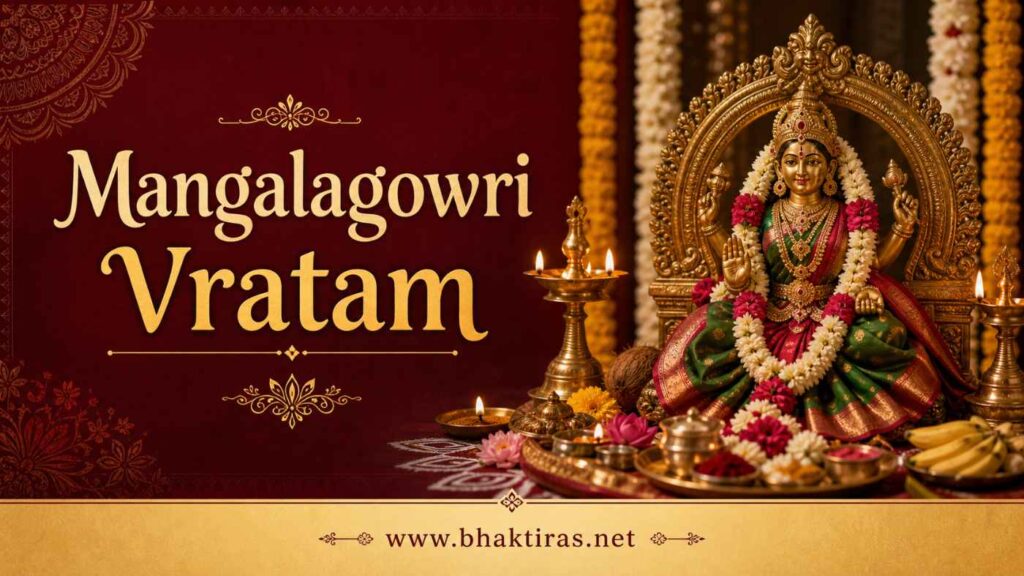
Mangala Gauri Vrat is a Tuesday fast kept through the sacred month of Shravana by married women, and with special devotion by first-year brides, to seek their husband’s long life, healthy children and an untroubled married home. The worship is offered to Mangala Gauri, an auspicious form of Goddess Parvati who is honoured as the model of a devoted wife. Because Shravana is considered the most blessed month for worshipping Shiva and Parvati, each of its Tuesdays becomes an occasion for the puja, the vrat katha and the shared company of women. In 2026 the North Indian cycle opens on Tuesday, 4 August.
Mangala Gauri Vrat 2026-2028: Dates & Calendar
The vrat is kept on every Tuesday of Shravana, so its dates shift each year with the lunar month. In 2026 the North Indian Shravan Tuesdays begin on 4 August; because Purnimanta and Amanta calendars start Shravana about a fortnight apart, the Maharashtra and southern cycle begins later.
| Year | Region | Shravan Tuesdays | Notes |
|---|---|---|---|
| 2026 | North India | 4, 11, 18, 25 Aug | Next cycle; first Tuesday 4 August |
| 2026 | Maharashtra & South | 18, 25 Aug · 1 Sep | Amanta Shravana begins later |
| 2027 | North India | 20, 27 Jul · 3, 10, 17 Aug | Five Tuesdays in Shravana |
| 2027 | Maharashtra & South | 3, 10, 17, 24, 31 Aug | Five Tuesdays |
| 2028 | North India | 11, 18, 25 Jul · 1 Aug | Four Tuesdays |
| 2028 | Maharashtra & South | 25 Jul · 1, 8, 15 Aug | Four Tuesdays |
The number of Tuesdays varies between four and five depending on when Shravana opens and closes. Many families keep the vow for every Tuesday of the month, while some brides pledge it for a set number of years and then perform the closing udyapan ritual.
Why Mangala Gauri Vrat Is Kept
Mangala Gauri Vrat is kept so that married women may win Goddess Gauri’s blessing of a long-lived husband, healthy children and a peaceful married life. It is above all a wife’s vow for the wellbeing of her family.
A wife's vow for her husband
The heart of the observance is a prayer for the husband’s long life and good health. Women fast, worship Gauri and hear her story, offering their devotion in exchange for the goddess’s protection over the marriage. The Tuesday, ruled by Mangal (Mars), is chosen because it is thought to strengthen marital fortune.
The special vow of new brides
A newly married woman traditionally keeps the Mangala Gauri Vrat for the first five years after her wedding, often beginning it at her parents’ home in her first Shravana. The pledge is completed with the udyapan ceremony, in which the vrat is formally handed on, usually to the mother-in-law or another elder married woman.
Gauri as the ideal wife
Parvati won Shiva through years of penance, and in her form as Gauri she is remembered as the loyal, patient companion. Women invoke this ideal when they pray for harmony at home, so the festival is as much about the spirit of devotion within a marriage as it is about ritual.
The blessing of Shravana
Shravana is held to be the most sacred month for Shiva and Parvati, when the very act of worship is believed to carry added merit. Keeping a vow on its Tuesdays, alongside the Monday Shravan Somvar fasts, is seen as a way to draw the divine couple’s grace over the whole household.
Deity Worshipped
The vrat is dedicated to Mangala Gauri, an auspicious form of Goddess Parvati (Gauri), the consort of Lord Shiva.
Mangala Gauri
Mangala Gauri is worshipped as the giver of marital bliss and the guardian of a wife’s suhaag, the married state. ‘Mangala’ carries the sense of auspiciousness and is also the name of Mangalvar (Tuesday), tying the goddess to the day of the fast. She is honoured through a small clay or metal idol, or a kalash, dressed and adorned as a bride.
Parvati (Gauri)
Gauri is Parvati, the daughter of the mountain king Himavan who won Lord Shiva as her husband through great tapasya. In this form she represents patience, fidelity and the strength of a devoted wife, which is why married women turn to her for the wellbeing of their own homes.
Mangala Gauri Puja, Step by Step
The puja is done in the morning after a bath, usually by the woman herself, often joined by other married women of the family and neighbourhood.
- Sankalp and bath. The woman rises early, bathes and puts on fresh, preferably auspicious clothing. She takes a sankalp, a spoken resolve to keep the fast that Tuesday for the wellbeing of her husband and family.
- Set up Gauri. A small idol of Gauri is installed on a wooden seat, often over a mound of wheat or rice, or a kalash (pot) is set up to represent her. The goddess is bathed, dressed and decorated like a bride with a red cloth, bangles, bindi and flowers.
- Aavahan and shodashopachar. Gauri is invited (aavahan) into the idol or kalash. She is then honoured with the sixteen traditional offerings (shodashopachar) such as water, sandal paste, akshat, flowers, incense, a lamp and food.
- Sixteen-fold offerings. A distinctive feature is the offering of items in sets of sixteen: sixteen laddus or sweets, sixteen betel leaves and nuts, sixteen bangles, sixteen types of flowers and grains, and other suhaag articles, placed before the goddess.
- Recite the vrat katha. The women gather to read or hear the Mangala Gauri Vrat katha, the traditional story of a childless couple whose devotion to Gauri is rewarded, which explains the fruit of the vow.
- Aarti. The puja closes with the aarti of Mangala Gauri, lamps circled before the goddess while the women sing together.
- Exchange among women. Married women exchange suhaag items, bangles, kumkum, sweets and small gifts, and bless one another with the wish of an unbroken married life (akhand saubhagya).
- Udyapan. In the final year of the vow the woman performs udyapan, feeding and gifting other married women or Brahmins and formally handing on the vrat, which completes the observance.
Foods of Mangala Gauri Vrat
Because it is a fasting day, meals are simple and grain-light, while the offerings to the goddess are rich and made in sets of sixteen.
The sixteen offering
Sixteen laddus or sixteen small sweets are a signature offering, echoing the theme of sixteen that runs through the puja. These are placed before Gauri and later shared as prasad among the women who gather.
Kheer and sweets
Kheer, along with sweets such as puran poli in Maharashtra and laddus or halwa in the north, is prepared as naivedya and shared at the end of the fast. Sweet dishes are favoured as an offering of auspiciousness.
Fasting fare
Those keeping a strict fast take only fruit, milk and water through the day. Where a lighter fast is kept, women eat vrat foods such as sabudana khichdi, kuttu or singhare ka atta preparations and boiled potatoes, avoiding ordinary grains and salt.
Breaking the fast
The fast is usually broken after the evening puja and aarti with prasad and a simple sattvik meal. Many women eat only once, taking the goddess’s naivedya as their first food of the day.
Regional Names & Variations
The vrat is kept across much of India, though the timing and some customs differ between the north, Maharashtra and the Telugu south.
Maharashtra
Known as Mangala Gauri or Mangalagaur, it is a lively household affair, especially for new brides. Young married women gather through the night on the eve or the day itself for jhimma, phugadi and other traditional games, songs and ukhane (rhyming verses), turning the vow into a joyful community gathering. Puran poli is a favourite offering.
North India
In Uttar Pradesh, Bihar, Rajasthan and neighbouring states the vrat follows the Purnimanta calendar, so its Tuesdays fall earlier, from 4 August in 2026. The focus is on the morning puja, the sixteen-fold offerings, the katha and the aarti, kept alongside the Monday Shravan Somvar fasts for Shiva.
Andhra Pradesh & Telangana
In the Telugu states it is called Mangala Gauri or Mangala Gowri Vratam and is treated as an important Shravana observance for married women. The puja to Gowri Devi centres on prayers for a long married life, and it sits close in the calendar to Varalakshmi Vratam, kept on the Friday of the same month.
Mangala Gauri Vrat Do's and Don'ts
The vow is simple to keep if a few customs of purity and intent are followed.
Do
- Bathe and wear clean, auspicious clothing before the morning puja.
- Take a clear sankalp for the fast and keep it with a calm, devoted mind.
- Adorn Gauri as a bride and offer items in the traditional sets of sixteen.
- Read or hear the Mangala Gauri Vrat katha and perform the aarti.
- Share prasad, bangles and suhaag items with other married women.
Avoid
- Do not take ordinary grains or salt if keeping the traditional fast; stay with fruit, milk or vrat foods.
- Avoid onion, garlic, meat and alcohol on the vrat day.
- Do not skip the katha, as hearing the story is held to be central to the vow’s fruit.
- Avoid anger, quarrels and harsh speech at home, which run against the spirit of the day.
- Do not abandon the vow midway once taken; complete it with the udyapan in the final year.
Frequently Asked Questions
When is the first Mangala Gauri Vrat in 2026?
The first Mangala Gauri Vrat of 2026 is on Tuesday, 4 August in North India. The four Shravan Tuesdays in the north are 4, 11, 18 and 25 August 2026. In Maharashtra and the southern states, where Shravana begins later, the vrat is kept on 18 and 25 August and 1 September 2026.
What are the Mangala Gauri Vrat dates in 2027 and 2028?
In 2027 the North Indian Shravan Tuesdays fall on 20 and 27 July and 3, 10 and 17 August, while Maharashtra and the south keep them on 3, 10, 17, 24 and 31 August. In 2028 the north observes 11, 18 and 25 July and 1 August, and the southern and western states keep 25 July and 1, 8 and 15 August.
Why is Mangala Gauri Vrat celebrated?
Mangala Gauri Vrat is celebrated so that married women may seek Goddess Gauri’s blessing of a long-lived husband, healthy children and a happy married life. It is kept on the Tuesdays of the sacred month of Shravana, with special devotion by brides in their first years of marriage, who often keep it for five years before completing it with the udyapan ceremony.
Which goddess is worshipped in Mangala Gauri Vrat?
Mangala Gauri Vrat worships Mangala Gauri, an auspicious form of Goddess Parvati, the consort of Lord Shiva. She is honoured as the giver of marital happiness and the protector of a wife’s married state, and is worshipped through a small idol or kalash dressed and adorned like a bride.
Who should keep the Mangala Gauri Vrat?
Married women keep the Mangala Gauri Vrat, and it holds special importance for newly married brides. A bride traditionally observes it for the first five years after her wedding, frequently beginning in her first Shravana at her parents’ home, and then hands the vow on through the closing udyapan ritual.
How is the Mangala Gauri Vrat kept?
The Mangala Gauri Vrat is kept by bathing early, taking a sankalp and fasting through the day on fruit, milk or light vrat foods. A small Gauri idol or kalash is set up and dressed as a bride, honoured with offerings in sets of sixteen, and worshipped with the vrat katha and aarti, after which married women share prasad and suhaag items.
What is the difference between Shravan Somvar and Mangala Gauri Vrat?
Shravan Somvar is the Monday fast of Shravana dedicated to Lord Shiva, kept by devotees of every kind for his blessings. Mangala Gauri Vrat is the Tuesday fast of the same month, kept specifically by married women for Goddess Gauri to secure their husband’s long life and marital happiness, so the two run in parallel through Shravana.
What is udyapan in Mangala Gauri Vrat?
Udyapan is the concluding ceremony performed in the final year of the Mangala Gauri Vrat, usually the fifth year for a new bride. In it the woman feeds and gifts married women or Brahmins and formally hands the vow on to an elder married woman, such as her mother-in-law, which completes the observance.
May Goddess Mangala Gauri bless every home with an unbroken bond and lasting happiness this Shravana.