
Basant Panchami 2027 – Spring, Saraswati and Yellow Blooms
बसंत पंचमी
When is Basant Panchami in 2027?
Basant Panchami falls on Thursday, 11 February 2027. It is observed on Magha Shukla Panchami, the fifth day of the bright fortnight of the Magha month, and marks the arrival of spring. The day honours Goddess Saraswati, so students and artists worship their books, pens and instruments and wear yellow.
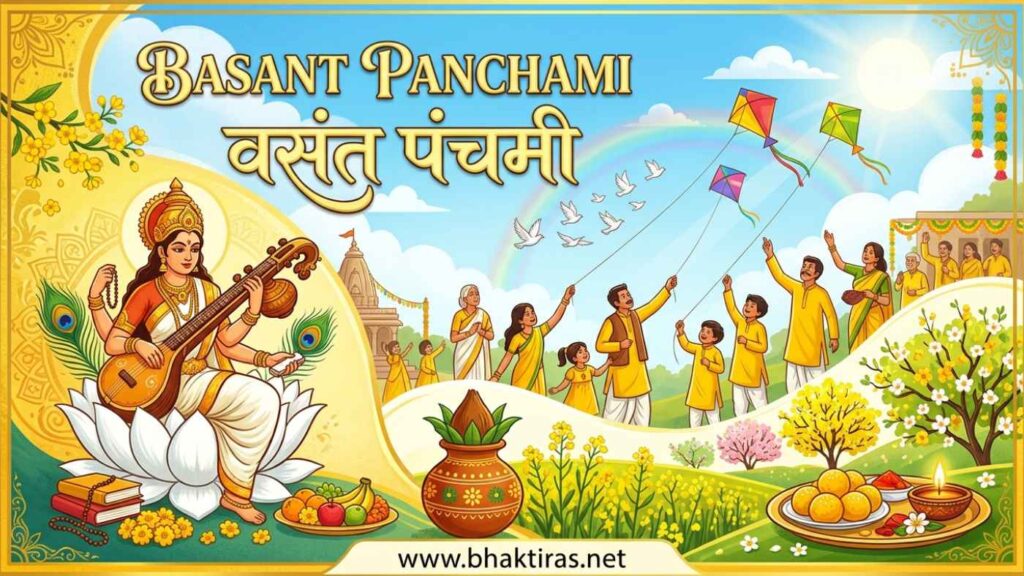
Basant Panchami is the day India turns yellow to greet the spring. Falling on Magha Shukla Panchami, usually in late January or February, it honours Saraswati, the goddess of knowledge, music and speech. Mustard fields are in bloom, the air softens, and people wear yellow, cook yellow sweets and lay their books, pens and instruments before the goddess. It is the favourite day to begin a child’s education and to start learning music or dance, which makes it as much a festival of fresh starts as of the season.
Basant Panchami 2026-2028: Dates & Calendar
The next Basant Panchami is on Thursday, 11 February 2027. The date shifts each year because it follows the Hindu lunar calendar – the fifth day of the waxing moon in Magha – rather than a fixed solar date.
| Year | Date | Day | Tithi |
|---|---|---|---|
| 2026 | 23 January | Friday | Magha Shukla Panchami |
| 2027 | 11 February | Thursday | Magha Shukla Panchami |
| 2028 | 31 January | Monday | Magha Shukla Panchami |
The Panchami tithi does not always sit neatly within daylight hours, so the puja is generally done in the forenoon when the tithi prevails. Follow your local panchang for the exact window, as a few calendars mark 2028 on the following day.
Why Basant Panchami Is Celebrated
Basant Panchami is celebrated to welcome spring and to worship Saraswati, the goddess of learning and the arts. It blends a seasonal thanksgiving with a day of knowledge, which is why yellow, mustard flowers and open books all belong to it.
The turn of the season
Basant means spring, and this is the day it is formally welcomed. In the fields the mustard has flowered into sheets of yellow, the cold begins to loosen, and the colour of the crop becomes the colour of the festival. People wear yellow to mirror the season and to invite its warmth and abundance.
The day of Saraswati
By tradition, Saraswati is honoured on this tithi as the giver of vidya – knowledge, speech and the arts. Placing books, pens and instruments at her feet is a way of saying that learning itself is sacred and that skill is a gift to be tended, not just owned.
A day for beginnings
Because it is dedicated to knowledge, Basant Panchami is treated as an auspicious muhurat for firsts. Children are helped to write their first letters, new music and dance lessons are begun, and foundation ceremonies and other fresh starts are timed to it.
Kama and the colours of love
In parts of the north the day also remembers Kamadeva, the god of love and desire, and the reawakening of nature. This gives Basant Panchami a lighter, romantic note alongside its scholarly one, and connects it to the coming season of Holi.
Deities & Figures Worshipped
The presiding deity of Basant Panchami is Saraswati, goddess of knowledge and the arts. In some regions Kamadeva and the season of spring itself are also honoured.
Saraswati
Saraswati is worshipped as the source of learning, music, poetry and clear speech. She is pictured seated on a white lotus, dressed in white or yellow, holding the veena and a book, with a swan or peacock nearby. On this day her image is dressed in yellow and offered books, pens and instruments.
Kamadeva and Rati
Kamadeva, the deity of love, and his consort Rati are remembered in some northern traditions, tied to the reawakening of desire and greenery in spring. It is a minor strand of the day but explains its softer, romantic mood.
Key Rituals, Step by Step
The heart of the day is Saraswati Puja at home, in schools and in community pandals. The steps below follow the usual morning sequence.
- Bathe and wear yellow. People bathe early, put on yellow clothes and prepare a clean space or pandal for the goddess, often adding marigold and other yellow flowers.
- Set up the idol or image. A murti or picture of Saraswati is placed on a decorated platform, dressed in yellow, and given a lamp, incense and a small water pot.
- Lay out the books and instruments. Students place their textbooks, notebooks and pens before her, while musicians and dancers set down their veena, tabla, harmonium or ghungroo to be blessed.
- Offer the puja. The goddess is worshipped with roli, rice, yellow flowers and sweets; a diya is lit and the Saraswati Vandana or her mantras are recited.
- Perform Vidyarambham for children. Where it is customary, a young child is guided to write their first letters, often in a plate of rice or with an elder holding their hand, marking the start of formal learning.
- Distribute prasad. Yellow sweets, boondi, kesar-tinted rice and fruit are offered and then shared among family, classmates and neighbours.
- Fly kites or enjoy the outdoors. In Punjab and parts of the north the afternoon turns to kite-flying, picnics and spring outings in the mustard fields.
Special Foods of Basant Panchami
Yellow is the theme on the plate too, from saffron-tinted rice to turmeric sweets. Here are the dishes most associated with the day.
Kesari bhaat / meethe chawal
Sweet rice cooked with saffron or turmeric, sugar, ghee and dry fruits, giving it a warm yellow colour. It is the signature dish of the day and is often offered to Saraswati first.
Boondi and besan sweets
Yellow gram-flour treats such as boondi, boondi ke laddoo and besan barfi are made and shared, their colour matching the mood of the festival.
Rajbhog and Bengali sweets
In Bengal, where Saraswati Puja is a major event, the offerings often include kul (ber), sweets like rajbhog and sandesh, and khichuri served as bhog at pandals and homes.
Saffron kheer and malpua
Saffron-scented kheer and golden malpua add to the spread, keeping the yellow-and-sweet theme that runs through the whole day.
Regional Names & Variations
Basant Panchami is kept across much of India but takes on a distinct flavour in each region.
Bengal & Odisha
Here it is above all Saraswati Puja, celebrated with great warmth in schools, colleges and homes. Students clean their study corners the night before, keep their books before the goddess, and pandals go up in neighbourhoods; in Bengal it is also a day young people traditionally wear their first saree or panjabi.
Bihar & Uttar Pradesh
Saraswati idols are installed in schools and localities, followed by prasad and, the next day, immersion processions. The mustard fields around make the yellow theme especially fitting.
Punjab & Haryana
Alongside the puja, Basant is a kite-flying day. The sky fills with kites, people wear yellow, and mustard-field outings mark the spring in a lively, outdoor style.
Rajasthan & Gujarat
People dress in yellow, prepare saffron sweets and mark the arrival of spring; in Rajasthan garlands of jasmine are a common offering and the day carries a festive, colourful mood.
Basant Panchami Do's and Don'ts
A few simple customs help you keep the spirit of the day.
Do
- Wear yellow to match the season and the goddess.
- Keep your books, pens or instruments before Saraswati and clean your study space.
- Offer yellow flowers and sweets, and begin the puja in the forenoon when the tithi holds.
- Encourage a child’s first writing (Vidyarambham) or start a new lesson today.
- Share prasad with family, classmates and neighbours.
Avoid
- Avoid treating your books or instruments carelessly on this day – they are being worshipped.
- Do not skip the morning puja for the evening if the Panchami tithi ends earlier.
- Avoid non-vegetarian food and alcohol during the observance if you keep the fast.
- Do not step on or over books, papers or musical instruments.
- Avoid speaking harshly, since the day honours the goddess of speech.
Frequently Asked Questions
When is Basant Panchami in 2027?
Basant Panchami in 2027 is on Thursday, 11 February. It is observed on Magha Shukla Panchami, the fifth day of the bright half of the Magha month, and the Saraswati Puja is usually performed in the forenoon.
When is Basant Panchami in 2026 and 2028?
Basant Panchami was on Friday, 23 January 2026, and will next fall on Monday, 31 January 2028. The date moves each year because it follows the Hindu lunar calendar rather than a fixed solar date; a few panchangs mark the 2028 observance on the following day.
Why is Basant Panchami celebrated?
Basant Panchami is celebrated to welcome spring and to worship Saraswati, the goddess of knowledge, music and the arts. The mustard fields bloom yellow, people wear yellow, and students and artists honour their books and instruments, making it a festival of both the season and fresh learning.
Which god is worshipped on Basant Panchami?
Saraswati, the goddess of knowledge, speech, music and the arts, is the main deity worshipped on Basant Panchami. In some northern traditions Kamadeva, the god of love, and the season of spring are also remembered.
Why do people wear yellow on Basant Panchami?
People wear yellow on Basant Panchami to reflect the season, when the mustard fields are in full yellow bloom and spring is arriving. Yellow is also linked to Saraswati and to energy and warmth, so yellow clothes, flowers and sweets all feature through the day.
What is Vidyarambham on Basant Panchami?
Vidyarambham, also called Akshar-Abhyasam, is the ceremony of a child writing their first letters, and Basant Panchami is one of the most favoured days for it. An elder guides the child’s hand to trace letters, often in a plate of rice, marking the auspicious start of formal education.
How is Saraswati Puja done at home?
To do Saraswati Puja at home, place her idol or image on a clean platform dressed in yellow, lay your books, pens and instruments before her, and offer roli, rice, yellow flowers, a lamp and sweets while reciting the Saraswati Vandana. The puja is best done in the morning, after which prasad is shared.
Is Basant Panchami connected to kite-flying?
Yes, in Punjab and parts of northern India Basant Panchami is a well-known kite-flying day. Alongside the Saraswati worship, the afternoon skies fill with kites as families enjoy the spring weather and mustard-field outings.
May Saraswati bless your books and your beginnings this spring – happy Basant Panchami.