
Ayudha Puja 2026 – Worship of Tools, Weapons & Vehicles
आयुध पूजा
When is Ayudha Puja in 2026?
Ayudha Puja falls on Tuesday, 20 October 2026, on Mahanavami, the ninth day of Sharadiya Navratri. On this day people across South India clean and decorate the tools, machines, books and vehicles of their livelihood and worship them as forms of the Goddess, resting them for the day.
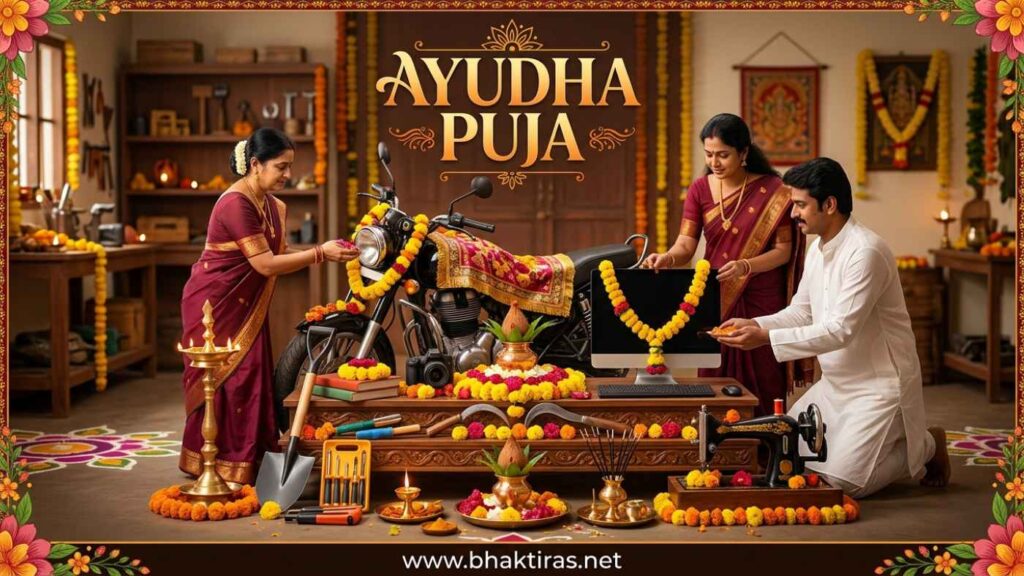
Ayudha Puja is the Hindu practice of honouring the implements of one’s work as living forms of the divine. Held on Mahanavami, the ninth day of Sharadiya Navratri, it turns kitchen knives, farm sickles, carpentry tools, factory machines, laptops, buses and lorries into objects of worship. Craftspeople, drivers, students, shopkeepers and factory hands clean their tools, dress them in turmeric, kumkum and flowers, and set them at rest for the day. The idea is simple and quietly powerful: the skill in your hands and the tool that earns your bread carry the power of the Goddess.
Ayudha Puja 2026-2028: Dates & Calendar
Ayudha Puja in 2026 is on 20 October. The date shifts each year because it follows the lunar tithi Mahanavami of Ashwin, not a fixed Gregorian day.
| Year | Date | Day | Notes |
|---|---|---|---|
| 2026 | 20 October | Tuesday | Next occurrence (Mahanavami) |
| 2027 | 8 October | Friday | Mahanavami of Sharadiya Navratri |
| 2028 | 27 September | Wednesday | Mahanavami of Sharadiya Navratri |
Ayudha Puja is observed on the ninth day of Navratri, the day before Vijayadashami (Dussehra). In many regions the auspicious Vijaya Muhurat in the afternoon is preferred for placing tools before the deity, though the whole day is considered suitable.
Why Ayudha Puja Is Celebrated
Ayudha Puja celebrates the divine present in honest work by worshipping the tools that make a living possible. It marks Goddess Durga’s victory over the demon Mahishasura and treats every implement as a vessel of her Shakti.
The festival grew from the older idea that the Goddess resides not only in temples but in the instruments through which people create, protect and provide. By worshipping a plough, a loom, a car or a set of textbooks, a devotee acknowledges that the outcome of any effort depends on grace, not skill alone. Resting the tools for one full day is itself the offering: labour pauses so that gratitude can take its place.
Durga's victory
Ayudha Puja falls on Mahanavami, the culmination of the nine-night battle in which Durga slew Mahishasura. Her weapons, once the instruments of that victory, become the template for worshipping every tool of ordinary life.
The Shami tree legend
In the Mahabharata, the Pandavas hid their weapons in a Shami (banni) tree during their year in disguise. When the exile ended, Arjuna recovered his Gandiva bow from the tree and worshipped the arms before battle. This episode is remembered as the root of Astra Puja, the worship of weapons on Navami.
The divine in labour
By honouring the sickle, the anvil, the sewing machine or the delivery van, the day dignifies manual and skilled work. It reframes tools not as dead metal but as partners that carry Saraswati’s knowledge, Lakshmi’s wealth and Durga’s strength.
Deities & Figures Worshipped
Ayudha Puja invokes the Goddess in three aspects, understood as the Shakti living inside every implement. In South India the day is closely tied to Saraswati.
Saraswati
The goddess of learning, music and craft is worshipped through books, pens, musical instruments and the tools of any art. Students and teachers place their study materials before her, and many keep them untouched for the day so that knowledge may be honoured over routine use.
Durga
As the slayer of Mahishasura, Durga represents the force that Ayudha Puja celebrates. Weapons, machines and any tool of protection or heavy work are dedicated to her power, in memory of the Navami victory.
Lakshmi
The goddess of wealth is honoured through the tools that generate livelihood: shop scales, cash boxes, tractors, autos and lorries. Worshipping them asks for continued abundance from one’s trade in the year ahead.
Key Rituals, Step by Step
The heart of Ayudha Puja is simple: stop work, clean the tools, decorate them, and worship them together before the deity.
- Rest the tools. On Ayudha Puja day the implements, machines and vehicles are set aside and not used. Shops, workshops and offices often close so nothing that is being worshipped is put to work.
- Clean everything. Tools, cars, computers and books are washed or wiped down thoroughly, a symbolic and literal fresh start for the instruments of one’s trade.
- Apply the sacred marks. Turmeric (haldi), kumkum, sandal paste and vibhuti are applied to each tool, along with a tilak, marking it as an object of worship for the day.
- Decorate with leaves and flowers. Banana stems, mango and neem leaves, marigold garlands and rangoli are arranged around the machines and vehicles. A lime is sometimes placed under a car tyre to be crushed as it drives off afterwards, warding off the evil eye.
- Arrange before the deity. Books, instruments and smaller tools are placed together before an image of Saraswati or Durga, or on a Golu display, so they can be worshipped as a group.
- Perform the puja and aarti. The family or workers light a lamp and incense, offer the puja, break a coconut and wave the aarti, praying for safety, skill and prosperity through the coming year.
- Distribute prasad. Cooked offerings such as sundal, pongal and sweets are shared among family, colleagues and workers, closing the observance on a note of gratitude and community.
Special Foods of Ayudha Puja
The prasad leans towards simple South Indian dishes that are quick to prepare and easy to share among a workshop or household.
Sundal
A dry, lightly spiced dish of boiled chickpeas, black gram or other pulses tempered with mustard seeds, curry leaves and grated coconut. It is the classic Navratri and Ayudha Puja offering, cheap, filling and easy to distribute.
Pongal
Rice cooked with moong dal, either the savoury ven pongal with pepper, ginger and ghee or the sweet sakkarai pongal with jaggery. It is a staple prasad offered before the tools and shared afterwards.
Vadai
Crisp fried savouries of urad dal (medu vadai) or split chickpeas (masala vadai) are a festive favourite, often prepared in bulk for the workers and visitors who gather for the puja.
Payasam
A milk or jaggery pudding made with rice, vermicelli or moong dal and flavoured with cardamom, cashews and raisins. It rounds off the offering as the sweet centrepiece of the day.
Regional Names & Variations
Ayudha Puja is strongest across South India, where the same core idea takes different colours from state to state.
Tamil Nadu
The day blends with the Golu display and Saraswati Puja. Books, instruments and tools are laid before the deity on Navami and kept out of use; children often place their schoolbooks for blessing before resuming study on Vijayadashami.
Karnataka
Ayudha Puja is woven into Mysuru Dasara. The royal family and countless households worship weapons, vehicles and machinery, and the Shami (banni) tree is honoured in remembrance of Arjuna recovering his arms.
Andhra Pradesh & Telangana
Observed as Aayudha Pooja alongside Dasara, with strong emphasis on decorating vehicles and business equipment. Autos, lorries and shop implements are dressed in flowers and limes for a prosperous year.
Offices, factories & fleets
Well beyond South India, garages, IT firms, transport companies and small workshops mark the day by garlanding machines, servers and vehicles. It has become the standard occasion to bless anything mechanical that earns a living.
Ayudha Puja Do's and Don'ts
A short guide to observing the day with the right spirit.
Do
- Clean your tools, vehicles, books and machines thoroughly before the puja.
- Rest the worshipped implements for the day and let work pause.
- Decorate with turmeric, kumkum, sandal, flowers and fresh leaves.
- Offer and share simple prasad such as sundal, pongal or payasam.
- Include the tools of every worker, from the humblest to the most modern.
Avoid
- Do not use the tools, machines or vehicles you have worshipped that day.
- Do not begin new work or major repairs during the observance.
- Do not leave implements dirty or broken when you dedicate them.
- Do not treat it as a mere formality; the point is genuine gratitude.
- Do not fabricate muhurat timings; follow a reliable local panchang.
Frequently Asked Questions
When is Ayudha Puja in 2026?
Ayudha Puja in 2026 is on Tuesday, 20 October. It is observed on Mahanavami, the ninth day of Sharadiya Navratri, the day before Vijayadashami (Dussehra).
When is Ayudha Puja in 2027 and 2028?
Ayudha Puja falls on Friday, 8 October 2027 and on Wednesday, 27 September 2028. The date changes each year because it follows the lunar tithi Mahanavami rather than a fixed calendar day.
Why is Ayudha Puja celebrated?
Ayudha Puja is celebrated to honour the tools, weapons, machines and books that make a living possible, treating them as forms of the Goddess. It marks Durga’s victory over Mahishasura on Navami and expresses gratitude for the skill and means by which people work.
Which god is worshipped on Ayudha Puja?
Ayudha Puja worships the Goddess in three aspects: Saraswati for knowledge, Durga for strength and Lakshmi for prosperity. Each tool is treated as holding this Shakti, and in South India the day is closely linked with Saraswati.
What is the Shami tree connection to Ayudha Puja?
The Shami tree connection comes from the Mahabharata, where the Pandavas hid their weapons in a Shami tree during their year in disguise. When the exile ended, Arjuna recovered his Gandiva bow and worshipped the arms, which is remembered as the origin of Astra Puja on Navami.
How is Ayudha Puja related to Saraswati Puja?
Ayudha Puja and Saraswati Puja are observed together in much of South India on the same Navami. Saraswati Puja focuses on worshipping books, pens and instruments of learning, while Ayudha Puja extends the same honour to all tools of work; in Tamil Nadu and Kerala the two are often treated as one observance.
What is the difference between Ayudha Puja and Vijayadashami?
Ayudha Puja is held on Mahanavami, the ninth day, when tools are worshipped and rested. Vijayadashami (Dussehra) is the tenth day, when the worshipped tools are taken up again for auspicious new beginnings and Durga’s final victory is celebrated.
What foods are offered on Ayudha Puja?
Common offerings on Ayudha Puja are simple South Indian dishes such as sundal, ven or sweet pongal, vadai and payasam. These are placed before the tools and deity and then shared as prasad among family, colleagues and workers.
However you earn your bread, may your tools be blessed and your work prosper this Ayudha Puja. Shubh Ayudha Puja!