
Kharchi Puja 2026 – Tripura's Festival of the Fourteen Gods
खार्ची पूजा
When is Kharchi Puja in 2026?
Kharchi Puja begins on Tuesday, 21 July 2026 and runs for seven days at the Chaturdasha Devata temple in Old Agartala, Tripura. It falls on Ashadha Shukla Ashtami, the eighth day after the Ashadha new moon, and honours the fourteen ancestral deities of the Tripuri royal line while ritually cleansing Mother Earth.
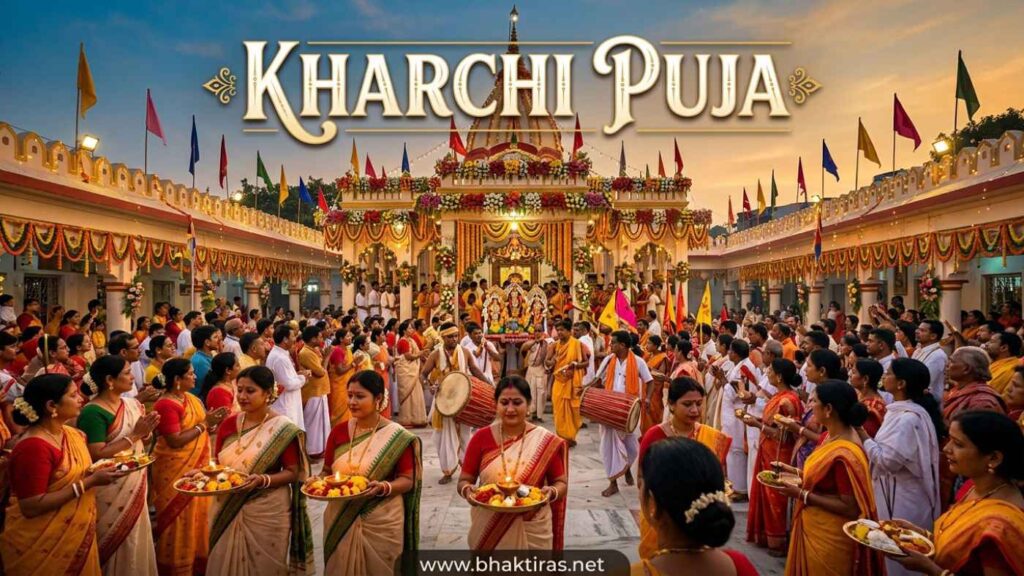
Kharchi Puja is Tripura’s seven-day worship of the Chaturdasha Devata, the fourteen gods once held as the dynastic deities of the Tripuri Manikya kings. Held in the Hindu month of Ashadha, on the eighth day after the new moon, it centres on the temple at Old Agartala where the deity heads are carried to the Saidra river, bathed and returned for a week of offerings. Underlying the ritual is an older idea: after the earth’s yearly cycle of rest, worshippers gather to cleanse her and ask her pardon for the year’s tilling and treading.
Kharchi Puja 2026-2028: Dates & Calendar
The next Kharchi Puja begins on 21 July 2026. Because it is fixed to Ashadha Shukla Ashtami on the Hindu lunar calendar, the starting date shifts by a week or two each year against the Gregorian calendar.
| Year | Start date | Day | Notes |
|---|---|---|---|
| 2026 | 21 July | Tuesday | Next occurrence – seven-day festival to 27 July |
| 2027 | 11 July | Sunday | Ashadha Shukla Ashtami |
| 2028 | 29 June | Thursday | Earlier this year with the lunar shift |
All seven days centre on the Chaturdasha Devata temple in Old Agartala (Puran Agartala), with the ceremonial river bath on the opening day and the fair continuing through the week.
Why Kharchi Puja Is Celebrated
Kharchi Puja is celebrated to worship the fourteen ancestral gods of Tripura and to ritually purify Mother Earth after her period of rest. The word Kharchi is traced to the Tripuri khya, meaning earth, so the festival is at heart an act of cleansing and thanksgiving to the land.
The earth's rest and pardon
Tripuri belief holds that the earth goddess passes through an annual cycle of rest, an idea close to the Ambubachi period observed further east. Once that cycle ends, the soil is thought to have grown impure through the year’s ploughing and use. Kharchi Puja washes away that impurity and seeks the earth’s forgiveness before farming resumes in full.
Deities of a dynasty
The fourteen gods were the household and state deities of the Tripuri Manikya kings, and their worship was once a royal duty. Even after the monarchy ended, the ritual passed to the Chantai, the traditional priests, keeping a line of practice that reaches back centuries to the royal court.
A shared festival
Kharchi Puja is one of the few large observances where indigenous Tripuri communities and Bengali Hindu settlers worship side by side. The fair around the temple draws people of every background, making it as much a social gathering for the whole state as a religious rite.
Deities & Figures Worshipped
The festival worships the Chaturdasha Devata, fourteen gods represented not as full images but as fourteen sculpted deity heads. They are local Tripuri forms of familiar Hindu gods and goddesses.
Hara (Shiva)
Hara is the Tripuri form of Shiva, counted first among the fourteen and treated as the presiding presence of the group. His worship anchors the festival’s Shaivite character.
Uma (Parvati)
Uma is the goddess consort of Shiva, honoured as mother and as the shakti or active power behind creation. She pairs with Hara at the head of the pantheon.
Hari (Vishnu) & Ma (Lakshmi)
Hari is the Tripuri Vishnu, the preserver, worshipped alongside Ma, the form of Lakshmi who brings wealth and wellbeing. Together they represent sustenance and prosperity.
Vani (Saraswati) & Ganapati (Ganesha)
Vani is Saraswati, goddess of learning and speech, while Ganapati is Ganesha, remover of obstacles and lord of beginnings. Both are widely loved across the fourteen.
Vidhi (Brahma) & the earth
Vidhi is Brahma the creator, and the group also includes forms tied directly to the land and elements, such as Kshiti (the earth) and Kumara (Kartikeya, the war god). The full fourteen span the elements, the seasons and the great gods of the Hindu tradition.
Key Rituals, Step by Step
The seven days open with the most striking rite, the river bath of the fourteen deity heads, and settle into daily worship and a large fair.
- Waking the deities. On the opening morning the Chantai priests prepare the fourteen deity heads at the Old Agartala temple, offering incense and early prayers before they are moved.
- Procession to the Saidra. The heads are lifted and carried in procession, accompanied by drums and chanting, to the nearby Saidra river for their yearly bath.
- The holy bath. At the riverbank the deities are bathed in the flowing water, a purification that mirrors the cleansing being sought for the earth herself.
- Return and adornment. The bathed heads are brought back to the temple and decorated with fresh flowers and vermilion, then set out for the week of public worship.
- Offerings and sacrifice. Devotees present sweets, fruit and cooked food; by long tradition animal and bird offerings such as goats and pigeons were also made to the deities during the puja.
- Daily worship through the week. For seven days pilgrims queue to pray before the fourteen gods, seeking blessings for health, harvest and family.
- The Kharchi fair. Around the temple a large fair runs alongside the rites, with stalls, food, folk music and cultural programmes drawing crowds from across Tripura and beyond.
Special Foods of Kharchi Puja
Food at Kharchi Puja blends temple prasad with the everyday tastes of Tripura, and the fair fills with cooked treats.
Khichuri
A soft, warming mix of rice and lentils, khichuri is the classic offering-and-feast dish of the region, cooked in large pots and shared among devotees and fair-goers.
Hilsa & river fish
Hilsa and other freshwater fish are prized across Tripura, and fish dishes appear on family tables during the festival week, reflecting the state’s riverine food culture.
Prasad sweets
Sweets, batasha and fruit are offered to the fourteen gods and then distributed as prasad, carrying the deities’ blessing back to each home.
Fair snacks
The fair around the temple sells jalebi, fried snacks and seasonal treats, part of the festive, market-day mood that surrounds the worship.
Where Kharchi Puja Is Celebrated
Kharchi Puja is a Tripura festival, most concentrated at one temple but felt across the state and among the Tripuri diaspora.
Old Agartala (Puran Agartala)
The heart of the festival is the Chaturdasha Devata temple at Old Agartala, the former royal seat, where the fourteen gods are housed and the river bath and main worship take place.
Across Tripura
Communities throughout Tripura mark the week with prayers, feasting and visits to the fair, and it is a public holiday in the state, so schools and offices pause for the observance.
Tripuri diaspora
Tripuri families settled outside the state, and neighbours in nearby parts of the Northeast, keep the festival in smaller ways, remembering the fourteen ancestral gods wherever they are.
Kharchi Puja Do's and Don'ts
A few simple courtesies help visitors take part respectfully at a festival that carries deep local meaning.
Do
- Dress modestly and remove footwear before entering the temple precinct.
- Join the queue patiently; the crowds during the seven days can be very large.
- Accept and share prasad with clean hands as a mark of the deities’ blessing.
- Ask before photographing the deity heads or the priests during rituals.
- Carry water and travel early if you plan to see the opening river procession.
Avoid
- Do not touch the deity heads or push past the Chantai priests during the rites.
- Avoid loud or disruptive behaviour near the sanctum during worship.
- Do not litter around the Saidra river or the fairground.
- Avoid treating the fair as only a market; the festival is a sacred earth-worship first.
- Do not force your way to the front; let elders and priests lead the procession.
Frequently Asked Questions
When is Kharchi Puja in 2026?
Kharchi Puja begins on Tuesday, 21 July 2026 and continues for seven days at Old Agartala in Tripura. It falls on Ashadha Shukla Ashtami, the eighth day after the Ashadha new moon.
When is Kharchi Puja in 2027 and 2028?
Kharchi Puja is expected to begin on Sunday, 11 July 2027 and around Thursday, 29 June 2028. The start moves each year because it is set to Ashadha Shukla Ashtami on the lunar calendar rather than a fixed Gregorian date.
Why is Kharchi Puja celebrated?
Kharchi Puja is celebrated to worship Tripura’s fourteen ancestral gods and to ritually cleanse Mother Earth. Local belief holds that the soil grows impure through the year and that the festival, whose name links to the word for earth, purifies the land and seeks its pardon.
Which gods are worshipped during Kharchi Puja?
Kharchi Puja worships the Chaturdasha Devata, fourteen gods shown as sculpted deity heads. They are Tripuri forms of Hindu gods including Hara (Shiva), Uma (Parvati), Hari (Vishnu), Ma (Lakshmi), Vani (Saraswati), Ganapati (Ganesha) and Vidhi (Brahma), along with forms of the earth, fire and other elements.
Where is Kharchi Puja celebrated?
Kharchi Puja is celebrated mainly at the Chaturdasha Devata temple in Old Agartala (Puran Agartala), the former royal seat of Tripura. The whole state observes it as a holiday, and a large fair surrounds the temple through the seven days.
What is the main ritual of Kharchi Puja?
The central ritual of Kharchi Puja is carrying the fourteen deity heads in procession to the Saidra river for a holy bath, then returning them to the temple for a week of worship. Offerings include sweets, fruit and, by tradition, animal and bird sacrifices.
What does the word Kharchi mean?
The word Kharchi is traced to the Tripuri term khya, meaning earth. The festival is therefore understood as a worship and cleansing of Mother Earth, carried out after her yearly cycle of rest.
How is Kharchi Puja linked to Ambubachi?
Kharchi Puja follows the same idea seen in Ambubachi, that the earth goddess undergoes an annual period of rest thought of as menstruation. Once that period ends the earth is considered impure, and Kharchi Puja is held soon after to purify her and resume normal worship and farming.
May the fourteen gods of Tripura bless your home and the earth beneath your feet. Kharchi Puja-r shubhechchha.