
Rishi Bhrigu
भृगु
Bhrigu is one of the seven great sages of Hindu tradition and a Prajapati, a mind-born son of Brahma. He founded the Bhargava clan and is remembered as the father of predictive astrology, credited with the Bhrigu Samhita. His most retold act is testing the Trimurti, which left the Srivatsa mark on Vishnu's chest.
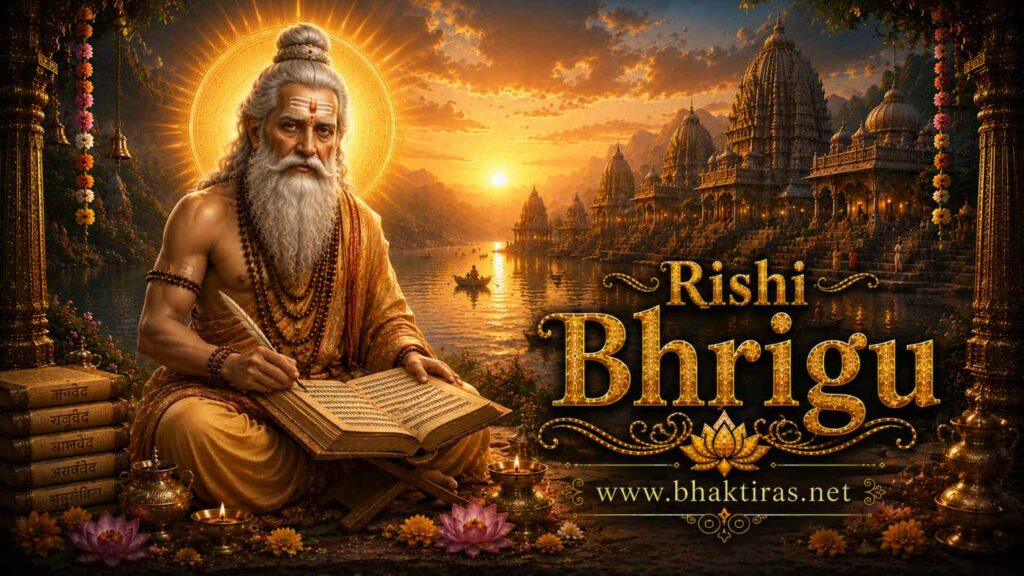
Who Is Rishi Bhrigu
Bhrigu belongs to the small circle of sages the tradition places at the very beginning of things. He is counted among the Saptarishi, the seven great seers, and among the Prajapatis, the progenitors through whom creation was carried forward. The oldest texts describe him not as a man who grew into wisdom over a lifetime, but as a manasaputra – a son born from the mind of Brahma himself, brought into being to help order the young world.
From him descends the Bhargava line, one of the most influential priestly and scholarly families of the Vedic age. His household was no quiet retreat. His wife was Khyati, and among his children the tradition names Shukracharya, who would become the preceptor of the asuras, and, in several accounts, the goddess Bhargavi – a name of Lakshmi herself. To read about Bhrigu is to trace a thread that runs through hymns, family genealogies, and the very machinery of destiny.
The name Bhrigu is often linked to a root meaning to shine or to burn brightly, and it suits him. He is associated with the discovery and keeping of sacred fire, and later with the light of foreknowledge – the ability to read what the stars have written for a soul before it is born.
Father of Predictive Astrology – the Bhrigu Samhita
If one work has carried Bhrigu’s name across the centuries, it is the Bhrigu Samhita. Tradition holds that the sage compiled it as a vast register of jyotisha, the science of light, gathering into a single treatise the horoscopes and life-readings of a very large number of souls. The idea behind it is unusual: rather than casting a fresh chart for each person, a reader locates the individual’s pre-written reading within the compilation, matched by planetary positions at the moment of birth.
This places Bhrigu at the head of the branch of astrology called nadi, the palm-leaf readings still practised in parts of southern and western India. Whatever survives today is fragmentary and scattered across many families of astrologers, and scholars debate how much of any manuscript reaches back to a single ancient source. Yet the reverence is real. For centuries, people have travelled to nadi readers hoping to hear a verse that names them, describes their family, and sketches the arc of their years – and they have credited the first authorship of that method to Maharishi Bhrigu. In the temples of Hindu memory, he is the sage who first dared to write destiny down.
The Test of the Trimurti
The best-loved story about Bhrigu begins with an argument among the sages. They wished to know which of the three great powers – Brahma, Vishnu, or Shiva – carried the greatest measure of sattva, the quality of pure goodness and patience. To settle it, they chose Bhrigu, and he agreed to test each of the Trimurti in turn.
The kick that left a mark
The trials with Brahma and Shiva did not satisfy the test, so Bhrigu came at last to Vaikuntha, the abode of Vishnu. He found the Lord resting, and rather than announce himself with courtesy, the sage walked up and struck Vishnu on the chest with his foot. It was a deliberate provocation, a rude blow meant to draw out the truth of the Lord’s temper. Vishnu did not flare into anger. Instead he rose, took the sage’s foot gently into his hands, and began to press it, asking whether the hard surface of his chest had hurt the elder’s tender sole. Such forbearance settled the question at once – here was the most sattvic and forgiving of the three.
The Srivatsa and Lakshmi's displeasure
The kick, however, did not pass without consequence. It left a mark upon Vishnu’s chest, remembered afterwards as the Srivatsa, a curl of hair or auspicious sign that iconography still depicts there. But the chest of Vishnu is the seat of Lakshmi, the goddess of fortune, who dwells close to his heart. That the sage had struck the very place where she resides, and that her Lord had answered only with tenderness, displeased her deeply. In several tellings her hurt at this moment sets in motion her departure from Vaikuntha – a thread that later winds toward the hills of Tirupati.
The story is told to teach a hard lesson gently: that true greatness reveals itself not in power but in the refusal to return injury with injury. Bhrigu’s foot did the wounding; Vishnu’s patience did the answering; and both are remembered.
The Bhargava Clan and Shukracharya
Around Bhrigu grew a whole lineage, the Bhargavas, whose members appear again and again across the Vedic hymns and the later epics. To belong to the Bhrigu gotra is to name him as the founding ancestor, and many families across India still trace their descent to him in this way. The Bhargavas were priests, poets, and keepers of powerful knowledge, and their fortunes were tangled with both gods and demons.
The most striking of his sons is Shukracharya, whom the tradition seats as the guru of the asuras. Where Brihaspati counselled the devas, Shukra counselled their rivals, and he alone possessed the Sanjivani knowledge that could restore the dead to life. That a sage of Bhrigu’s stature should father the teacher of the demons is not treated as a contradiction. It reflects a world in which wisdom is not the property of one side alone, and in which learning, once earned, serves whoever holds it faithfully. Through this line the Bhargavas sit at the crossroads of the eternal contest between devas and asuras, advising, tempering, and sometimes deciding it.
Bhrigu and the Tirupati Legend
The mark left by Bhrigu’s foot has a long afterlife. Because the sage had struck the seat of Lakshmi upon Vishnu’s chest, and because the Lord’s calm forgiveness had, in her eyes, made light of the offence, the goddess withdrew from Vaikuntha in her displeasure. Her departure leaves Vishnu bereft, and the account becomes one of the roots of the great pilgrimage tradition of the seven hills.
In the wider cycle of stories tied to Tirumala, Vishnu descends to the earth as Venkateswara, the lord of the seven hills, in part to seek Lakshmi and to make his home where she has gone. The pilgrimage to Tirupati, one of the busiest shrines in the world, carries within its layers of legend this quarrel that began with a sage’s foot. It is a fitting turn: a single act of testing by Bhrigu ripples outward into the descent of a god and the founding of a pilgrimage that millions still walk. The devotee who climbs those hills is, without always knowing it, following a story that opened in a hermit’s decision to prove which of the three was the most forbearing.
Iconography & Symbols
Bhrigu is pictured as one would expect of an ancient rishi, though a few details set him apart.
The elder sage
He appears as an aged seer with a long white beard and matted locks, his frame lean from tapas. His expression is grave and inward, the face of one accustomed to reading what others cannot see.
The manuscript
Because his fame rests on the Bhrigu Samhita, he is often shown holding or seated beside a palm-leaf manuscript, the physical form of the destinies he is said to have recorded. It is the emblem of the astrologer-sage.
Fire and the sacred thread
As a brahmarshi and a keeper of sacred fire, he wears the yajnopavita, the sacred thread, and is associated with the ritual flame. The connection of his name to shining and burning is carried in this link to agni.
The touch of foreknowledge
Where art wishes to mark him as more than an ordinary rishi, it lends his gaze a distant, knowing quality – the look of a seer who has already read the years that lie ahead for the one before him.
How Rishi Bhrigu Is Remembered
Across India, Bhrigu is honoured less through grand temples than through the living practices and lineages he set in motion.
- As the patriarch of the Bhrigu gotra, invoked by countless families who name him in their genealogies and ritual introductions.
- As the fountainhead of nadi astrology, whose palm-leaf readers in Tamil Nadu and beyond credit the Bhrigu Samhita as the source of their tradition.
- As one of the Saptarishi, remembered together with the other great seers in prayer, ritual, and the naming of stars.
- As a composer and hearer of Vedic hymns, with the Bhargava family associated with several portions of the sacred corpus.
- As a figure in temple lore at Tirupati, where his testing of Vishnu forms part of the story pilgrims carry up the seven hills.
- Through the sage Chyavana and other descendants, whose own stories in the Puranas keep the Bhargava name alive across generations.
Prayers & Mantras
Devotees who seek Bhrigu’s blessing – often those drawn to astrology, learning, or clarity about their path – turn to a simple invocation of his name. The short seed mantra below is recited with a settled mind, ideally after a bath and before study or worship.
ॐ भृगवे नमः
Om Bhrigave Namah
I bow to the sage Bhrigu. The line offers respect to the great seer and asks that his clarity of vision and steady wisdom guide the one who prays.
Because Bhrigu belongs to the Saptarishi, he is also honoured whenever the seven sages are invoked together in ritual, and his name is remembered in the pravara recitations of families of the Bhrigu gotra. For many, the truest prayer to him is simply the honest practice of the knowledge he opened – the careful, humble reading of a life’s course.
Frequently Asked Questions about Rishi Bhrigu
Who is Rishi Bhrigu?
Bhrigu is one of the seven great sages of Hindu tradition and a Prajapati, born from the mind of Brahma. He founded the Bhargava clan and is honoured as the father of predictive astrology through the Bhrigu Samhita. He is also known for testing the Trimurti and leaving the Srivatsa mark on Vishnu's chest.
What is the Bhrigu Samhita?
The Bhrigu Samhita is the treatise on predictive astrology attributed to Bhrigu. Tradition holds it as a vast compilation of pre-written horoscopes and life-readings, matched to a person by their birth planets. It is regarded as a founding text of nadi astrology, the palm-leaf reading tradition still practised in parts of India.
Why did Bhrigu kick Lord Vishnu?
The sages wanted to know which of the Trimurti was the most patient and forgiving. Bhrigu was chosen to test them, and to provoke Vishnu he struck the Lord on the chest with his foot. Vishnu answered not with anger but by gently pressing the sage's foot, proving himself the most sattvic of the three.
How is Bhrigu related to Shukracharya and Lakshmi?
Bhrigu is the father of Shukracharya, the guru of the asuras who held the Sanjivani knowledge. Through his lineage he is also linked to the goddess Lakshmi, who bears the name Bhargavi in several accounts. His household thus connects the world of sages to both the demons and the fortunes of the gods.
How is Bhrigu connected to the Tirupati legend?
When Bhrigu kicked Vishnu, the blow struck the chest where Lakshmi resides, and Vishnu's calm forgiveness displeased her. Her departure from Vaikuntha in her hurt is one root of the Tirupati story, in which Vishnu descends as Venkateswara and settles on the seven hills near where the goddess has gone.
Is Bhrigu one of the Saptarishi?
Yes. Bhrigu is counted among the Saptarishi, the seven great seers of the tradition, and among the Prajapatis, the progenitors of creation. As a mind-born son of Brahma, he stands at the very beginning of the sages' line and is remembered alongside the other rishis in prayer and ritual.
What does the Srivatsa mark mean?
The Srivatsa is the auspicious mark on Vishnu's chest, remembered in this story as the trace left by Bhrigu's foot. Iconography depicts it as a curl of hair or sacred sign upon the Lord's chest, and it endures as a reminder of both the sage's boldness and Vishnu's boundless forbearance.
May the clear sight of Maharishi Bhrigu, the sage who first wrote destiny down, bring patience and wisdom to all who walk their own path.