
Lord Shiva
शिव – महादेव
Lord Shiva is one of the three principal deities of Hinduism, honoured within the Trimurti as the destroyer and transformer who dissolves the universe so it can be created anew. Worshipped as the formless lingam and as the meditating yogi of Mount Kailash, he is the supreme God of the Shaiva tradition, husband of Parvati, father of Ganesha and Kartikeya, and is invoked with the mantra Om Namah Shivaya.
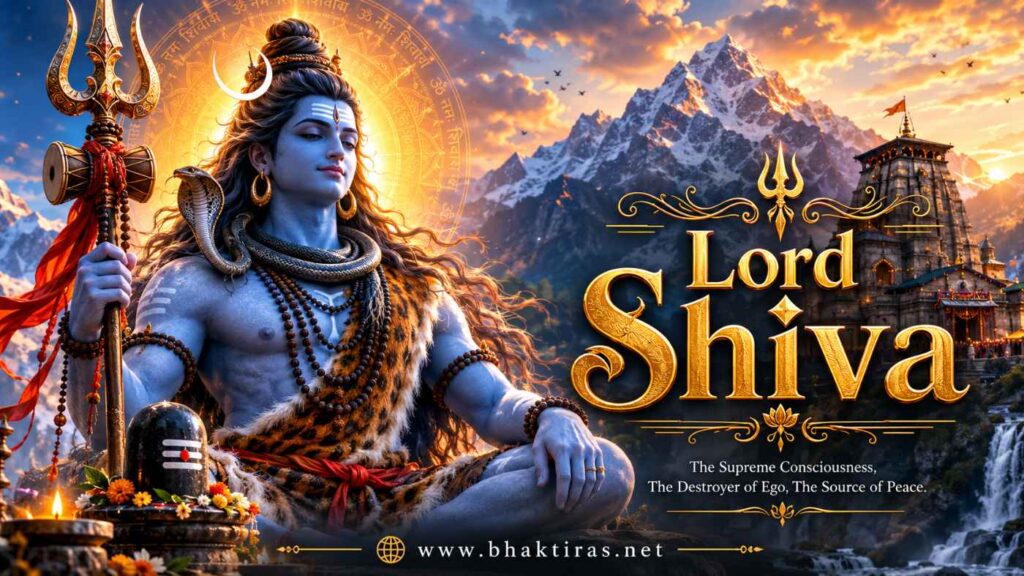
Who Is Lord Shiva?
Shiva’s name comes from the Sanskrit śiva – auspicious, kind, gracious. It is less a personal name than a description of what devotees experience: however fierce his stories become, he is easy to please and quick to forgive. That is why millions simply call him Bholenath, the innocent lord, and why a single bilva leaf offered with a full heart is said to satisfy him completely.
His earliest form appears in the Rigveda as Rudra, the howling storm god, feared and praised in the same breath. Over the centuries Rudra’s fire settled into Shiva’s stillness, and by the time of the Shvetashvatara Upanishad he is described as the one reality behind all gods. Today Shaivism – the tradition that worships Shiva as the Supreme – is one of the largest streams of Hinduism, alongside Vaishnavism and Shaktism.
Shiva holds two roles that look like opposites. He is the perfect ascetic, seated in meditation on Mount Kailash, body smeared with ash, needing nothing. He is also the perfect householder – husband of Parvati, father of Ganesha and Kartikeya. Hindu tradition never tried to resolve this tension; it celebrated it. The lesson is that renunciation and family life are both roads to the same summit.
Within the Trimurti, Brahma creates, Vishnu preserves, and Shiva dissolves. His “destruction” is not cruelty – it is the clearing away of the worn-out so something new can grow, the way a farmer burns stubble before sowing. Yogis honour him further as Adiyogi, the first yogi, who is said to have taught the inner science of yoga to the seven sages, the Saptarishis.
Iconography: What Every Symbol of Shiva Means
Almost nothing on Shiva’s form is decoration. Each element answers a question devotees have asked for thousands of years.
Third Eye (Trinetra)
The eye of inner sight, seeing what the two outer eyes cannot. When it opens outward it burns illusion to ash – Kamadeva, the god of desire, learned this the hard way.
Crescent Moon (Chandrashekhara)
The fifth-day moon resting on his matted hair marks his mastery over time and over the tides of the mind, which wax and wane like the moon itself.
Ganga in His Hair
When the river descended from heaven with world-breaking force, Shiva caught her in his locks and released her gently. Raw power, made safe for the earth.
Serpent Vasuki
The king of serpents coiled calmly at his throat shows fear itself resting quietly upon him – death worn as an ornament rather than dreaded.
Trishula (Trident)
Three points, one handle: creation, preservation and dissolution held in a single hand. The trident also signifies the three gunas – sattva, rajas and tamas.
Damaru (Drum)
The two-headed drum whose beat, tradition says, released the fourteen sounds from which Sanskrit grammar arose – the first rhythm of the universe.
Blue Throat (Neelkanth)
He drank the Halahala poison to save all creation and held it in his throat forever. Compassion, in Shiva’s iconography, means absorbing what others cannot bear.
Rudraksha Beads
“Rudra’s tears,” worn on his arms and chest. Devotees wear rudraksha malas for japa, keeping his name literally close to the skin.
Bhasma (Sacred Ash)
The ash on his body is the plainest sermon in Hinduism: everything ends as ash, so live free of vanity while you are here.
Tiger Skin
His seat is the hide of a tiger – the mind’s pride and desire – mastered and sat upon, not obeyed.
Family: Consort, Children and Nandi
Shiva’s first wife was Sati, daughter of Daksha. When her father insulted Shiva at a grand yajna, Sati gave up her body in protest – the event from which the Shakti Peethas spread across the subcontinent. Sati was reborn as Parvati, daughter of the mountain king Himavan, who won Shiva not through beauty but through tapasya so fierce that the gods themselves petitioned him to accept her.
Parvati is no background companion. She is Shakti – the energy without which, the scriptures say bluntly, Shiva is shava, a corpse. Their household on Kailash includes two sons: Ganesha, remover of obstacles, whom Parvati fashioned with her own hands, and Kartikeya (Murugan in the south), commander of the armies of the gods.
Nandi the bull is both Shiva’s mount and the chief of his ganas. Every Shiva temple seats Nandi directly facing the sanctum, gazing at his lord without blinking – devotees whisper their wishes into his ear so he may carry them inside.
The form of Ardhanarishvara – one body, half Shiva and half Parvati – says in a single image what a thousand verses attempt: the masculine and the feminine are not rivals but halves of one whole.
Forms and Manifestations of Shiva
The Shivalinga
Most Shiva sanctums hold no statue at all. The lingam, an aniconic pillar, points to that which has no beginning and no end – a deliberate refusal to trap the infinite in a shape. Twelve of these, the Jyotirlingas, are believed to be self-manifested columns of light.
Nataraja – Lord of the Dance
Ringed by fire, Shiva dances the tandava that keeps the cosmos in motion. His raised foot offers liberation; the dwarf beneath the other foot is ignorance being pressed down, not a victim but a lesson.
Dakshinamurthy – The Silent Teacher
A young Shiva sits beneath a banyan tree facing south, while aged sages sit before him as students. He teaches without a word, and their doubts dissolve – the tradition’s reminder that the deepest knowledge passes in silence.
Ardhanarishvara – Half Shiva, Half Parvati
The right half bears the trident and rudraksha, the left half wears bangles and silk. Creation requires both, joined at the heart.
Bhairava – The Fierce Guardian
In his wrathful aspect Shiva becomes Bhairava, keeper of boundaries and destroyer of ego. Kashi honours him as Kaal Bhairav, the city’s kotwal, whose permission pilgrims traditionally seek before worshipping Vishwanath.
How Lord Shiva Is Worshipped
Devotees say, with real affection, that Shiva is the easiest of all gods to please. He asks for no gold and no elaborate ritual – a handful of water, a bilva leaf and a sincere ॐ नमः शिवाय count as a complete offering.
- Sacred day: Monday (Somvar). Many devotees observe a Monday fast, especially the sixteen consecutive Solah Somvar vrats sought for a good spouse and family harmony.
- Abhishek: Bathing the lingam – with water, milk, curd, honey or sugarcane juice – is the heart of Shiva puja. Continuous pouring with a steady mind matters more than the substance used.
- Bilva leaves: Offered as trifoliate sprigs, said to cool Shiva’s poison-heated throat. Tulsi and ketaki flowers are traditionally not offered to him.
- Mantra japa: The five-syllable Om Namah Shivaya needs no initiation and no muhurat – it can be repeated by anyone, anywhere.
- Pradosh Vrat: The thirteenth lunar evening of each fortnight, when Shiva is said to dance in his happiest mood and grants prayers readily.
- Shravan month (July-August): The year’s most sacred stretch, when kanwariyas carry Ganga water on foot to bathe their local shivling and entire towns turn saffron.
Major Temples: The 12 Jyotirlingas and Beyond
Twelve shrines across India enshrine the Jyotirlingas, lingams of light where Shiva is believed to have revealed himself. Together they form Hinduism’s most travelled pilgrimage map:
- Somnath – Prabhas Patan, Gujarat
- Mallikarjuna – Srisailam, Andhra Pradesh
- Mahakaleshwar – Ujjain, Madhya Pradesh
- Omkareshwar – Mandhata Island, Madhya Pradesh
- Kedarnath – Rudraprayag, Uttarakhand
- Bhimashankar – Pune district, Maharashtra
- Kashi Vishwanath – Varanasi, Uttar Pradesh
- Trimbakeshwar – Nashik, Maharashtra
- Baidyanath – Deoghar, Jharkhand
- Nageshwar – near Dwarka, Gujarat
- Ramanathaswamy – Rameswaram, Tamil Nadu
- Grishneshwar – near Ellora, Maharashtra
Beyond the twelve: the ice-lingam of Amarnath in Kashmir, Lingaraja in Bhubaneswar, the Chola-built Brihadeeswarar in Thanjavur, the rock-cut Kailasa at Ellora, and Pashupatinath in Kathmandu – Nepal’s national shrine – each a chapter of Shaiva history in stone.
Festivals of Lord Shiva
Mahashivratri (February-March) is the great night of Shiva, observed with a day-long fast and worship through all four prahars of the night. Traditions remember it variously as the night Shiva married Parvati and the night of his cosmic dance; devotees stay awake, chanting through till dawn.
Shravan turns a whole month into a festival – every Monday of it (Shravan Somvar) draws long queues at Shiva temples, and the kanwar pilgrimage fills the highways of north India.
Pradosh Vrat arrives twice each lunar month, and in Varanasi, Dev Deepawali on Kartik Purnima lights every ghat with lamps in his honour.
Two Stories Every Devotee Knows
The Poison That Turned His Throat Blue
When the devas and asuras churned the ocean of milk for the nectar of immortality, the first thing to surface was Halahala – a poison potent enough to end all three worlds. Everyone fled. Shiva cupped it in his palms and drank. Parvati pressed his throat so the poison would go no lower, and it lodged there, staining it a deep blue. The nectar came later; the willingness to swallow the world’s poison came first. That is why he is Neelkanth, and why devotees trust him with their worst days.
How Ganga Came Down to Earth
King Bhagiratha performed penance for generations of his ancestors, and heaven finally agreed to send the Ganga down. But a river falling from the sky would have split the earth open. Shiva stood beneath the descent and took the entire force on his head, letting the river wander his matted locks until she emerged tamed, life-giving, ready to water a civilisation. Power without gentleness destroys – this story is the counter-argument.
Chalisa, Aarti and Mantras
The Shiv Chalisa – forty verses in praise of Mahadev – is the most recited Shiva prayer in north Indian homes; read it with verse-by-verse meanings on Bhaktiras. The evening aarti Jai Shiv Omkara follows in most households and temples, and you can browse more devotional hymns in our Aarti collection.
Mahamrityunjaya Mantra
From the Rigveda, chanted for healing, protection and freedom from fear:
ॐ त्र्यम्बकं यजामहे सुगन्धिं पुष्टिवर्धनम् ।
उर्वारुकमिव बन्धनान्मृत्योर्मुक्षीय मामृतात् ॥
Om tryambakam yajāmahe sugandhim pushti-vardhanam, urvārukam iva bandhanān mrityor mukshīya māmritāt – “We worship the three-eyed one, fragrant, who nourishes all. As the ripe cucumber slips from its stem, may we be freed from death, not from immortality.”
Frequently Asked Questions about Lord Shiva
Who is Lord Shiva in Hinduism?
Shiva is one of Hinduism’s three principal deities, the destroyer and transformer within the Trimurti alongside Brahma the creator and Vishnu the preserver. In the Shaiva tradition he is worshipped as the Supreme Being himself, most often in the aniconic form of the lingam.
Who is the wife of Lord Shiva?
Parvati, daughter of the mountain king Himavan, is Shiva’s consort and his Shakti – his creative energy. She is the rebirth of Sati, his first wife, and is also worshipped in her powerful forms as Durga and Kali.
What is Lord Shiva’s vahana?
Nandi, the sacred bull, is Shiva’s vahana and the chief of his attendants. A statue of Nandi faces the sanctum in nearly every Shiva temple, and devotees traditionally whisper their prayers into his ear.
What weapon does Lord Shiva carry?
His primary weapon is the trishula, a trident whose three points represent creation, preservation and dissolution. He also bears the Pinaka bow and the damaru, the two-headed drum whose beat is linked to the origin of Sanskrit sounds.
Which day of the week is dedicated to Lord Shiva?
Monday (Somvar) is Shiva’s day, when devotees fast and offer water or milk on the shivling. Pradosh – the thirteenth lunar evening of each fortnight – and every Monday of the Shravan month are considered especially powerful.
Why is Lord Shiva’s throat blue?
During the churning of the cosmic ocean, Shiva drank the Halahala poison to save creation. Parvati held his throat so it would spread no further, and the poison stayed there, turning it blue – hence his name Neelkanth, “the blue-throated one.”
What is the meaning of Om Namah Shivaya?
It means “I bow to Shiva.” The five syllables – Na, Ma, Shi, Va, Ya – are linked to the five elements, so the mantra is also a salute to all of existence. It requires no initiation and may be chanted by anyone at any time.
What should be offered to Lord Shiva?
Simple offerings please him most: fresh water, milk, bilva (bel) leaves in sets of three, white flowers, bhasma and dhatura. Tulsi leaves and ketaki flowers are traditionally excluded from Shiva worship.
How many Jyotirlingas are there in India?
There are twelve Jyotirlingas – shrines where Shiva is believed to have appeared as a column of light – including Somnath, Mahakaleshwar, Kashi Vishwanath, Kedarnath, Trimbakeshwar and Rameswaram, spread across nine Indian states.
Content reviewed for accuracy against the Shiva Purana, Shvetashvatara Upanishad and living temple traditions. Found something to improve? Tell us – Bhaktiras is built with devotees, for devotees.