ॐ
Trimbakeshwar Jyotirlinga Temple
Shri Tryambakeshwar · Nashik, Maharashtra
॥ ॐ नमः शिवाय ॥
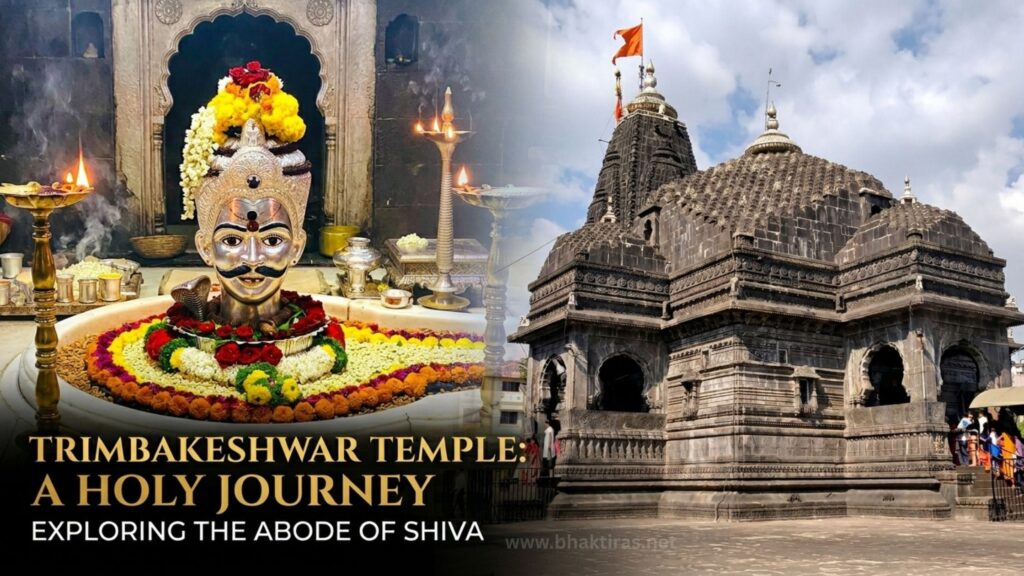
Trimbakeshwar is a Shiva temple in the town of Trimbak, about 28 km west of Nashik in Maharashtra. It is one of the twelve Jyotirlingas — the shrines where Shiva is worshipped as a pillar of light — and the only one whose lingam carries three faces, for Brahma, Vishnu and Shiva. The temple also stands at the source of the Godavari, the longest river of the Deccan, which is why most pilgrims pair their darshan with a dip at the nearby Kushavarta kund.
Why the lingam has three faces
Inside the sanctum the lingam is not a single stone. In a small hollow sit three thumb-sized faces — Tridev, the trinity of Brahma, Vishnu and Mahesh. Generations of water and abhishek have worn them smooth, so for most of the day they stay hidden under a jewelled silver crown, the Panchamukhi mukut. The crown is placed on the lingam during the evening worship, and the Monday crown darshan is the moment most visitors time their trip around.
A Peshwa-era temple on an ancient site
The black-stone temple seen today was commissioned by Nanasaheb Peshwa (Balaji Bajirao) around 1755 and took close to three decades to complete. It replaced a much older shrine on the same spot, linked in the Puranas to the sage Gautama, whose penance is said to have drawn the Godavari down from the Brahmagiri hill to wash away a grave sin. Locally, the river’s descent and the lingam are told as a single story.
Architecture
The temple is built entirely from local black basalt in the north-Indian Nagara style — a compact, heavily carved structure with a stepped shikhara crowned by a gold kalash, a pillared sabha-mandap, and walls worked with gods, dancers and floral bands. A stone wall rings the courtyard, and the Brahmagiri ridge rises directly behind it.
The rituals people travel here for
Beyond darshan, Trimbakeshwar is known across India for ancestral and remedial rites performed here and at very few other places:
- Narayan Nagbali — a three-day ritual undertaken for relief from pitru dosh (ancestral debt), persistent obstacles or childlessness.
- Kaal Sarp Shanti — a remedy for the Kaal Sarp yoga in a horoscope, often booked for Nag Panchami or amavasya.
- Tripindi Shraddha — performed for ancestors whose final rites were left incomplete.
These are conducted by authorised local priests within the precincts and at the Kushavarta kund. Most run for the better part of a day or longer, so they are booked in advance rather than walked into.
Festivals
Shravan, the monsoon month sacred to Shiva, is the busiest stretch of the year, when Monday crowds spill well past the temple gates. Maha Shivaratri brings night-long worship, and the Nivrittinath Yatra honours the saint Nivrittinath, whose samadhi lies close by. Every twelfth year the town hosts the Nashik–Trimbak Simhastha Kumbh Mela — the last was in 2015, and the next falls around 2027.
Darshan timings and dress code
The temple is generally open from about 5:30 am to 9:00 pm, with morning, midday and evening aartis. General darshan needs no special clothing, but antargruh (inner-sanctum) sparsh darshan and abhishek follow a strict rule: men perform it in a dhoti or sovala (unstitched traditional wear), not shirts and trousers. Entry is free; abhishek, special pujas and faster darshan are paid.
How to reach Trimbakeshwar
- By road: about 28–30 km from Nashik, with frequent buses and shared cabs from the city’s CBS stand.
- By train: the nearest railhead is Nashik Road (~40 km), on the Mumbai–Bhusawal line.
- By air: Nashik (Ozar) airport is ~50 km; Mumbai (~170 km) and Pune (~210 km) are the nearest major airports.
Tips for your visit
- Weekday mornings are calmest; avoid Mondays and all of Shravan if you dislike long queues.
- Planning a Narayan Nagbali or Kaal Sarp puja? Contact an authorised Trimbakeshwar priest ahead of time and keep a full day free.
- Carry a change of clothes if you intend to bathe at the Kushavarta kund.
- Combine the visit with the Brahmagiri climb (the Godavari’s source) or nearby Anjaneri hill, held to be Hanuman’s birthplace.
Frequently Asked Questions
What makes the Trimbakeshwar Jyotirlinga unique?
It is the only Jyotirlinga whose lingam has three faces, representing Brahma, Vishnu and Shiva, and it sits at the source of the Godavari river.
Is there a dress code for inner-sanctum darshan?
Yes. For antargruh (sparsh) darshan and abhishek, men must wear a dhoti or sovala — unstitched traditional attire — rather than shirts and trousers. General darshan has no such requirement.
Which special pujas is Trimbakeshwar known for?
Narayan Nagbali, Kaal Sarp Shanti and Tripindi Shraddha — rites for ancestral (pitru) dosh and Kaal Sarp yoga, performed by authorised local priests. They are booked in advance and can take a full day.
What are the darshan timings?
The temple is usually open from about 5:30 am to 9:00 pm, with aartis through the day. It is busiest on Mondays and throughout the month of Shravan.
How do I reach Trimbakeshwar from Nashik?
It is about 28–30 km from Nashik by road, with regular buses and cabs. The nearest railway station is Nashik Road (~40 km) and the nearest airport is Nashik/Ozar (~50 km).
When is the next Kumbh Mela at Trimbakeshwar?
The Nashik–Trimbak Simhastha Kumbh Mela is held once every twelve years. The last was in 2015, and the next is expected around 2027.
॥ हर हर महादेव ॥ • Bhaktiras.net Temple Guide
| Temple Name | Trimbakeshwar Shiva Temple |
| Primary Deity | Lord Shiva (Tryambakeshwar) |
| Location | Trimbak, Nashik dist. |
| State | Maharashtra, India |
| Significance | One of the 12 Jyotirlingas |
| Architecture | Nagara, black basalt |
| Built | c. 1755 CE (Nanasaheb Peshwa) |
| Key Festival | Shravan Mondays, Maha Shivaratri |
| River Nearby | Godavari (origin) · Kushavarta Kund |
| Special Feature | Three-faced (Tridev) lingam |
| Darshan | 5:30 AM – 9:00 PM |
| Nearest Railhead | Nashik Road (~40 km) |
| Coordinates | 19.9325° N, 73.5293° E |
| Entry | Free (special pujas paid) |
Related Temples
Explore more sacred temples connected by deity and region.