ॐ
Kailasa Temple, Ellora
Shiva • Ellora, Maharashtra
॥ ॐ नमः शिवाय ॥
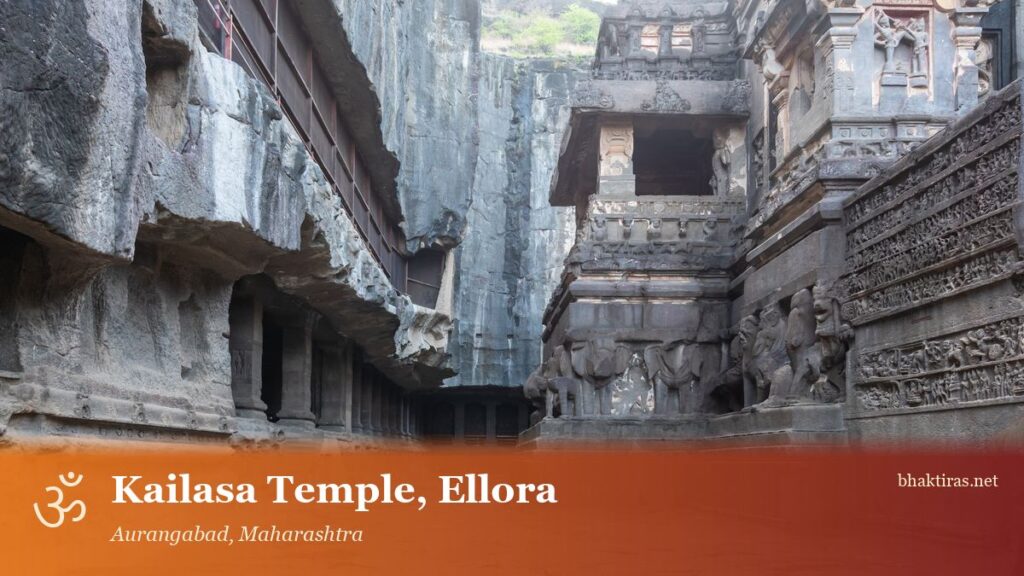
Cave 16 at Ellora, the Kailasa temple, was carved downward from a single basalt cliff into a full multi-storey temple — the largest monolithic rock-cut structure in the world. Conceived in the 8th century as Shiva’s mountain home, it stands today as a complete temple complex that was sculpted rather than built.
Carved from a single cliff
Unlike a normal temple raised stone upon stone, Kailasa was excavated from the living rock of a basalt hillside. The sculptors began at the top and worked downward, cutting away the cliff to leave the temple standing free within a great open courtyard.
Because there was no second chance — rock once removed cannot be replaced — the whole design had to be held in mind from the first cut. The scale of stone shifted to release the temple makes it the largest monolithic rock excavation known.
Shiva’s Mount Kailash on earth
The temple was conceived as Kailash, the Himalayan peak that is Shiva’s abode, brought into form in the Deccan. Every element serves that idea, from the towering vimana standing for the mountain to the courtyard that frames it like a sacred enclosure.
Within the complex are a gateway, a Nandi pavilion facing the sanctum, pillared halls and shrines, all hewn from the same continuous rock. Carved elephants and lions appear to carry the platform, as though the mountain rests on the strength of beasts.
The work of the Rashtrakutas
The temple was created in the 8th century under the Rashtrakuta king Krishna I, whose court commanded the resources and craftsmen for so vast an undertaking. The achievement reflects a kingdom at the height of its confidence and devotion.
Estimates of the stone removed run into hundreds of thousands of tonnes, and the precision of the result — sharp mouldings, deep relief and balanced proportion — shows that this was disciplined design rather than rough quarrying. It remains a benchmark of what rock-cut architecture could reach.
Sculpture across the walls
The temple is covered in relief sculpture drawn from the epics and Puranas. Scenes of Shiva and Parvati, processions and battles wrap the lower walls, turning the stone into a gallery of narrative.
Among the most admired is the panel showing the demon king Ravana trapped beneath Kailash, straining to shake the mountain while Shiva calmly presses it down with his toe. Kailasa is part of the Ellora Caves, a UNESCO World Heritage Site that also holds Buddhist and Jain excavations nearby.
Frequently Asked Questions
What is the Kailasa Temple at Ellora?
The Kailasa Temple is Cave 16 at Ellora, the largest monolithic rock-cut structure in the world. It was carved top-down from a single basalt cliff in the 8th century as a temple dedicated to Shiva.
How was the Kailasa Temple built?
It was not built up from blocks but carved downward from a single basalt cliff. Sculptors removed the surrounding rock to leave a complete temple — with gateway, Nandi pavilion, tower and courtyards — standing free within the hillside.
Who built the Kailasa Temple at Ellora?
The temple was created in the 8th century under the Rashtrakuta king Krishna I. His court provided the resources and craftsmen for one of the most ambitious rock-cut projects ever attempted.
Why is the Kailasa Temple named after Kailash?
It was conceived as Mount Kailash, the Himalayan home of Shiva, given form in stone. The towering vimana and surrounding courtyard represent the sacred mountain and its setting.
What is the famous Ravana sculpture at Kailasa?
It is a relief panel showing the demon king Ravana trapped beneath Mount Kailash, trying to shake it loose. Shiva calmly steadies the mountain with his toe, and the scene is among the most admired carvings at Ellora.
Is the Kailasa Temple a UNESCO site?
Yes. Kailasa is part of the Ellora Caves, which are a UNESCO World Heritage Site. The wider site also includes Buddhist and Jain rock-cut excavations near the Hindu temple.
॥ हर हर महादेव ॥ • Bhaktiras.net Temple Guide
| Identity | Cave 16, Ellora |
| Significance | Largest monolithic rock-cut structure in the world |
| Deity | Shiva |
| Built | 8th century CE |
| Patron | Rashtrakuta king Krishna I |
| Method | Carved top-down from a single basalt cliff |
| Theme | Shiva’s Mount Kailash |
| UNESCO status | Part of the Ellora Caves |
| Location | Ellora, Maharashtra |
Related Temples
Explore more sacred temples connected by deity and region.