
Goddess Lakshmi
लक्ष्मी
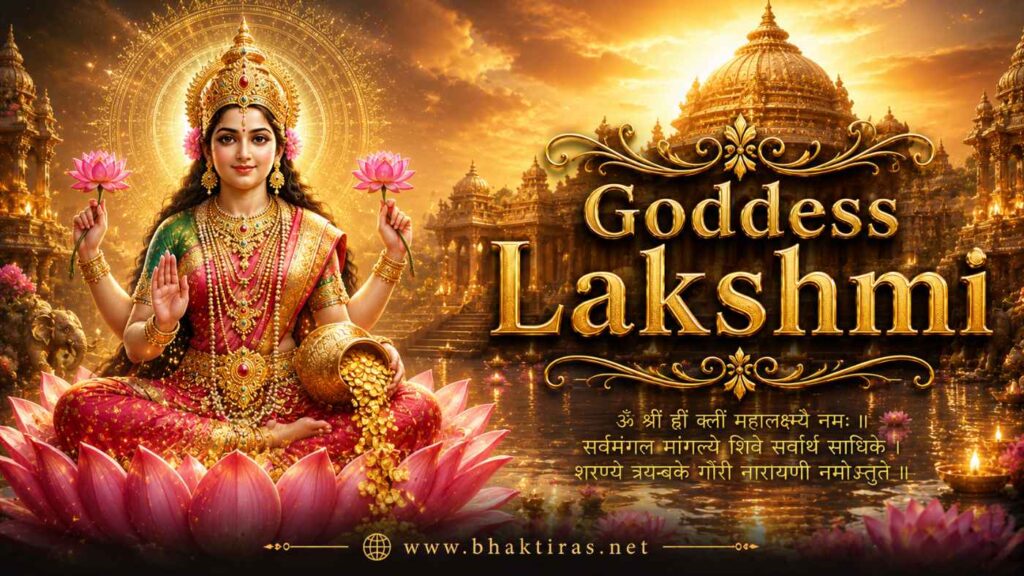
Goddess Lakshmi is the Hindu goddess of wealth, fortune, prosperity, beauty and abundance, and the divine consort of Vishnu. Seated on a lotus with gold coins flowing from her palm, she is honoured most brightly at Diwali, when families clean and light their homes to welcome her in.
Who Is Goddess Lakshmi
Lakshmi is the Hindu goddess of wealth, fortune, prosperity and beauty, and one of the three great goddesses of the Tridevi alongside Parvati and Saraswati. Her name comes from the Sanskrit lakshya, meaning a goal or that which one strives toward, and she embodies every kind of richness a life can hold, from gold and grain to good health, wisdom and a home full of warmth.
She is almost always seen beside Vishnu, the preserver of the cosmos. Where Vishnu sustains and protects, Lakshmi supplies the energy, plenty and grace that make preservation possible. In many households she is addressed simply as Sri, an ancient word for auspiciousness and glory, and the syllable is placed before names and letters to invoke her blessing.
Lakshmi is a mother figure as much as a giver of riches. Devotees ask her not only for money but for contentment, fertility, family well-being and the quiet steadiness that keeps fortune from slipping away. Her presence is felt in a clean, orderly, welcoming house, which is why so much of her worship centres on tidying, decorating and lighting the home before she is invited in.
She is also called Chanchala, the restless one, because worldly fortune is fickle and rarely sits still. This gentle warning runs through her worship: wealth is a blessing to be used well and shared, never hoarded, or the goddess may quietly move on.
Iconography & Symbols
Few Hindu images are as instantly recognised as Lakshmi on her lotus. Each element of her form carries a meaning about how prosperity should be earned, held and given away.
The lotus seat and lotus in hand
Lakshmi sits or stands on a fully open pink lotus and holds lotuses in her upper hands. The flower grows out of muddy water yet stays clean and beautiful, a reminder that true wealth rises above its surroundings and remains untainted by greed.
Cascading gold coins
From one lower palm, turned downward, a steady stream of gold coins falls. It shows abundance that flows outward and keeps moving. Fortune is meant to circulate through generosity, not be locked away.
Elephants (Gaja Lakshmi)
In the beloved Gaja Lakshmi form, two elephants stand on either side and pour water over her from raised trunks. Elephants signify royal power, rain, fertility and the material plenty that a well-watered land provides.
The owl (Uluka)
Her mount is the owl, a bird that sees in darkness. It teaches the seeker to look past the dazzle of riches and stay clear-eyed, and it warns against the blindness that unchecked wealth can bring.
The red and gold sari
Lakshmi is dressed in a deep red sari edged with gold. Red stands for activity and life energy, gold for the prosperity she bestows. Together they mark her as a queen of vitality and plenty.
Four hands and mudras
Her four arms represent the four aims of human life, righteousness, wealth, desire and liberation. Her free hands show the abhaya mudra of fearlessness and the varada mudra of giving, promising both protection and blessing.
The Ashta Lakshmi – Eight Forms of Abundance
Lakshmi is not wealth of one kind alone. She unfolds into eight aspects known as the Ashta Lakshmi, each governing a different form of plenty that a full life needs. Together they show that prosperity is far wider than money.
- Adi Lakshmi – the primeval goddess, the original source from whom all the other forms flow.
- Dhana Lakshmi – the giver of monetary wealth, gold and financial security.
- Dhanya Lakshmi – the goddess of grain and food, the prosperity of a well-fed household.
- Gaja Lakshmi – the goddess of animals, land, power and royal dignity, flanked by elephants.
- Santana Lakshmi – the bestower of children, family and continuity.
- Veera (Dhairya) Lakshmi – the goddess of courage, valour and inner strength.
- Vijaya Lakshmi – the giver of victory and success in every worthy effort.
- Vidya Lakshmi – the wealth of knowledge, learning and the arts.
Temples such as the Ashtalakshmi shrine in Chennai are built specifically to honour all eight forms together, so a devotee can seek every dimension of abundance in a single visit.
Consort & Origin
Lakshmi’s story is bound to two great themes: her eternal partnership with Vishnu and her dramatic emergence from the churning of the cosmic ocean.
As Vishnu’s consort she takes a matching form in each of his descents. When he comes as Rama she is Sita, when he comes as Krishna she is Rukmini, and at his abode in Vaikuntha she is Mahalakshmi at his side. Their union is often described as inseparable, the preserver and the prosperity that makes preservation meaningful.
Her most famous origin is the Samudra Manthan, the churning of the milk ocean. When the gods and demons together stirred the sea to release its hidden treasures, Lakshmi rose from the waters seated upon a lotus, radiant and fully grown, holding a garland. Of all the beings and objects that appeared, she chose Vishnu, and by that choice the balance of the cosmos was restored. This is why she is honoured as the fruit of great collective effort, arriving only when patience and cooperation have done their work.
How Goddess Lakshmi Is Worshipped
Lakshmi is worshipped through actions that prepare a space worthy of her, as much as through prayer. The idea running through every practice is that she comes to homes that are clean, bright, orderly and generous.
- Cleaning the home – houses are swept and scrubbed before her festivals, since she will not settle where there is clutter or neglect.
- Drawing rangoli – coloured floor patterns and lotus designs are laid at the entrance to greet her and mark a welcoming threshold.
- Lighting lamps – rows of oil diyas are lit at doorways and windows to guide the goddess in and drive away darkness.
- Keeping the Friday vrat – many devotees observe a fast on Fridays, her sacred day, offering white or red flowers and kheer.
- Reciting the Sri Suktam – this Vedic hymn to Lakshmi is chanted during puja, often with offerings of lotus flowers, coins and sweets.
Businesses and traders hold special reverence for her, opening new account books on Lakshmi Puja and keeping her image near the place where money is handled. Her close association with Kubera, the treasurer of the gods, means the two are often worshipped side by side, Lakshmi as the source of fortune and Kubera as its keeper.
Diwali & Lakshmi Puja
The brightest night of Lakshmi’s year is the Diwali Amavasya, the new-moon evening at the heart of the festival of lights. On this night families believe the goddess walks from house to house, entering only where she finds a home lit, cleaned and lovingly prepared.
Preparations begin days ahead. Homes are washed and repainted, doorways are strung with lamps and marigolds, and fresh rangoli is drawn at every entrance. At dusk the family gathers for Lakshmi Puja, placing her image beside Ganesha, who is invoked first as the remover of obstacles. Coins, kheer, sweets and lotus flowers are offered, the Sri Suktam and Lakshmi aarti are sung, and doors are left open so she may enter freely.
In the eastern regions the same devotion takes the form of Kojagari Lakshmi Puja on the full-moon night of Ashwin, when people stay awake through the night, since Lakshmi is said to ask Ko jagarti, who is awake, and to bless those she finds keeping vigil. In the south, the Varamahalakshmi Vrat falls on a Friday in the month of Shravana, when married women worship her for the welfare and long life of their families.
Temples & Sacred Sites
Lakshmi is worshipped across every corner of the country, both in her own dedicated shrines and beside Vishnu in his great temples. A few sites are especially loved by her devotees.
- Mahalakshmi Temple, Kolhapur (Maharashtra) – one of the most revered Shakti sites, where the goddess Ambabai is worshipped as Mahalakshmi and a famous ray of the setting sun touches her image on certain days of the year.
- Sri Padmavati Temple, Tiruchanur (Andhra Pradesh) – dedicated to Padmavati, a form of Lakshmi and consort of the lord of Tirumala, and traditionally visited before the hill shrine of Venkateswara.
- Ashtalakshmi Temple, Chennai (Tamil Nadu) – a seaside temple built so that all eight forms of the Ashta Lakshmi are enshrined together across its tiers.
A Story Every Devotee Knows
Two tales are told wherever Lakshmi is loved, and both explain why she is welcomed with such care.
Rising from the churning ocean
In the age when gods and demons had grown weak, they were told that the milk ocean held the nectar of immortality, and that only by churning it together could they win it back. Using the mountain Mandara as a churning rod and the serpent Vasuki as the rope, the two sides pulled for ages. Many wonders came forth, and then, seated on a lotus and glowing like the dawn, Lakshmi herself rose from the waters. She looked upon all who stood there and placed her garland around Vishnu’s neck, choosing him and restoring fortune to the worlds. Devotees remember that she appeared only after long, patient, shared effort, and that she gives herself to those who work with steadiness rather than greed.
The goddess who leaves and returns
It is often said that Lakshmi does not stay where she is treated carelessly. In many household tales she departs from homes filled with quarrels, dirt, waste or arrogance, and lingers where there is cleanliness, kindness and gratitude. This is why she is called Chanchala, the restless one. Far from being a warning against wealth, the story teaches that fortune must be honoured through good conduct. Keep the home bright and harmonious, use what you have generously, and the goddess is content to remain.
Prayers & Mantras
The simplest and most widely chanted prayer to the goddess is her seed mantra, repeated on Fridays, during Lakshmi Puja and whenever a devotee seeks her grace. The syllable Shreem is her bija or seed sound, carrying the whole energy of prosperity.
For a fuller worship, devotees turn to the Sri Suktam, an ancient Vedic hymn that praises Lakshmi as golden, lotus-dwelling and ever-giving, and asks her to grant food, cattle, gold and lasting well-being. Reciting it during puja, especially with offerings of lotus flowers, is considered one of the most complete ways to invite her blessing.
Frequently Asked Questions about Goddess Lakshmi
Who is Goddess Lakshmi?
Lakshmi is the Hindu goddess of wealth, fortune, prosperity and beauty, and one of the Tridevi. As the consort of Vishnu she embodies abundance in every form – material, spiritual and inner grace. Seated on a lotus with gold coins flowing from her hand, she is invited into clean, harmonious homes and grateful hearts.
Why is Lakshmi worshipped on Diwali?
Diwali falls on the dark Kartik new-moon night, and tradition says Lakshmi walks the earth then, entering homes that are clean, lit and welcoming. Families sweep and decorate, draw rangoli, light rows of lamps and perform Lakshmi Puja at night to invite her blessings of wealth and wellbeing for the year ahead.
Who are the Ashta Lakshmi?
The Ashta Lakshmi are her eight forms, each governing a kind of abundance: Adi (primeval), Dhana (money), Dhanya (grain), Gaja (power), Santana (progeny), Veera or Dhairya (courage), Vijaya (victory) and Vidya (knowledge). Together they teach that true prosperity is far wider than wealth alone.
What is the Lakshmi mantra?
The core mantra is 'Om Shreem Mahalakshmyai Namah', where 'Shreem' is her seed sound of abundance. The Sri Suktam, a Vedic hymn, is also chanted during her worship. Devotees repeat the mantra 108 times on Fridays and at Diwali, ideally facing a clean altar with a lit lamp and lotus.
What offerings please Goddess Lakshmi?
Lakshmi loves lotus and red flowers, kheer and sweets, coins, turmeric, kumkum and lamps of pure ghee. Cleanliness itself is an offering, since she avoids clutter and neglect. Many keep her image beside Ganesha, offer her freshly cooked food first, and place a small silver coin in the puja to invite steady fortune.
Why is she shown with lotuses and elephants?
The lotus that seats and surrounds her stands for purity and beauty that rise unstained from muddy water – wealth held without greed. In the Gaja Lakshmi form, two elephants pour water over her from raised trunks, a symbol of royal abundance, fertility and the rains that bring the harvest.
Which day of the week is dedicated to Lakshmi?
Friday, or Shukravar, is Lakshmi's day. Devotees clean the home, light a lamp, wear fresh clothes and perform Lakshmi Puja or a Friday vrat for prosperity and family welfare. Fridays in the month of Kartik, and the Kojagari and Varamahalakshmi observances, are considered especially powerful for her worship.
May Goddess Lakshmi light your home, steady your fortune and fill every day with grace, plenty and peace.