
Lord Vishnu
विष्णु
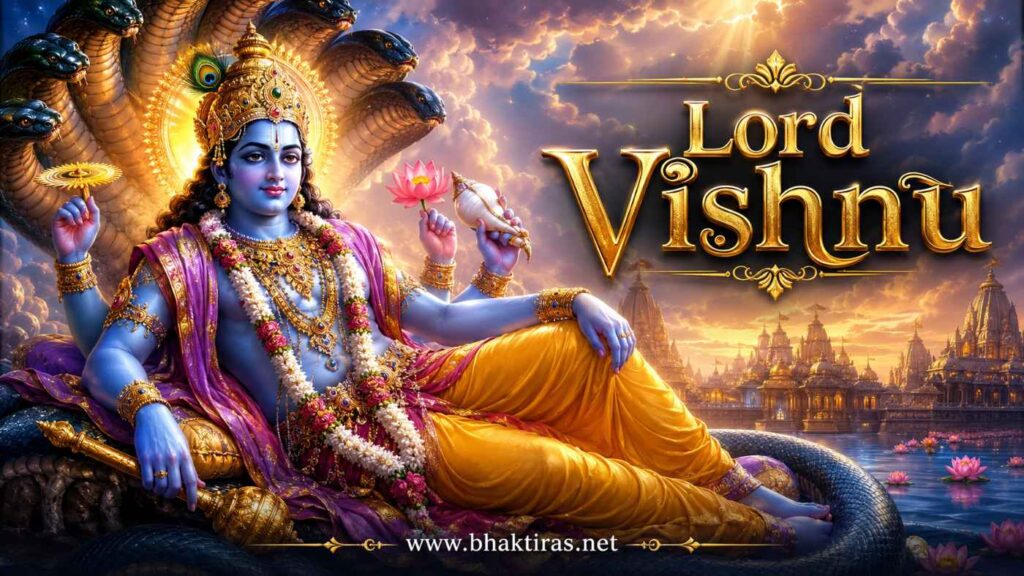
Lord Vishnu is the Preserver in the Hindu Trimurti, the deity who sustains creation and protects cosmic order (dharma). He rests on the serpent Ananta-Shesha upon the ocean of milk, holds a discus, conch, mace and lotus in his four arms, and descends across ages as ten avatars, including Rama and Krishna, whenever the world needs saving.
Who Is Lord Vishnu?
Lord Vishnu is one of the three great deities of the Hindu Trimurti. Where Brahma creates and Shiva dissolves, Vishnu preserves – holding the universe together, guarding the balance between good and evil, and keeping dharma, the moral order, from collapsing. His name is often read as विष्णु, “the all-pervading one,” the presence that fills every corner of existence.
Devotees picture him resting on the coils of the serpent Ananta-Shesha, floating on the cosmic ocean of milk (Kshira Sagara), while a lotus rises from his navel bearing Brahma the creator. This image carries a quiet message: even in the interval between world-cycles, when everything else has dissolved, Vishnu remains, calm and watchful, ready for the next unfolding of creation.
What sets Vishnu apart in devotional life is his willingness to come down. Whenever dharma weakens and injustice grows unbearable, he takes a bodily form and walks among beings. The Bhagavad Gita puts this promise in Krishna’s own words – that he manifests age after age to protect the good and restore righteousness. These descents are the celebrated Dashavatara, the ten avatars.
The tradition that centres worship on Vishnu and his forms is called Vaishnavism, one of the largest streams of Hindu practice. For a Vaishnava, Vishnu is not merely one god among many but the supreme reality itself, approachable through love, service and the constant repetition of his names – Hari, Narayana, Vasudeva.
Iconography and Symbols
Vishnu is usually shown with skin the deep blue of a rain-cloud or the ocean, dressed in golden-yellow silk, and crowned like a king. Each object in his four hands, and each companion at his side, carries meaning worked out over centuries of devotional thought.
The Four Arms
Vishnu’s four arms signal his reach across every direction and dimension. They let him hold his four emblems at once – the tools of a sovereign who governs, protects and blesses the whole of creation without effort.
Sudarshana Chakra
The spinning discus on his finger is the weapon of cosmic order. It destroys ignorance and evil, and represents the wheel of time turning ceaselessly – sharp, luminous and always returning to his hand.
Panchajanya Shankha
The conch shell produces the primal sound of creation, close to the sacred syllable Om. Its spiral echoes the way the universe expands from a single point, and its call announces the presence of the divine.
Kaumodaki Gada
The heavy mace stands for the power of knowledge and the strength that subdues arrogance. It is authority made visible – the firm hand that keeps order when persuasion is not enough.
Padma – the Lotus
The lotus, blooming clean above muddy water, is purity, spiritual awakening and the unfolding of the world. It links Vishnu to abundance and to his consort Lakshmi, herself the lotus goddess.
Garuda
His mount is Garuda, the mighty eagle-man who carries him across the skies at the speed of thought. Garuda embodies courage, devotion and the soul’s swift flight toward the divine.
Ananta-Shesha
The thousand-headed serpent forms Vishnu’s couch and canopy. Coiled on the ocean of milk, Shesha represents endless time and the residue that survives every dissolution, cradling the Preserver as he rests.
Kaustubha and Srivatsa
On his chest gleams the Kaustubha gem, the most radiant of jewels, and the Srivatsa mark, a curl of hair said to hold the goddess Lakshmi. Together they show that fortune itself lives close to his heart.
The Dashavatara – Ten Avatars
The Dashavatara are Vishnu’s ten principal descents into the world, each arriving at a moment of crisis to rescue creation and re-set the moral balance. Read in order, they trace a striking arc – from fish to fully human – that many see as a spiritual map of growth from the elemental to the enlightened.
- Matsya – the fish who warns Manu of a great flood and tows his boat to safety, preserving the seeds of life and the Vedas.
- Kurma – the tortoise who bears Mount Mandara on his back so the gods and demons can churn the ocean of milk (Samudra Manthan).
- Varaha – the boar who dives into the cosmic waters and lifts the drowning earth on his tusks back into place.
- Narasimha – the man-lion who bursts from a pillar to destroy the tyrant Hiranyakashipu and save his devoted child Prahlada.
- Vamana – the dwarf-brahmin who, granted three paces of land, grows vast and reclaims the three worlds from the demon-king Bali.
- Parashurama – the axe-wielding sage who curbs the arrogance of oppressive warrior-kings and restores balance.
- Rama – the ideal prince of Ayodhya, hero of the Ramayana, who upholds truth and duty and defeats the demon-king Ravana.
- Krishna – the cowherd, statesman and teacher whose life and words in the Bhagavad Gita shape much of Hindu devotion.
- Buddha – included in most listings as the compassionate teacher who turns the mind toward non-violence and inner truth.
- Kalki – the avatar yet to come, foretold to appear on a white horse at the end of this dark age to end injustice and renew the world.
Consort and Divine Family
Vishnu’s family life is woven into the cosmos itself. His eternal consort is Lakshmi, the goddess of wealth, beauty and good fortune, who was reborn from the churning ocean and chose Vishnu as her lord. Where Vishnu preserves, Lakshmi provides – the two are inseparable, and in many hymns they are addressed together as a single grace.
From the lotus that rises out of Vishnu’s navel emerges Brahma, the creator, seated on the bloom and setting the next world in motion. This पद्मनाभ (Padmanabha, “lotus-navelled”) image gives Vishnu one of his best-loved names and places him at the very source of creation. Through his avatars he also takes on earthly families – Sita beside Rama, Rukmini and Radha in the world of Krishna – each relationship becoming a doorway for devotion.
How Lord Vishnu Is Worshipped
Worship of Vishnu blends simple daily acts with deep contemplative practice. Thursday is his special weekday, and the eleventh lunar day of each fortnight, Ekadashi, is set aside for fasting and remembrance. Here are the practices most central to his devotees:
- Ekadashi fasting – observing a fast twice a month, often without grains, spent in prayer, reading and chanting to purify body and mind.
- Offering tulsi – the sacred basil leaf is dear to Vishnu; garlands and single leaves of tulsi are placed at his feet, along with yellow flowers and panchamrita.
- Vishnu Sahasranama – reciting the thousand names of Vishnu, a beloved hymn from the Mahabharata believed to bring peace and protection.
- Chanting the names – the repetition of Hari, Narayana and the Vishnu mantras, whether whispered on beads or sung in kirtan.
- Reading the scriptures – study of the Bhagavata Purana, Vishnu Purana and Bhagavad Gita, retelling his avatars and teachings.
Major Temples of Lord Vishnu
Some of the most visited and revered shrines in India are dedicated to Vishnu and his forms. Pilgrims travel across the country to stand before these deities, each with its own living tradition:
- Tirupati Balaji (Andhra Pradesh) – the hill shrine of Venkateshwara, a form of Vishnu, among the most-visited and richly endowed temples in the world.
- Jagannath Puri (Odisha) – home of Lord Jagannath, a distinctive wooden form of Vishnu-Krishna, famous for its grand annual Rath Yatra chariot festival.
- Badrinath (Uttarakhand) – a Himalayan shrine to Vishnu as Badri-Narayan, one of the four Char Dham pilgrimage sites.
- Srirangam Ranganathaswamy (Tamil Nadu) – a vast island temple where Vishnu reclines as Ranganatha on the serpent Shesha, foremost of the 108 Divya Desams.
- Guruvayur (Kerala) – the beloved abode of Guruvayurappan, a youthful form of Krishna, drawing steady streams of devotees.
Festivals of Lord Vishnu
Vishnu is celebrated both directly and through the festivals of his avatars, filling the Hindu calendar with days of fasting, song and joyful ritual:
- Vaikuntha Ekadashi – the most sacred Ekadashi of the year, when temple gates to the “heaven’s doorway” are opened and devotees fast through the day for liberation.
- Rama Navami – the birth of Rama, the seventh avatar, marked with readings of the Ramayana, processions and temple celebrations.
- Krishna Janmashtami – the midnight birth of Krishna, the eighth avatar, kept with fasting, cradle rituals and lively night-long devotion.
- Narasimha Jayanti – honouring the man-lion avatar who saved the child devotee Prahlada from his tyrant father.
- Rath Yatra – the chariot festival of Jagannath at Puri, when the deities ride out among the crowds on towering wooden chariots.
A Story Every Devotee Knows
Gajendra Moksha – the elephant's cry
An elephant-king named Gajendra was bathing in a lake when a crocodile seized his leg and would not let go. For years the two struggled, and slowly Gajendra’s strength drained away. At the edge of death, the elephant lifted a lotus in his trunk and called out to Vishnu with complete surrender, expecting nothing in return. Vishnu came at once, riding Garuda, and freed him with the Sudarshana Chakra. The tale is loved because Gajendra is saved not by his own power but by the simple, wholehearted cry of a soul that has given up all other hope – the exact devotion Vishnu answers.
Samudra Manthan – the churning of the ocean
The gods and demons once churned the ocean of milk together to win the nectar of immortality, using a mountain as the churning rod and the serpent Vasuki as the rope. The mountain began to sink, so Vishnu became the tortoise Kurma and slid beneath it, steadying the whole effort on his back. From the churning rose Lakshmi, who chose Vishnu, and finally the nectar itself, which Vishnu carefully secured for the gods. The story shows him as the quiet support beneath great endeavours – the one who bears the weight so that good can prevail.
Prayers, Sahasranama and Mantras
The names of Vishnu are considered a direct path to him. The Vishnu Sahasranama, his thousand names, is chanted for peace and protection, while short mantras carry the same power in a single breath. The simplest and most cherished is the mool mantra, spoken below. Devotees repeat it softly on tulsi beads, letting the sound settle the mind and turn the heart toward Narayana.
Whether sung in a crowded temple hall or whispered alone at dawn, these prayers rest on one idea – that calling his name with love is never wasted, and that the Preserver hears even the faintest voice.
Frequently Asked Questions about Lord Vishnu
Who is Lord Vishnu in Hinduism?
Lord Vishnu is the Preserver in the Hindu Trimurti, the deity who sustains the universe and protects dharma, the cosmic order. He rests on the serpent Ananta-Shesha, holds a discus, conch, mace and lotus, and descends as ten avatars, including Rama and Krishna, whenever the world needs saving.
What are the ten avatars of Vishnu?
The Dashavatara are Matsya (fish), Kurma (tortoise), Varaha (boar), Narasimha (man-lion), Vamana (dwarf), Parashurama, Rama, Krishna, Buddha and Kalki, who is yet to come. Each descends at a moment of crisis to restore righteousness, tracing an arc from elemental forms to fully human ones.
What does Lord Vishnu hold in his four hands?
Vishnu holds four emblems: the Sudarshana Chakra (discus of cosmic order), the Panchajanya Shankha (conch of primal sound), the Kaumodaki gada (mace of strength) and the Padma (lotus of purity and creation). His four arms show his reach across all directions and dimensions.
Who is the consort of Lord Vishnu?
Vishnu's eternal consort is Lakshmi, the goddess of wealth, beauty and good fortune. She arose from the churning of the ocean of milk and chose Vishnu as her lord. The two are worshipped together, since Vishnu preserves the world while Lakshmi grants its abundance and grace.
What is Vaikuntha?
Vaikuntha is the eternal, sorrowless abode of Vishnu, described as a realm of pure light and peace beyond the cycles of birth and death. Devotees pray to reach it after life, and Vaikuntha Ekadashi is the sacred day believed to open its gates to sincere souls.
Why is Ekadashi important to Vishnu devotees?
Ekadashi, the eleventh lunar day of each fortnight, is dedicated to Vishnu. Devotees fast, often without grains, and spend the day in prayer, reading and chanting. The practice is believed to purify the body and mind and to bring the worshipper closer to Vishnu and to liberation.
What is the mool mantra of Vishnu?
The mool mantra is Om Namo Narayanaya (ॐ नमो नारायणाय), meaning "I bow to Narayana." It is one of the most cherished Vishnu mantras, repeated on tulsi beads to calm the mind and turn the heart toward the Preserver. Longer prayers include the thousand-name Vishnu Sahasranama.
What is the difference between Vishnu, Rama and Krishna?
Rama and Krishna are avatars, or earthly descents, of Vishnu. Vishnu is the supreme preserving deity, while Rama (the seventh avatar) and Krishna (the eighth) are the forms he took on earth to restore dharma. Worshipping them is understood as worshipping Vishnu himself in a specific, approachable form.
What offerings please Lord Vishnu?
Vishnu is especially pleased by tulsi (sacred basil) leaves, which are considered dear to him, along with yellow flowers, panchamrita (a sweet mixture of milk, curd, ghee, honey and sugar) and simple sweets. Chanting his names and observing Ekadashi are valued as much as any physical offering.
May Lord Vishnu keep you steady through every season of life, and may the name of Narayana bring calm to your heart. Om Namo Narayanaya.