
The Saptarishi
सप्तर्षि
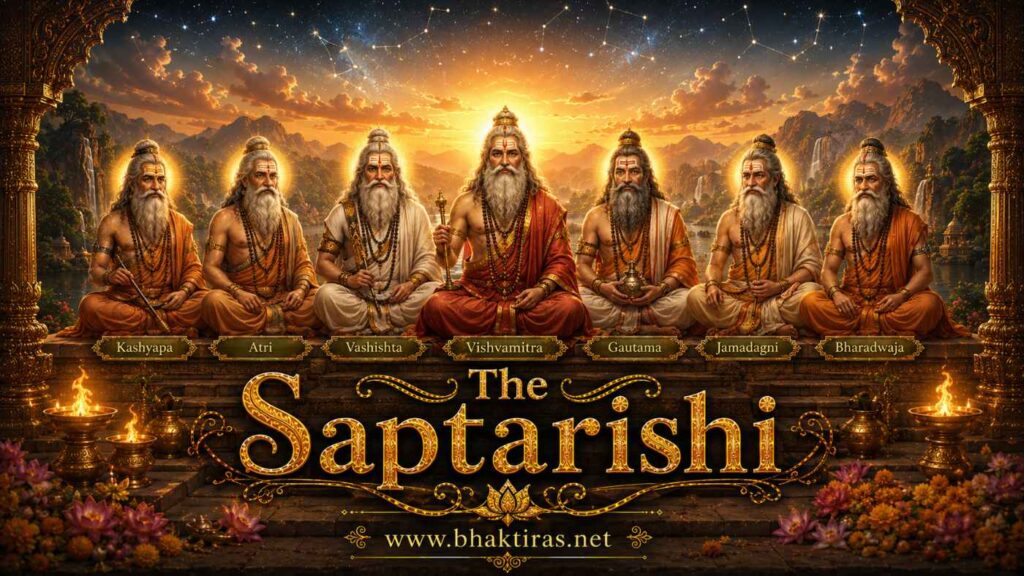
The Saptarishi are the seven supreme sages of Hindu tradition, the mind-born sons of Brahma who first received and transmitted the Vedas. Guardians of dharma and sacred knowledge, they are identified with the seven bright stars of Ursa Major, the Great Bear, and each cosmic age has its own set of seven who carry wisdom forward.
Who Are the Saptarishi?
The word Saptarishi joins two ideas that sit at the heart of the Hindu worldview: sapta, seven, and rishi, a seer who does not merely think about the truth but perceives it directly. Together they name the seven greatest sages of all – the first minds to hear the eternal sound of the Vedas and to hold that knowledge in trust for every generation that followed.
These are not ordinary teachers. Hindu texts describe them as manasa-putras, the mind-born sons of Brahma the creator. When Brahma turned his thought inward at the dawn of creation, seven perfected beings arose from that thought, already whole in wisdom. They needed no schooling, for they were the source from which schooling would flow. From them came the hymns, the rituals, the sciences, and the moral order by which people learn to live rightly.
To speak of the Saptarishi is to speak of the very idea of transmitted knowledge. Before there were books there were these seven voices, carrying truth from age to age by memory, discipline, and the spoken word. They are at once historical figures woven through countless legends and living symbols of the human capacity to know the sacred.
Their presence reaches beyond scripture into the night sky itself, for the seven sages are seen shining as the seven bright stars of the Great Bear – a reminder written in light that wisdom endures long after those who first spoke it have passed on.
The Seven Seers of the Vedas
In the Hindu understanding, the Vedas were not composed the way a poet composes a song. They are considered apaurusheya, without human authorship – eternal truths that already existed, waiting to be perceived. The rishis were the ones capable of that perception. Sitting in deep meditation, their minds stilled by long penance, they received the sacred verses as sound and became their earthly keepers.
This is why the Saptarishi are called drashtaras, seers rather than makers. Each is traditionally linked to portions of the Vedic corpus, and the great mantras of the Rigveda are attributed to particular sages within this circle and their descendants. Vishwamitra is remembered as the seer of the Gayatri mantra, the most revered prayer in all of Hinduism. Vashishtha, Bharadvaja, Atri, and the others gave their names to whole families of hymns.
Yet their guardianship went beyond memorising verses. The sages set down the rules of ritual, the codes of conduct, and the ordering of society that together make up dharma – the pattern of right living. When kings needed counsel, they sought a rishi. When a moral question troubled the world, it was the sages who spoke to it. They were the conscience of the cosmos as much as its scholars.
Through drought and flood, through the rise and fall of dynasties, the Saptarishi held the thread of sacred knowledge unbroken. Every priest who chants a Vedic hymn today stands at the end of a line that begins with these seven.
Meet the Seven Sages
Which seven sages count as the Saptarishi depends on the text one reads. The list shifted across the Vedas, the epics, and the Puranas, and each cosmic age is said to have its own seven. One of the most widely cited Puranic sets names Marichi, Atri, Angiras, Pulaha, Kratu, Pulastya, and Vashishtha. Another equally famous list, often used for the present age and for the gotra system, gives Kashyapa, Atri, Vashishtha, Vishwamitra, Gautama, Jamadagni, and Bharadvaja. Both are honoured; here are the sages who appear across these traditions.
- Marichi – one of the first mind-born sons of Brahma and, through his son Kashyapa, an ancestor of gods, sages, and mankind alike.
- Atri – a sage of deep austerity whose wife Anasuya is celebrated for her devotion; father of the sage Dattatreya in later legend.
- Angiras – a master of the fire ritual and progenitor of the Angirasa line, to which many Rigvedic hymns belong.
- Pulaha and Kratu – two of Brahma’s mind-born sons named in the older Puranic set, associated with creation and the ordering of the worlds.
- Pulastya – the ancestor of the rakshasa and yaksha races and, through his line, of both Ravana and the wise Kubera.
- Vashishtha – the royal preceptor of the solar dynasty and guru of Lord Rama’s forefathers, remembered for his composure and his wife Arundhati.
- Kashyapa – called a father of creation, from whom gods, demons, serpents, and countless beings are said to descend.
- Vishwamitra – a king who won brahmarshi status through fierce penance and gave the world the Gayatri mantra.
- Gautama, Jamadagni, and Bharadvaja – sages of the alternate list, founders of major gotras and central figures in the Vedic and epic traditions.
The Saptarishi in the Sky – Ursa Major
Look north on a clear night and you will find seven bright stars arranged in the familiar shape of a ladle or a plough. Western astronomy calls this pattern the Big Dipper, part of the constellation Ursa Major, the Great Bear. To Hindu eyes, these seven stars are the seven sages themselves, seated in the heavens – the Saptarishi Mandala, the circle of the great seers.
The connection is ancient and heartfelt. To point at those stars is to point at the sages, and their steady turning around the pole star through the night has long been read as a sign that dharma keeps its course while the world sleeps. Each star is traditionally given a sage’s name, so that the whole group forms a kind of celestial council overhead.
Close beside one of the seven sits a faint companion star. This is Arundhati, the devoted wife of the sage Vashishtha, identified with the small star known to astronomers as Alcor, near the middle of the Dipper’s handle. In Hindu wedding ceremonies the couple is shown this pairing of Vashishtha and Arundhati as an emblem of a marriage that stays close and constant through the ages.
Because the stars return to the same place each year, the sky became a calendar and a compass for the sages’ devotees – a permanent reminder that the guardians of knowledge are always watching, written into the very architecture of the heavens.
Renewed Each Cosmic Age
Hindu cosmology measures time in vast cycles. A single day of Brahma is divided into fourteen great ages called Manvantaras, each presided over by a Manu, the progenitor of humankind for that period. And for every Manvantara there is a fresh set of seven Saptarishi appointed to guard and teach the sacred knowledge of that age.
This idea keeps the office of the seven sages eternal even as its holders change. The particular souls who serve as Saptarishi in one age complete their work and move on; a new seven then take up the same duty for the next. The names shift from list to list precisely because the texts are describing different Manvantaras. In the current age, the Manvantara of Vaivasvata Manu, the commonly named seven include Kashyapa, Atri, Vashishtha, Vishwamitra, Gautama, Jamadagni, and Bharadvaja.
What never changes is the function. In every age, seven perfected sages hold the Vedas in trust, uphold the moral order, and pass the light of knowledge to a new humanity. The Saptarishi are less a fixed cast of characters than an unbroken institution – a promise that wisdom will always have its keepers, no matter how many worlds rise and fall.
The Sages and the Gotra Lineages
The influence of the Saptarishi reaches into the daily life of millions through the gotra system. A gotra is a lineage that traces a family’s spiritual descent back to one of the ancient sages. To this day, when a Hindu recites their gotra in a ritual or a wedding, they are naming the rishi from whom their line is believed to spring – Kashyapa, Bharadvaja, Vashishtha, Gautama, and the rest.
This is one of the oldest ways in which Hindu society has organised itself. The gotra links the present to the primordial teachers, giving every family a place in the great chain of transmission that began with the seven. It governs matters of marriage and ritual, and it carries a quiet dignity: to belong to a gotra is to claim kinship, however distant, with the seers who first heard the Vedas.
In this way the Saptarishi are not remote star-figures alone. They are ancestors, woven into the identity of countless households. The wisdom they guarded in the heavens continues on earth as living lineage, name passing to name, generation to generation, keeping the memory of the seven sages alive in the most personal of ways.
How the Saptarishi Are Honoured
Reverence for the seven sages is woven through both temple ritual and quiet household practice. They are remembered daily by priests, invoked at ceremonies, and thanked as the source of the very knowledge being recited. A few of the most common ways devotees honour them:
- Rishi tarpana – offering water to the seven sages, especially during the ancestral rites of the fortnight known as Pitru Paksha.
- Daily sandhya – reciting the names of the rishis and the Gayatri mantra, given by Vishwamitra, in the twilight prayers.
- Gotra recitation – naming one’s ancestral sage at weddings, upanayana, and other rites, keeping the lineage alive.
- Raksha Bandhan and Upakarma – the annual changing of the sacred thread, when the Vedic students renew their bond with the seers.
- Stargazing devotion – looking to the Saptarishi Mandala in Ursa Major and pointing out Arundhati beside Vashishtha as a blessing on married life.
- Study and chanting – the very act of learning the Vedas is regarded as honouring the sages who first received them.
Prayers & Mantras
Devotees turn to the seven sages for clarity of mind, steadiness in study, and blessings on their family line. A simple salutation invokes all seven together and is fitting for daily remembrance or before beginning any sacred learning.
Devanagari: ॐ सप्तर्षिभ्यो नमः
Transliteration: Om Saptarishibhyo Namah
Meaning: Om, salutations to the seven sages. The prayer bows to the whole circle of seers at once, honouring them as the keepers of sacred knowledge and asking that their wisdom and discipline settle in the one who prays.
During ancestral rites, devotees also perform rishi tarpana, offering handfuls of water to each of the seven by name – Kashyapa, Atri, Vashishtha, Vishwamitra, Gautama, Jamadagni, and Bharadvaja – together with a simple namaskar. This gesture thanks the sages for the gift of the Vedas and asks their grace upon the family and its lineage.
Frequently Asked Questions about the Saptarishi
Who are the Saptarishi?
The Saptarishi are the seven greatest sages of Hindu tradition, described as the mind-born sons of Brahma. They were the first to perceive and transmit the Vedas, and they serve as guardians of dharma and sacred knowledge. They are identified with the seven bright stars of Ursa Major in the night sky.
Who are the seven Saptarishi?
The list varies by text. A common Puranic set names Marichi, Atri, Angiras, Pulaha, Kratu, Pulastya, and Vashishtha. Another well-known list, used for the present age and the gotra system, gives Kashyapa, Atri, Vashishtha, Vishwamitra, Gautama, Jamadagni, and Bharadvaja.
Which stars are the Saptarishi?
The Saptarishi are identified with the seven bright stars of Ursa Major, the Great Bear, known in the West as the Big Dipper and in Hindu tradition as the Saptarishi Mandala. Each star carries a sage's name, and the small nearby star Alcor is honoured as Arundhati, the wife of Vashishtha.
Why does the list of Saptarishi change?
Hindu cosmology divides time into great ages called Manvantaras, and each Manvantara has its own set of seven Saptarishi. The names differ between texts because they describe different cosmic ages. What stays constant is their duty: to guard the Vedas and transmit sacred knowledge to that age's humanity.
What is the connection between the Saptarishi and the gotra system?
The gotra system traces a family's spiritual descent back to one of the ancient sages. When a Hindu names their gotra in a ritual, they are naming the rishi from whom their line is believed to spring. In this way the Saptarishi are honoured as the ancestors of countless families across India.
Are the Saptarishi gods or humans?
The Saptarishi are neither ordinary humans nor deities in the usual sense. They are perfected sages, born from the mind of Brahma, who attained the highest wisdom through penance. They stand between the divine and human worlds as seers and teachers, honoured for their tapas, knowledge, and role as guardians of dharma.
What is the significance of Arundhati among the stars?
Arundhati, identified with the faint star Alcor beside the Saptarishi in Ursa Major, was the devoted wife of the sage Vashishtha. In Hindu weddings the couple is shown the pairing of Vashishtha and Arundhati as a symbol of a marriage that remains close and constant, a small star faithfully beside its greater one.
May the seven sages who first heard the Vedas keep the light of wisdom burning in your home and guide your steps upon the path of dharma.