
Sharadiya Navratri 2026 – Nine Nights of Goddess Durga
शारदीय नवरात्रि
When is Sharadiya Navratri in 2026?
Sharadiya Navratri 2026 runs from Sunday 11 October to Monday 19 October, beginning with Ghatasthapana on 11 October and ending on Maha Navami on 19 October. Dussehra (Vijayadashami) follows on Tuesday 20 October. These nine autumn nights honour the nine forms of Goddess Durga, one goddess and one colour each day.
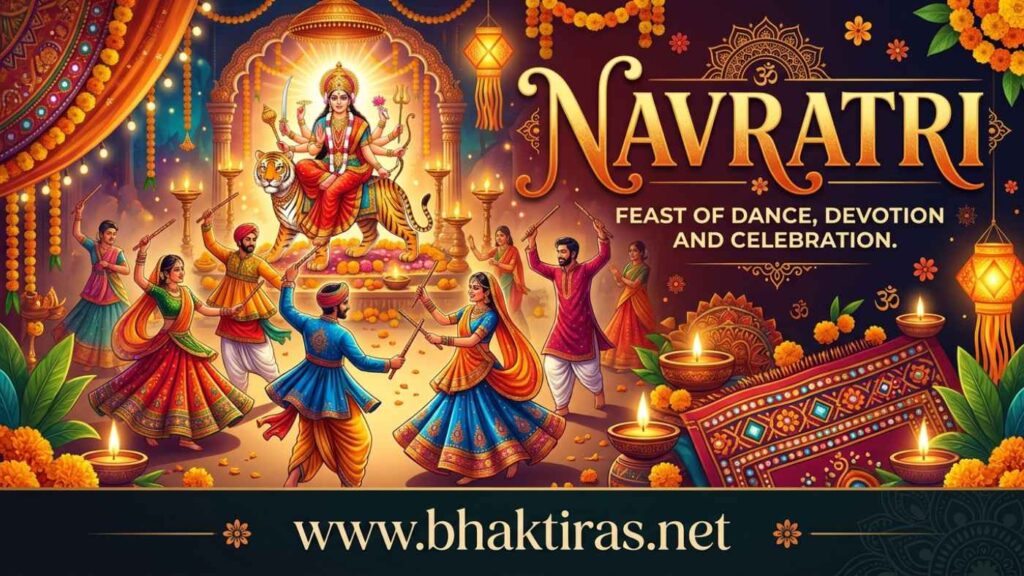
Sharadiya Navratri is the autumn festival of nine nights that Hindus keep during the bright half of the month of Ashwin, from Pratipada to Navami. Of the four Navratris in the Hindu year, this one is the most widely observed. Devotees worship the nine forms of Goddess Durga, the Navadurga, one form each day, moving from Shailaputri to Siddhidatri. The nine days blend fasting and quiet prayer with the joyous Garba and Dandiya nights of Gujarat, and the festival flows into Dussehra on the tenth day.
Sharadiya Navratri 2026-2028: Dates & Calendar
Sharadiya Navratri 2026 begins with Ghatasthapana on 11 October and closes on Maha Navami on 19 October. The dates shift every year because they follow the lunar month of Ashwin rather than the Western calendar.
| Year | Ghatasthapana (Start) | Maha Navami (End) | Notes |
|---|---|---|---|
| 2026 | Sunday, 11 October | Monday, 19 October | Next occurrence; Ashtami 18 Oct, Dussehra 20 Oct |
| 2027 | Thursday, 30 September | Friday, 8 October | Ashtami 7 Oct, Dussehra 9 Oct |
| 2028 | Tuesday, 19 September | Tuesday, 26 September | Ashtami and Navami combined; Dussehra 27 Sep |
Durga Ashtami and Maha Navami, the eighth and ninth days, are the ritual high points, when many families hold Kanya Pujan. The festival always leads directly into Dussehra on the tenth day, Vijayadashami.
Why Sharadiya Navratri Is Celebrated
Sharadiya Navratri celebrates the victory of Goddess Durga over the buffalo demon Mahishasura, and honours the feminine divine energy, Shakti, in her nine forms across nine nights.
The best known story tells of Mahishasura, a demon granted a boon that no man or god could kill him. When he grew unstoppable, the gods pooled their energies to create Durga, who fought him for nine nights and slew him on the tenth. Each night marks a stage of that battle, and Dussehra marks the win.
A second thread comes from the Ramayana: Rama is said to have worshipped Durga before his war with Ravana, so many link Navratri to Rama’s preparation and Dussehra to his eventual victory.
The four Navratris
Hindus keep four Navratris a year: two well known (Chaitra in spring and Sharadiya in autumn) and two Gupt or secret ones (Magha and Ashadha). Sharadiya, in the month of Ashwin, is the grandest and most widely observed.
Nine nights, nine forms
Each day is given to one of the Navadurga: Shailaputri, Brahmacharini, Chandraghanta, Kushmanda, Skandamata, Katyayani, Kalaratri, Mahagauri and Siddhidatri. Devotees often wear a different colour each day, matched to the goddess of the day.
Shakti and the harvest
Coming at the turn from monsoon to autumn, Sharadiya Navratri is also a seasonal festival. Barley seeds sown in the Ghatasthapana kalash sprout over the nine days, read as a sign of the coming harvest and the Goddess’s blessing on the land.
Deities & Figures Worshipped
Sharadiya Navratri is dedicated to Goddess Durga in her nine forms, the Navadurga, with one form worshipped on each of the nine days.
Shailaputri
The daughter of the mountains, worshipped on Ghatasthapana day. She rides a bull and carries a trident and lotus, and represents the awakening of divine energy.
Brahmacharini & Chandraghanta
Brahmacharini embodies penance and devotion, while Chandraghanta, with a half-moon shaped like a bell on her brow, stands for courage and the readiness to protect.
Kushmanda, Skandamata, Katyayani
Kushmanda is said to have created the universe with her smile; Skandamata is the mother of Kartikeya; and Katyayani, the warrior form, is the goddess most directly linked with slaying Mahishasura.
Kalaratri, Mahagauri, Siddhidatri
Kalaratri is the fierce dark form that destroys evil; Mahagauri, pure and radiant, grants peace; and Siddhidatri, worshipped on the last night, bestows spiritual powers and completes the cycle.
Key Rituals, Step by Step
Sharadiya Navratri opens with Ghatasthapana and builds through nine days of worship to Kanya Pujan on Ashtami or Navami.
- Ghatasthapana. On the first morning a kalash (pot) of water is installed on a bed of soil sown with barley seeds, invoking the Goddess and marking the formal start of the nine days.
- Daily puja of the Navadurga. Each day one form of Durga is worshipped with flowers, lamps and the reading of the Durga Saptashati, and many devotees wear the colour of the day.
- Fasting (vrat). Many keep partial or full fasts, eating only vrat foods such as kuttu, singhara flour, sabudana and fruit, and avoiding grains, onion, garlic and non-vegetarian food.
- Garba and Dandiya-Raas. Especially in Gujarat, evenings fill with Garba circles danced around a lamp or image of the Goddess and Dandiya-Raas played with wooden sticks.
- Durga Ashtami and Sandhi Puja. The eighth day is a major worship day; the transition between Ashtami and Navami, Sandhi Puja, is considered especially powerful.
- Kanya Pujan (Kanjak). On Ashtami or Navami, young girls are honoured as living forms of the Goddess, their feet washed, and offered puri, halwa and black chana.
- Havan and visarjan. A fire offering closes the worship, and where clay images are used, they are immersed as the festival ends.
- Vijayadashami. On the tenth day the festival culminates in Dussehra, celebrating Durga’s victory and, elsewhere, Rama’s win over Ravana.
Special Foods of Sharadiya Navratri
Navratri cooking centres on vrat (fasting) food that skips grains, onion and garlic, alongside sweet offerings for the Goddess and the Kanya Pujan feast.
Kuttu and singhara dishes
Puris, pakoras and rotis made from buckwheat (kuttu) and water-chestnut (singhara) flour are staples of the fast, since ordinary wheat and rice are avoided.
Sabudana khichdi & vada
Tapioca pearls cooked with peanuts, potato and mild spices give energy through the fast, eaten as khichdi or fried into crisp vada.
Samak rice & fruit
Barnyard millet (samak) stands in for rice, often with a light potato curry, while fresh fruit and milk sustain those on stricter fasts.
Kanya Pujan prasad
For the worship of young girls, families cook sooji or atta halwa, kala chana and puri, first offered to the Goddess and the girls, then shared.
Coconut & sweets
Coconut, batasha and simple sweets are offered to the Goddess, with the coconut breaking a symbol of surrender at many home altars.
Regional Names & Variations
The same nine nights are kept very differently across India, from Garba grounds in Gujarat to Ramlila stages in the north and grand pandals in the east.
Gujarat
Navratri here means Garba and Dandiya-Raas, danced late into the night around a decorated earthen lamp called the garbo. It is among the largest folk-dance festivals in the world.
North India
Homes keep fasts and daily Durga puja, Ramlila plays retell the Ramayana each evening, and Kanya Pujan on Ashtami or Navami is a central family ritual before Dussehra.
West Bengal & the East
The last days overlap with Durga Puja, when elaborate pandals house clay images of Durga slaying Mahishasura, honoured from Sashthi through Vijayadashami.
Maharashtra
Ghatasthapana and daily devi worship are common, with the growing barley sprouts and a nightly lamp; women also mark the days with visits and the exchange of haldi-kumkum.
South India
In much of the south the festival is kept as Golu or Bommai Kolu, with tiered displays of dolls and figurines, and it merges into Ayudha Puja and Vijayadashami.
Sharadiya Navratri Do's and Don'ts
A few simple customs help keep the nine days respectful and in the right spirit.
Do
- Perform Ghatasthapana within the day’s auspicious window and keep the kalash undisturbed.
- Keep your fast honestly with vrat foods, and stay hydrated with fruit, milk and water.
- Honour young girls with care and a genuine offering during Kanya Pujan.
- Keep the puja area and the growing barley sprouts clean and tended.
- Join Garba and community worship in a devotional, not merely festive, mood.
Avoid
- Do not eat grains, onion, garlic or non-vegetarian food if you are keeping the fast.
- Avoid alcohol, tobacco and other intoxicants through the nine days.
- Do not leave the sacred lamp or kalash neglected once installed.
- Avoid cutting hair or nails during the vrat, as many families hold.
- Do not treat Kanya Pujan as a formality; the girls are honoured as the Goddess herself.
Frequently Asked Questions
When is Sharadiya Navratri in 2026?
Sharadiya Navratri 2026 runs from Sunday 11 October to Monday 19 October. Ghatasthapana is on 11 October and Maha Navami on 19 October, with Durga Ashtami on 18 October and Dussehra following on 20 October.
When is Sharadiya Navratri in 2027 and 2028?
In 2027 Sharadiya Navratri runs from 30 September (Ghatasthapana) to 8 October (Maha Navami), with Dussehra on 9 October. In 2028 it falls from 19 September to 26 September, with Ashtami and Navami on the same day and Dussehra on 27 September.
Why is Sharadiya Navratri celebrated?
Sharadiya Navratri celebrates Goddess Durga’s victory over the demon Mahishasura after a nine-night battle, and honours the divine feminine energy, Shakti. Each of the nine nights is dedicated to one of Durga’s nine forms, and the festival culminates in Dussehra.
Which goddess is worshipped during Sharadiya Navratri?
Goddess Durga is worshipped during Sharadiya Navratri, in her nine forms known as the Navadurga. One form is honoured each day, beginning with Shailaputri on day one and ending with Siddhidatri on the ninth night.
What are the four Navratris?
There are four Navratris in the Hindu year: Chaitra Navratri in spring, Sharadiya Navratri in autumn, and two Gupt (secret) Navratris in the months of Magha and Ashadha. Sharadiya, in the month of Ashwin, is the most widely and grandly celebrated.
What are the nine colours of Navratri?
Many devotees wear a different colour on each of the nine days, matched to the goddess of that day. A common sequence is orange, white, red, royal blue, yellow, green, grey, purple and peacock green, though the order can vary by region and panchang.
What is Ghatasthapana?
Ghatasthapana is the ritual that opens Navratri on the first day, when a kalash of water is installed over a bed of soil sown with barley seeds. It invokes the Goddess for the nine nights, and the sprouting barley is read as her blessing.
What is Kanya Pujan during Navratri?
Kanya Pujan, also called Kanjak, is the worship of young girls as living forms of the Goddess, usually on Ashtami or Navami. Their feet are washed and they are offered puri, halwa and black chana before the family breaks its fast.
May the nine nights of the Goddess fill your home with strength and light. Jai Mata Di, and a joyful Sharadiya Navratri to you and your family.