
Goddess Varahi
वाराही
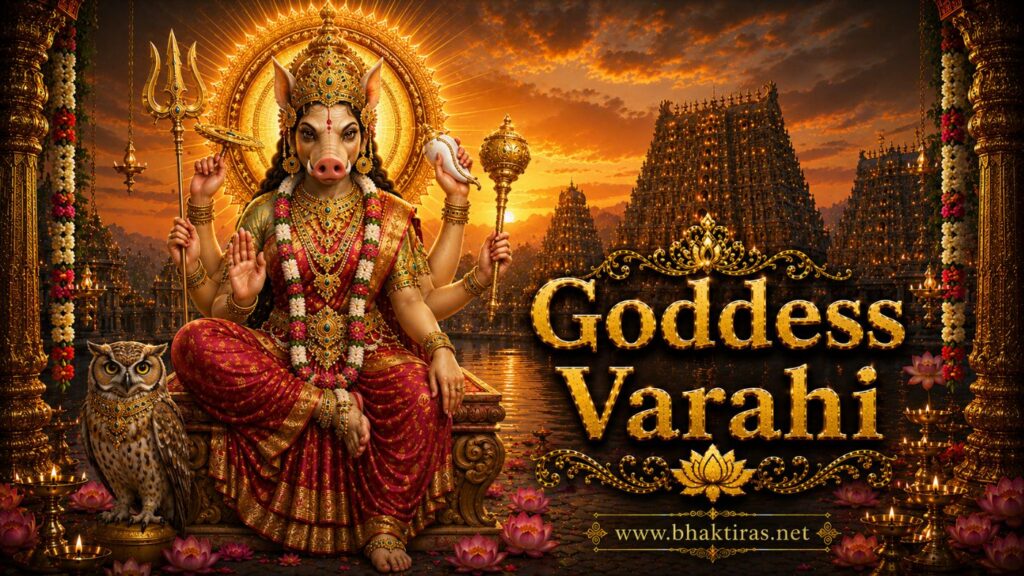
Varahi is one of the Sapta Matrikas, the seven mother goddesses, and she carries the divine energy of Varaha, Vishnu's boar avatar. She is boar-headed, holds a plough and a mace, and is a powerful figure in Shakta and Sri Vidya worship, especially in Odisha and Tamil Nadu.
Who Is Goddess Varahi?
Varahi is the feminine power of Varaha, the boar avatar in which Vishnu once dived into the cosmic ocean to lift the drowning earth on his tusks. From that mighty rescuing form comes Varahi, shown with the face of a boar and the deep, grounded strength of one who works close to the soil.
Among the Sapta Matrikas she stands out for her earthiness. Where some mothers gleam with celestial weapons, Varahi carries the hala, a plough, the tool that opens the ground and makes it yield. This links her to the land itself, to harvests, and to the hidden power beneath the surface of things.
In the Shakta and Sri Vidya traditions Varahi holds an especially high place. She is honoured as a commander of the Goddess’s forces, a fierce protector who removes enemies and obstacles, and a guardian invoked in the night. Her worship runs strong in Odisha and across Tamil Nadu, where she is deeply loved as Dandini, the one who wields the danda, the staff of authority.
Iconography and Symbols
Varahi is among the most striking of the Matrikas to look at, since she keeps the boar face of Varaha joined to a powerful maternal body.
Boar Face
Her head is that of a boar, echoing Varaha who lifted the earth. It gives her a fierce, unmistakable look and ties her to the raw, digging power of the animal.
The Plough (Hala)
She holds the hala, a plough, the tool that turns hard ground into fertile field. It marks her as a goddess of the earth, of harvest, and of buried strength brought to light.
Danda and Buffalo
The danda, or mace, in her hand shows her authority to punish wrongdoers, earning her the name Dandini. She is often linked to the buffalo, a mount of grounded, immovable force.
Varahi Among the Sapta Matrikas
Varahi is counted among the Sapta Matrikas, the seven mothers who each hold the power of a great god. She stands with Brahmani, the energy of Brahma, and Maheshwari, the energy of Shiva, together with Kaumari, Vaishnavi, Indrani, and the fierce Chamunda. In temple rows the mothers are carved with the marks of their source deities, so Varahi appears boar-faced with her plough. As a group the Matrikas surround and empower Durga in the battles of the Devi Mahatmya. Beyond that circle, however, Varahi grew into a major goddess in her own right. In the Sri Vidya tradition she is named Dandanatha, the commander of the Divine Mother’s army, second only to the Goddess herself in leading the fight against evil.
Worship, Mantra and Offerings
Varahi is worshipped both as one of the Matrikas and as an independent deity of great importance, especially in the Sri Vidya lineage where she is a chief protector of the Goddess. The Varahi temple at Chaurasi in Odisha, with its unusual tantric shrine, and many Amman temples across Tamil Nadu keep her worship alive and warm. She is often invoked at night and is regarded as a swift remover of enemies, fear, and obstacles. Devotees offer lamps, red flowers, and, in some traditions, night-time prayers seeking her protection. Navaratri and the Ashtami day are natural occasions to honour her with the other mothers. Because she is a fierce guardian, many turn to Varahi for courage, for shelter from harm, and for the strength to face difficulties that others cannot.
Stories and Legends
Battle with Shumbha-Nishumbha
In the war against the demon brothers Shumbha and Nishumbha, the Goddess brought forth the Matrikas from her own being so she could strike in many forms at once. Varahi charged into the field boar-faced and terrible, her plough tearing through the demon ranks as if opening hard earth. Her grounded, unshakeable force held a corner of the battle firm while the mothers pressed forward, until the Devi gathered all their power back into herself and won the day.
Commander of the Divine Army
In the Sri Vidya tradition a further role is given to Varahi. When the Divine Mother rides out against the forces of ignorance and evil, it is Varahi, under the name Dandanatha, who leads the army as its supreme commander. She goes ahead, clearing the path, crushing obstacles, and protecting the devotees who take refuge in the Goddess, which is why she is called upon in the dark hours when danger feels closest.
Frequently Asked Questions
Who is Goddess Varahi?
Varahi is one of the Sapta Matrikas, the seven mother goddesses. She holds the divine energy of Varaha, Vishnu's boar avatar, and is shown boar-headed with a plough and a mace.
Whose power does Varahi represent?
She represents the shakti of Varaha, the boar form in which Vishnu lifted the earth from the cosmic ocean, which is why she has a boar face and earth-linked symbols.
What are Varahi's symbols?
Her chief emblems are the hala, a plough, and the danda, a mace, along with her boar head. The danda gives her the name Dandini, the wielder of the staff.
Why is Varahi important in Sri Vidya?
In the Sri Vidya tradition Varahi is honoured as Dandanatha, the commander of the Divine Mother's army, a fierce protector who removes enemies and obstacles.
Where is Varahi most worshipped?
Her worship is especially strong in Odisha, where the Varahi temple at Chaurasi stands, and across Tamil Nadu, where she is a much-loved guardian goddess.
May Varahi’s plough clear every obstacle from the ground before you.