
Goddess Durga
दुर्गा
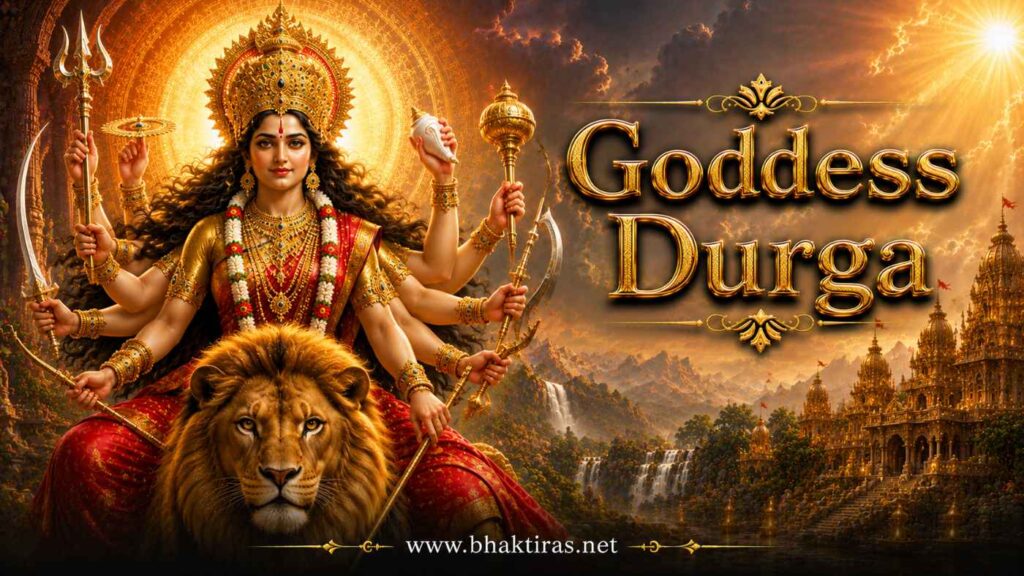
Durga is the supreme warrior goddess of Hinduism, the fierce and protective form of Adi Shakti, the primordial feminine power. Formed from the combined energy of all the gods to slay the buffalo-demon Mahishasura, she rides a lion, carries many weapons, and destroys evil while cradling her devotees as a loving mother.
Who Is Goddess Durga?
Durga is the great goddess of Hindu tradition – the supreme protectress, the warrior mother, and the visible face of Shakti, the creative and destructive power that moves the whole universe. When people fold their hands before her image, with its calm face and ten arms full of weapons, they are turning to a force that is both a fighter and a mother at once. She defends what is good, ends what is cruel, and holds her children close while she does it.
Her name carries her meaning. ‘Durga’ comes from a word for a fort or a difficult, impassable place – she is the one no evil can breach, and the refuge no danger can enter. To call her Maa, Mother, is not to soften her. It is to say that her strength belongs to those who love her.
In Hindu thought, Durga is understood as Adi Shakti, the primordial energy without which even the greatest gods are still. Vishnu preserves and Shiva transforms, but it is Shakti that gives them the power to act. Durga is that power gathered into a single blazing form. She is not a servant of the gods but the ground they stand on, worshipped in her own right by millions who see her as the highest reality.
She is also deeply personal. Farmers pray to her for a safe harvest, mothers pray to her for their children, soldiers and wrestlers touch the earth in her name before a fight. She is the goddess you can shout to when you are afraid, because her whole nature is to answer.
The Birth of Durga and the Slaying of Mahishasura
Iconography and Symbols
Every part of a Durga image carries meaning. Her form is designed to be read – a lesson in stone and paint about power, balance, and grace under pressure.
The Devi Mahatmya – Her Three Great Battles
The Navadurga – Nine Forms of Navaratri
During the nine nights of Navaratri, Durga is worshipped as nine distinct forms, the Navadurga. Each night belongs to one of them, and together they trace a journey from a mountain-daughter to the giver of all perfection.
- Shailaputri – ‘daughter of the mountain’, the goddess as Parvati newly born, riding a bull with a trident and lotus; worshipped on the first night as the pure beginning.
- Brahmacharini – the goddess as a serene ascetic, walking barefoot with a rosary and water pot, honoured for her penance, devotion, and unshakable calm.
- Chandraghanta – crowned with a half-moon shaped like a bell, ten-armed and riding a tiger, the fearless warrior form ready for battle.
- Kushmanda – the smiling goddess whose radiance is said to have created the cosmic egg and lit the sun; the source of light and life.
- Skandamata – the mother of Skanda (Kartikeya), shown holding her infant son, tender and protective, the loving parent among her forms.
- Katyayani – the fierce golden warrior born to sages, one of the most powerful forms, sword in hand, closely tied to the slaying of Mahishasura.
- Kalaratri – the dark night of destruction, wild-haired and terrifying, who annihilates fear itself and burns away ignorance and evil.
- Mahagauri – the brilliantly white and peaceful form, calm and forgiving, who washes away past sorrows and grants deep serenity.
- Siddhidatri – the giver of siddhis or spiritual perfections, seated on a lotus, worshipped on the final night as the goddess who completes the seeker.
Durga, Parvati and Kali
Navaratri and Durga Puja
How Goddess Durga Is Worshipped
Durga can be worshipped in a grand pandal or in a quiet corner of the home. Some of the most common ways devotees turn to her:
- Navaratri vrat – fasting through the nine nights, eating simple sattvic food, and worshipping a different form of the Navadurga each day.
- Durga Saptashati path – reciting or listening to the seven hundred verses of the Devi Mahatmya, considered one of the most powerful acts of devotion to her.
- Ghatasthapana and Akhand Jyoti – installing a sacred pot and sowing barley on the first day, and keeping a lamp burning unbroken through all nine nights.
- Offerings of red – red hibiscus and other red flowers, a red chunri or sari, sindoor, and sweets, all colours of Shakti and life.
- Kanya Pujan – on Ashtami or Navami, worshipping young girls as living forms of the goddess, washing their feet and feeding them with honour.
- Chanting her mantras and aartis – repeating ‘Om Dum Durgayai Namah’, singing her aarti, and reciting the Ya Devi Sarvabhuteshu shloka in daily prayer.
Temples and Shakti Sites
Durga is honoured at countless shrines, but a few draw pilgrims from across the country and beyond. Many of them are Shakti Peethas, sacred spots where, in myth, parts of Sati’s body fell to earth and became seats of the Goddess.
- Vaishno Devi (Jammu & Kashmir) – one of India’s most visited pilgrimages, high in the Trikuta hills, where the Mother is worshipped as three natural rock forms in a cave shrine.
- Kolkata’s Durga temples and Kalighat – the spiritual centre of Durga and Kali worship, where Kalighat is counted among the most revered Shakti Peethas.
- Kamakhya (Assam) – a great Shakti Peetha on Nilachal hill, one of the most powerful goddess shrines, deeply tied to Durga and the tantric traditions of Shakti.
- The fifty-one Shakti Peethas – a network of goddess shrines spread across the subcontinent, from Vindhyachal to Hinglaj, each remembering where a part of the Devi is said to dwell.
Prayers and Mantras
Durga’s mantras are among the most chanted in Hindu households, especially through Navaratri. The simple seed mantra below is easy to repeat as a daily practice, calling on her protection with each round of the beads. Beneath it is a verse from the Devi Mahatmya that greets the Goddess as she who lives inside every being.
Seed Mantra:
ॐ दुं दुर्गायै नमः
Om Dum Durgayai Namah
‘Om, and salutations to Goddess Durga.’ ‘Dum’ is her seed sound, believed to draw down her protective power.
Ya Devi Sarvabhuteshu (from the Devi Mahatmya):
या देवी सर्वभूतेषु शक्तिरूपेण संस्थिता।
नमस्तस्यै नमस्तस्यै नमस्तस्यै नमो नमः॥
Ya Devi sarvabhuteshu shakti-rupena samsthita, Namas-tasyai namas-tasyai namas-tasyai namo namah.
‘To the Goddess who dwells in all beings in the form of power – to her we bow, to her we bow, to her again and again we bow.’ The full hymn repeats this bow for the Goddess present as mercy, peace, hunger, sleep, and every other force of life.
Frequently Asked Questions about Goddess Durga
Who is Goddess Durga?
Durga is the supreme warrior goddess of Hinduism and a form of Adi Shakti, the primordial feminine power. She was created from the combined energy of all the gods to destroy the buffalo-demon Mahishasura. She protects the good, ends evil, and is loved as Maa, the fierce yet caring universal Mother.
Why does Durga ride a lion?
The lion was given to Durga by Himavan, lord of the mountains, when the gods armed her for battle. It stands for raw, untamed power and courage. That she rides such a fearsome predator calmly shows that her ferocity is completely mastered – strength held under perfect control and used only to protect.
What is the difference between Durga and Parvati?
They are the same goddess in different moods. Parvati is the gentle wife of Shiva and loving mother, the goddess of home and patience. Durga is what Parvati becomes when the world is threatened – her warrior form, riding a lion into battle to destroy evil. Durga is Parvati's protective power made visible.
How is Durga related to Kali?
Kali is the fiercest expression of the same Shakti. In the Devi Mahatmya, when Durga's anger against the demons peaks, Kali springs from her forehead – dark, wild, and unstoppable. Kali is Durga's rage let loose, the raw edge of the Goddess that swallows fear and time itself.
What is the story of Mahishasura?
Mahishasura was a shape-shifting buffalo-demon who won a boon that no man or god could kill him. He conquered the heavens, so the gods pooled their energy to create Durga – a woman, and thus outside his boon. After a long duel she pinned him and beheaded him, earning the name Mahishasuramardini.
What is the Devi Mahatmya?
The Devi Mahatmya, also called the Durga Saptashati, is a text of seven hundred verses in the Markandeya Purana. It is one of the earliest scriptures to declare the Goddess as the supreme power of the universe, telling of her three great battles. Devotees chant it in full during Navaratri.
What are the nine forms of Durga?
The Navadurga are nine forms worshipped over the nine nights of Navaratri: Shailaputri, Brahmacharini, Chandraghanta, Kushmanda, Skandamata, Katyayani, Kalaratri, Mahagauri, and Siddhidatri. Each night honours one form, tracing a journey from the mountain-born daughter to the giver of all spiritual perfection.
What is Durga Puja?
Durga Puja is the great autumn festival of Bengal and eastern India celebrating Durga's victory over Mahishasura. Huge clay idols of the goddess are worshipped in decorated pandals over Saptami, Ashtami, and Navami, then carried to the river and immersed on Vijaya Dashami as devotees bid the Mother farewell.
What should I offer to Goddess Durga?
Durga loves offerings in red – red hibiscus and other red flowers, a red chunri or sari, and sindoor, all colours of Shakti and life. Sweets, fruit, and a lit lamp are also traditional. During Navaratri many keep a fast and worship young girls as living forms of the goddess.
Whatever name you call her by – Durga, Bhavani, Ambika, or simply Maa – she is the Mother who fights for her children and never turns away. May her lion’s strength guard you and her calm face steady your heart.