
Goddess Parvati
पार्वती
Parvati is the Hindu goddess of power, love, and devotion, the gentle consort of Lord Shiva and mother of Ganesha and Kartikeya. Reborn from Sati, she won Shiva through years of penance. As Adi Shakti, she is the divine feminine energy behind creation, taking fierce forms such as Durga and Kali when the world needs protection.
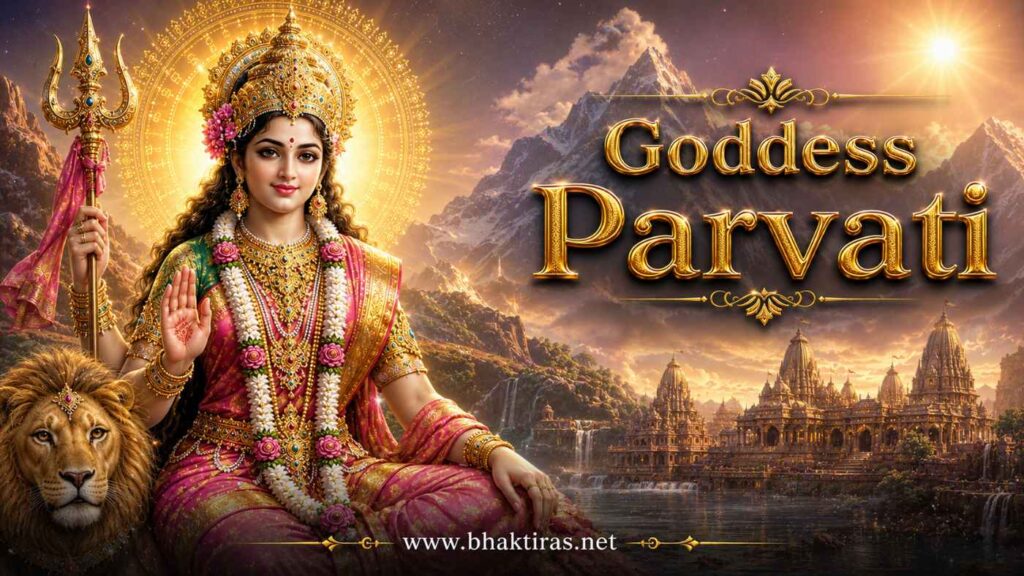
Who Is Goddess Parvati
Parvati is the goddess of love, devotion, and divine strength, and the gentle half of the eternal pair she forms with Lord Shiva. Her name means daughter of the mountain, for she was born to Himavan, the lord of the Himalayas, and his wife Mena. Devotees know her by many warm names – Gauri, the fair one; Uma; and Bhavani, giver of life.
Her story begins with loss. In an earlier birth she was Sati, Shiva’s first wife, who gave up her body when her father insulted her husband. Grief broke Shiva, and he withdrew into deep meditation. Sati was reborn as Parvati, and from childhood her heart was fixed on winning him back. She left the comforts of her mountain home and undertook fierce tapasya – standing through heat and cold, living on leaves and then on nothing at all – until Shiva finally opened his eyes to her devotion.
Beyond her role as wife and mother, Parvati is Adi Shakti, the primordial energy of the universe. Hindu thought holds that Shiva without Shakti is shava – a lifeless corpse. It is Parvati who animates creation, who moves the still and gives form to the formless. Every goddess of the tradition is understood, in one way or another, as an expression of her.
She is loved as the goddess who balances two natures. In her calm, golden form she is the ideal of wifely devotion and maternal tenderness. When cruelty threatens the world, that same energy blazes into Durga and Kali, warriors whom even demons cannot withstand.
Iconography and Symbols
Parvati is usually shown as a graceful, fair-skinned woman, often seated beside Shiva or riding her lion. Each detail of her image carries meaning.
The Lion
Her mount is a lion, sometimes a tiger – a symbol of raw courage and mastery over fear. That a goddess so gentle rides so fierce a beast shows the strength held quietly within her love.
The Trishula
The three-pronged trident she carries is shared with Shiva. Its three points stand for the three states of existence – creation, preservation, and dissolution – all held in her hands.
The Lotus
A lotus rests in her palm, rising unstained from muddy water. It marks her purity, her beauty, and the flowering of the soul that reaches toward the divine.
Abhaya and Varada
One hand is raised in abhaya mudra, the gesture of fearlessness that says “do not be afraid.” Another turns downward in varada mudra, the gesture of giving blessings and granting wishes.
Golden Complexion
As Gauri, she shines with a warm golden or fair glow. This radiance reflects her serene, nurturing nature and her name as the bright, auspicious one.
Sindoor and Ornaments
She is adorned as a married woman – sindoor in the parting of her hair, bangles, and rich jewellery. This marks her as the model of Saubhagya, marital good fortune, which brides invoke through her.
Family – Shiva, Ganesha and Kartikeya
Parvati’s family life on Mount Kailash is one of the most beloved pictures in Hindu devotion – a household of gods that still feels wonderfully human. Her husband is Shiva, the ascetic lord whom she coaxed from his solitude into marriage. Together they raise two sons: Ganesha, the elephant-headed remover of obstacles, and Kartikeya (also called Skanda or Murugan), the youthful commander of the divine armies.
The bond between Parvati and Shiva runs so deep that it is expressed in a single joined form, Ardhanarishvara – one body split down the middle, half Shiva and half Parvati. This image teaches that the masculine and feminine are not rivals but a single whole, that consciousness and energy cannot be pulled apart. Neither is complete without the other.
Her motherhood is fierce and tender at once. She created Ganesha from the turmeric paste of her own body to guard her door, and when he was harmed she was ready to unmake the universe until he was restored. As mother, wife, and equal partner in cosmic rule, Parvati holds the family of Kailash together and, through it, offers devotees a divine model of home and belonging.
The Many Forms of the Goddess
Because Parvati is Adi Shakti herself, the great goddesses of Hinduism are seen as her forms – each answering a different need of her devotees.
- Durga – the invincible warrior on a lion, who slew the buffalo-demon Mahishasura when no god could. She embodies Parvati’s protective power against evil.
- Kali – the dark, fearless goddess of time and destruction, who annihilates ego and demons alike. She rises from Parvati’s own brow in the heat of battle.
- Annapurna – the goddess of food and nourishment, ladle in hand, who feeds the whole world. In this form Parvati is the mother who ensures no one goes hungry.
- Meenakshi – the fish-eyed queen-goddess of Madurai, ruler and warrior, worshipped as Parvati wedded to Shiva as Sundareswarar.
- Kamakshi – the goddess of loving desire enshrined at Kanchipuram, seated in serene meditation, granting the heart’s true wishes.
- Gauri – the fair, gentle, auspicious form invoked by women for marriage, marital happiness, and the wellbeing of their families.
How Goddess Parvati Is Worshipped
Worship of Parvati is woven into daily life and the turning of the year. Fridays and Mondays are especially dear to her, and married women in particular keep her rites for the sake of their homes and husbands.
- Navaratri – across nine nights devotees honour her in her nine forms (Navadurga), with fasting, lamps, and recitation of the Devi texts.
- Teej vrats – married and unmarried women fast on Hartalika and Gauri Teej, praying to Parvati for a good husband and a lasting, happy marriage, just as she won Shiva.
- Sindoor and red flowers – offerings of vermilion, red hibiscus and roses, and bilva leaves are placed at her feet; sindoor especially is linked to the blessing of marital good fortune.
- Chanting her mantras – repeating Om Parvatyai Namah or the Devi stotras, either at a home shrine or in temple, to invite her grace of strength and love.
- Aarti and bhajans – evening lamp offerings and devotional songs sung to Gauri, Durga, and Bhavani lift the household in her praise.
Festivals of Goddess Parvati
Several of the most joyful festivals in the Hindu calendar centre on Parvati and her forms, drawing especially large gatherings of women and families.
Navaratri, the nine nights of the goddess, is the grandest of them. Twice a year devotees fast, dance the garba and dandiya, and worship her as Durga through her fierce and gentle aspects alike, culminating in the celebration of good’s victory over evil.
Hartalika Teej and Gauri Teej fall in the monsoon and honour Parvati’s union with Shiva directly. Women dress in green and red, apply mehndi, swing on flower-decked swings, and keep a day-long fast, remembering how Parvati’s own vow won her the lord of Kailash. Gangaur, celebrated with great colour in Rajasthan and parts of the west, worships Gauri and Shiva over many days as the model of the ideal married couple, with unmarried girls praying for a good match and married women for their husbands’ long lives.
Temples and Shakti Sites
Parvati is worshipped at thousands of shrines, but a few great temples and the network of Shakti Peethas hold special place in the hearts of her devotees.
- Meenakshi Amman Temple, Madurai – one of the largest and most magnificent temple complexes in India, where Parvati reigns as the fish-eyed goddess Meenakshi beside Shiva as Sundareswarar.
- Kamakshi Amman Temple, Kanchipuram – a revered seat of the goddess in her loving, meditative form Kamakshi, counted among the holiest Shakti shrines of the south.
- The Shakti Peethas – the many sacred sites, spread from Kamakhya in Assam to Kalighat in Bengal and beyond, that mark where parts of Sati’s body are said to have fallen, each a living centre of goddess worship.
- Kailash and Manasarovar – the Himalayan abode she shares with Shiva, held as the supreme pilgrimage of the pair by devotees across traditions.
A Story Every Devotee Knows
The Penance That Won Shiva
After Sati’s death, Shiva sank into meditation so profound that he seemed lost to the world. Reborn as Parvati, the mountain-king’s daughter grew up loving him, but Shiva would not stir. So she set aside her royal life and gave herself to tapasya of terrifying intensity. Through blazing summers she meditated ringed by fire; through winter she stood in icy water; she went from a diet of leaves to no food at all, earning the name Aparna, “she who took not even a leaf.” The heat of her devotion shook the heavens. When Shiva at last came to test her, disguised as a wandering ascetic, he spoke ill of himself to see her resolve – and Parvati defended her beloved so fiercely that he revealed his true form and accepted her. Their wedding on Kailash is remembered as the union of consciousness with its own creative power.
How She Made Ganesha
One day, wanting privacy for her bath and no one to guard the door, Parvati scraped the turmeric paste from her body and shaped it into a boy, breathing life into him as her own son. She set him at the entrance with orders to let no one pass. When Shiva returned and the boy blocked him, not knowing his father, a terrible clash followed and the child was beheaded. Parvati’s grief turned to fury that threatened all creation. To calm her, Shiva restored the boy to life with the head of an elephant, and blessed him to be worshipped before all other gods. Thus Ganesha, born of Parvati alone, became the beloved remover of obstacles.
Prayers and Mantras
Devotees call on Parvati for strength, love, marital happiness, and a protecting mother’s grace. Her simplest mantra can be repeated by anyone, at a home shrine or in the quiet of the heart. Reciting it with focus is said to draw her nurturing power and steady the mind through difficulty. Married women often turn to her forms as Gauri and Uma when praying for the wellbeing of their families.
The essential invocation is Om Parvatyai Namah – “I bow to Parvati.” Chanted with devotion, especially on Fridays and Mondays and through the nights of Navaratri, it honours her as the gentle mother and the boundless Shakti behind all things.
Frequently Asked Questions about Goddess Parvati
Who is Goddess Parvati?
Parvati is the Hindu goddess of power, love, and devotion, and the consort of Lord Shiva. Daughter of the Himalaya mountain, she is worshipped as Adi Shakti, the primordial feminine energy of the universe, and is the mother of Ganesha and Kartikeya. Her gentle form balances her fierce aspects, Durga and Kali.
Who are the children of Parvati?
Parvati has two sons. Ganesha, the elephant-headed remover of obstacles, whom she created from the turmeric of her own body. And Kartikeya, also called Skanda or Murugan, the youthful commander of the gods' armies. Together with Shiva they make up the beloved divine family of Mount Kailash.
Is Parvati the same as Durga and Kali?
Yes, in essence. Durga and Kali are understood as fierce forms of Parvati, arising from her power when the world needs protection from evil. Parvati is the gentle, nurturing aspect of the same great goddess, Adi Shakti, while Durga is her warrior form and Kali her form of fearless destruction of ego and demons.
What is the meaning of the name Parvati?
The name Parvati comes from the Sanskrit word Parvata, meaning mountain, so Parvati means "daughter of the mountain." She was born to Himavan, the personified lord of the Himalayas, and his wife Mena. She is also widely known by other names such as Gauri, Uma, Bhavani, and Shakti.
How did Parvati marry Shiva?
After being reborn from Sati, Parvati set her heart on winning Shiva, who was lost in deep meditation. She undertook extraordinary penance, enduring heat, cold, and hunger for years. Moved by the intensity of her devotion, Shiva finally accepted her, and their wedding on Mount Kailash is celebrated as the union of consciousness with its creative energy.
What is Ardhanarishvara?
Ardhanarishvara is a joined form of Shiva and Parvati shown as a single body split down the middle, one half male and one half female. It teaches that the masculine and feminine principles are inseparable parts of one reality, and that Shiva and Shakti, consciousness and energy, cannot exist without each other.
Why is Parvati worshipped during Teej?
During Hartalika and Gauri Teej, women honour Parvati because she won Shiva as her husband through her own vow and penance. Married and unmarried women fast and pray to her for a devoted husband and a lasting, happy marriage, seeking her blessing of Saubhagya, or marital good fortune, just as she achieved with Shiva.
What offerings please Goddess Parvati?
Parvati is offered red flowers such as hibiscus and roses, sindoor or vermilion, bilva (bael) leaves, and sweets. Sindoor is especially linked to her blessing of a happy married life. Worship on Fridays and Mondays, chanting Om Parvatyai Namah, and observing Navaratri and Teej are all cherished ways to seek her grace.
What does Parvati as Adi Shakti mean?
As Adi Shakti, Parvati is the original, supreme feminine energy from which all creation flows. Hindu thought holds that Shiva without Shakti is lifeless, so it is she who gives movement and form to the universe. Every goddess is seen as an expression of this one great power that Parvati embodies.
May Goddess Parvati bless your home with love, strength, and lasting harmony, and hold you always in a mother’s care.