
Lord Varaha
वराह
Lord Varaha is the third avatar of Vishnu, who took the form of a colossal boar to rescue the Earth goddess Bhudevi. When the demon Hiranyaksha dragged her beneath the cosmic ocean, Varaha dived into the depths, slew him, and lifted the Earth back to safety on his tusks. He is worshipped for upliftment, stability, and rescue from trouble.
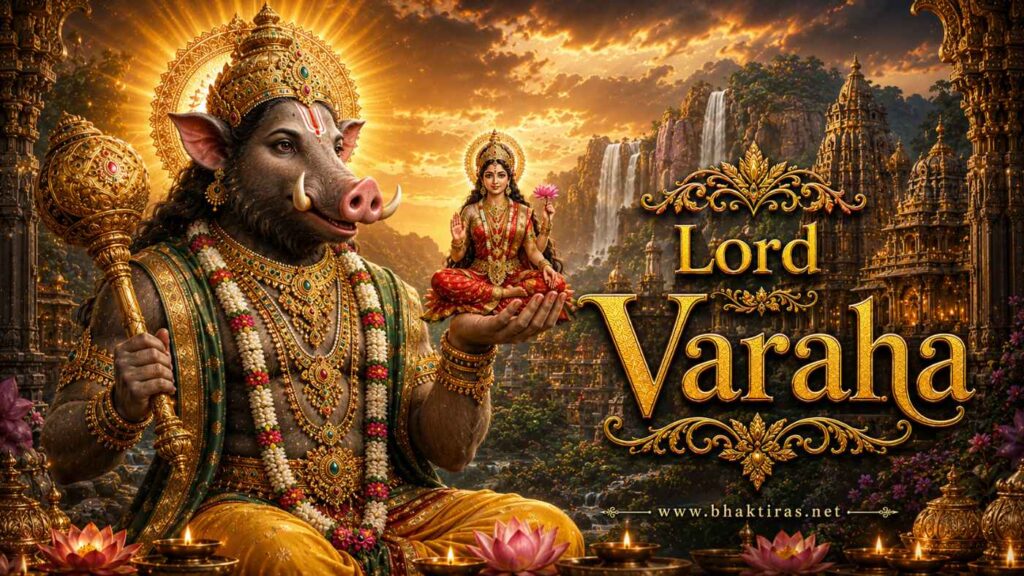
Who Is Lord Varaha?
Lord Varaha is the third of the ten principal avatars of Vishnu, the great preserver who steps into the world whenever it slips toward ruin. In this descent, Vishnu did not appear as a king or a sage. He came as a boar – a wild, earthy, powerful creature – because the crisis that called him was earthy and grave. The Earth herself had been stolen, and only a form built for digging, diving, and lifting could bring her home.A form shaped by the need of the hour
Hindu thought holds that the Lord chooses each of his forms to fit the trouble he comes to fix. When knowledge had to be recovered from the waters, he came as a fish. When a mountain had to be steadied, he came as a tortoise. When the Earth had to be pulled up from the deep, he came as a boar – low to the ground, strong in the shoulders, with tusks made for lifting. The strangeness of the shape is the point: no distress is beneath the Lord’s attention.
The tender image at the heart of it
For all his ferocity in battle, Varaha is remembered most for a gentle picture – the huge boar rising from the water with the small figure of the Earth goddess resting safely against his tusk. Sculptors across India have returned to this scene again and again. It holds two truths at once: overwhelming power, and the careful tenderness with which that power carries what is fragile.
When the Earth Sank into the Ocean
The trouble began with a demon named Hiranyaksha, whose very name means ‘golden-eyed.’ He and his brother Hiranyakashipu were born of a proud and restless line, and Hiranyaksha grew drunk on his own strength. Through fierce austerities he had won boons that made him nearly impossible to defeat, and with no one to check him, his greed reached beyond the three worlds.The theft of the world
In his arrogance Hiranyaksha seized the Earth goddess Bhudevi – the living presence of the ground beneath every creature – rolled her up like a mat, and dragged her down into the vast cosmic ocean that lies beneath all things. He hid her far below the surface, in the darkness where no light and no help seemed able to reach. With the Earth herself submerged, life had nowhere to stand. The whole order of creation trembled, and the gods, unable to face Hiranyaksha directly, cried out to Vishnu.
The waters that had no bottom
The cosmic ocean in these accounts is not an ordinary sea. It is the formless deep, the primal water from which worlds are made and into which they can dissolve. To go into it was to go to the very edge of nothingness. That the Earth had been pulled into such a place made the rescue seem hopeless – and made the one who answered the call all the more remarkable.
The Great Boar Who Lifted the Earth
Hearing the prayers of the gods, Vishnu took the shape of a boar. The Puranas describe him swelling from a small figure to a mountain of a creature, his body dark as a storm cloud, his roar shaking the heavens, his tusks curving white and sharp. Then, without hesitation, he plunged headlong into the cosmic ocean.The dive into the deep
Down and down the great boar went, cleaving the water with his snout, following the scent of the Earth through darkness that had swallowed her. His body parted the ocean as easily as a plough parts soil. Sages and gods watched from above, praising him as he vanished into depths no one else dared to enter, trusting that he would return.
The thousand-year battle
In the depths, Hiranyaksha was waiting, furious that anyone had come to challenge him. He struck at the boar with mace and fist, hurling curses and blows. The two clashed in the deep water in a duel the texts say lasted a thousand years, the ocean churning around them. The demon fought with every boon he had won, but the Lord met each attack and wore him down. At last Varaha struck the killing blow and Hiranyaksha fell, his stolen strength spent, the threat to the worlds ended.
The rescue on his tusks
With the demon slain, the boar found the Earth goddess where she had been hidden. Gently he slipped his mighty tusks beneath her and lifted, bearing her up through the endless water. He rose from the ocean carrying Bhudevi balanced on his tusk, and set her back in her rightful place, steadying her so that she would hold firm. The gods rained down flowers and praise, and the worlds, which had teetered on the edge of ruin, stood safe once more.
Varaha and Bhudevi – the Lord and the Earth
In this avatar, Vishnu’s consort is Bhudevi, also called Prithvi – the Earth goddess herself. Their bond gives the story a warmth that runs deeper than a rescue between strangers.A rescue that is also a reunion
Bhudevi is not a distant figure to be saved and forgotten. As the Earth, she is the mother of every living thing, patient and giving, bearing the weight of all creatures without complaint. When Varaha lifts her from the water, the Lord is not only restoring order to the cosmos; he is returning to the ground its dignity and its place. The tenderness in their images comes from this closeness – the protector and the protected are joined by love, not only by duty.
The Earth held safe
In temple sculpture Bhudevi is often shown small and serene against Varaha’s great form, sometimes seated on his elbow or resting near his tusk, one hand raised in trust. The message is quiet but strong: the Earth, and all who live upon her, are held in hands far greater and far kinder than any danger that threatens them.
The Meaning of the Boar Avatar
Every avatar carries a lesson, and the boar’s is one of the plainest and most comforting. Varaha is the Lord descending to raise up the world whenever it sinks – whether into water, into chaos, or into adharma, the loss of what is right.Lifting the fallen
The heart of the story is a single motion: something precious has sunk to the bottom, and the Lord goes down to bring it back up. Read closely, it speaks to every kind of sinking – a life pulled under by grief, a family dragged down by trouble, a whole age slipping away from goodness. Wherever there is a falling, the boar avatar promises a lifting. Nothing is written off as lost.
The dignity of humble strength
There is meaning too in the shape the Lord chose. A boar is not a noble lion or a soaring eagle; it is a rooting, digging animal, close to the mud. By taking this form the Lord honours humble, patient, groundward work – the labour of setting things right from below. Grand rescues, the avatar suggests, are often done with unglamorous strength.
Guardian of the turning ages
Varaha is also linked to the boundary between the great world-ages, the moment when one era ends and another must be steadied into place. He belongs to thresholds – to the dangerous crossings when the old order has failed and a new one must be lifted up. In such times, the tradition says, the Lord comes as the boar to hold the world steady while it finds its footing again.
Iconography & Symbols
Images of Varaha are unmistakable, built around a few powerful symbols. He appears either as a full boar or, more often in worship, as Bhuvaraha – a mighty man’s body crowned with the fierce head of a boar.The boar's head and tusks
The dark boar face, snout raised and tusks gleaming, is the avatar’s signature. The tusks are not just weapons but tools of rescue – the very instruments that lifted the Earth. In sculpture they are often carved long and curving, the eye drawn straight to the point where the world was saved.
The Earth goddess on the tusk
The defining detail is small Bhudevi lifted upon the Lord’s tusk or held against his upraised arm. Serene and safe amid his overwhelming size, she turns a battle scene into a scene of tenderness. This single motif tells the whole story at a glance.
The discus, mace, and lifted leg
As an avatar of Vishnu, Varaha carries the Sudarshana chakra (discus) and the gada (mace) in his upper hands, marking him clearly as the preserver in disguise. He is frequently shown in a striding, triumphant stance, one leg raised and planted on the serpent of the deep or on the vanquished demon, rising victorious from the water below.
How Lord Varaha Is Worshipped
Devotees turn to Lord Varaha for upliftment, stability, and rescue from difficulties that feel too deep to escape. Worship is simple, heartfelt, and rooted in trust that the Lord who raised the Earth can raise the worshipper’s own troubles too.- Reciting the Varaha mantra Om Varahaya Namah, often as a steady practice during times of hardship or uncertainty.
- Observing Varaha Jayanti, the avatar’s appearance day in the month of Bhadrapada, with fasting, prayer, and readings of his story.
- Reading or listening to the Varaha story from the Bhagavata Purana and Vishnu Purana, especially when seeking hope in a difficult season.
- Offering prayers for stability of home, land, and livelihood, since Varaha lifted and steadied the very ground of the world.
- Visiting Varaha shrines to seek his blessing for rescue, protection, and a fresh beginning after loss or difficulty.
- Honouring Bhudevi alongside Varaha, remembering the Earth’s patience and giving thanks for the ground that carries us.
Temples & Sacred Sites
Though temples dedicated wholly to Varaha are fewer than those for many other forms of Vishnu, several ancient and greatly revered shrines keep his worship alive across India.- Srimushnam, Tamil Nadu – home of the Bhuvaraha Swamy temple, one of the most important Varaha shrines in the country, where the Lord is worshipped as the boar who rescued the Earth.
- Tirumala, Andhra Pradesh – the Adi Varaha shrine on the sacred hill is honoured as the oldest temple there, and tradition holds that offerings are made to Varaha before the famous Venkateswara deity himself.
- Khajuraho, Madhya Pradesh – a striking stone Varaha, carved as a full boar and covered with tiny figures of gods and sages, stands among the temples there as a celebrated example of the avatar in sculpture.
- Varaha shrines within many Vishnu temples – across India, images of Bhuvaraha lifting the Earth are enshrined as part of larger temple complexes, keeping the rescue of Bhudevi before the eyes of worshippers.
Prayers & Mantras
A short, sincere mantra is often the readiest way to draw near to Lord Varaha. Repeated with attention, it becomes a quiet prayer to be lifted out of whatever waters one is sinking in.ॐ वराहाय नमः
Om Varahaya Namah – ‘I bow to Lord Varaha.’ This simple salutation to the boar avatar is chanted for stability, protection, and rescue from difficulty. Devotees repeat it as a mala practice or softly through the day, resting the mind on the Lord who raises what has fallen.
Frequently Asked Questions about Lord Varaha
Who is Lord Varaha?
Lord Varaha is the third avatar of Vishnu, who took the form of a colossal boar – or man-boar – to rescue the Earth goddess Bhudevi from the cosmic ocean. He is worshipped as a protector and uplifter, the Lord who descends to raise the world whenever it sinks into difficulty or wrongdoing.
How did Varaha save the Earth?
When the demon Hiranyaksha dragged the Earth goddess Bhudevi beneath the cosmic ocean, Vishnu became a giant boar and dived into the depths. After a battle said to last a thousand years, he slew Hiranyaksha, lifted the Earth on his powerful tusks, and set her safely back in her place.
Who is the consort of Varaha?
The consort of Varaha is Bhudevi, also called Prithvi – the Earth goddess herself. Their bond gives the avatar its tenderness, since the one the Lord rescues is also his beloved. Images often show the small figure of Bhudevi resting safely upon Varaha's tusk or arm.
Why did Vishnu take the form of a boar?
Vishnu chose the boar because the crisis was to lift the Earth from deep water, and a boar's rooting, digging strength suited that task perfectly. The form also teaches that no work is beneath the Lord and that humble, groundward strength can accomplish the greatest rescues.
Who was Hiranyaksha?
Hiranyaksha, whose name means 'golden-eyed,' was a powerful demon and the brother of Hiranyakashipu. Grown arrogant on the boons he had won, he seized the Earth goddess and hid her in the cosmic ocean. Varaha killed him in the deep, ending his threat to the worlds.
What does Lord Varaha bless devotees with?
Devotees pray to Varaha for upliftment, stability, and rescue from trouble. Because his great deed was to raise the sunken Earth, he is called upon to lift people out of hardship, steady their homes and livelihoods, and give a firm beginning after loss or difficulty.
Where are the main temples of Lord Varaha?
Notable Varaha shrines include the Bhuvaraha Swamy temple at Srimushnam in Tamil Nadu and the Adi Varaha shrine at Tirumala, honoured as the oldest temple on that sacred hill. A celebrated stone Varaha also stands among the temples of Khajuraho in Madhya Pradesh.
May Lord Varaha, who lifted the whole Earth from the deep, reach down and raise you out of every trouble, and set your feet again on solid ground.