
Goddess Bhudevi
भूदेवी
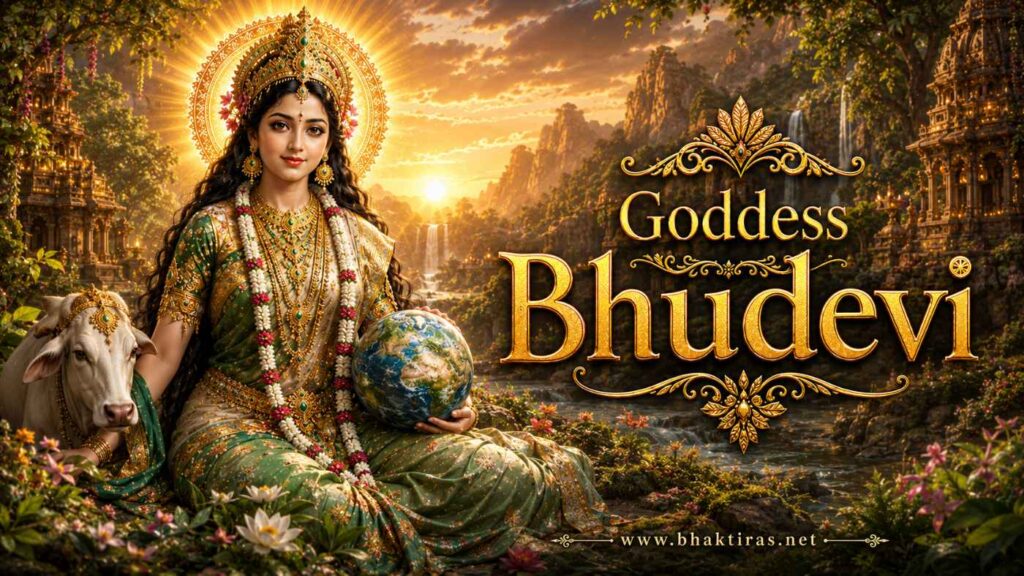
Bhudevi is the Hindu goddess of the Earth, the patient mother who carries and feeds every living thing. She is one of the two consorts of Lord Vishnu, alongside Sridevi (Lakshmi). When the demon Hiranyaksha dragged her into the cosmic ocean, Vishnu became Varaha, the boar, and lifted her back on his tusks.
Who Is Goddess Bhudevi?
Bhudevi is the ground beneath your feet given a face and a heart. She is the goddess of the Earth herself – the soil that holds the seed, the field that yields the harvest, the mountain that stays put through every storm. Where many deities rule from a distant heaven, Bhudevi is here, always, carrying the whole weight of the living world on her patient back.The Earth made mother
Her names tell you what she is. Bhumi and Prithvi both mean the wide earth; Vasundhara is she who holds treasures in her lap; Dharani is the one who bears and supports. To Hindus she is not a symbol of the Earth but the Earth as a person – one who feels our footsteps, who suffers when we harm the land, and who gives without ever asking anything back.
A goddess close to the ground
Farmers speak to her before they turn the first furrow. Families pray to her before laying a foundation stone. Many people, on rising, touch the floor and ask her pardon for walking upon her all day. That daily intimacy is what sets her apart. She belongs less to grand temple ceremony and more to the ordinary work of ploughing, building, and living.
The All-Bearing Mother
If Bhudevi has one great teaching, it is patience. She holds up oceans and forests, cities and deserts, saints and thieves alike, and she does it without complaint. She is called Kshama itself – forbearance – because she endures what would break anyone else.She carries everything
The old texts picture the whole world resting on her – and she never sets it down. Rain falls on her, ploughs cut her, fires scorch her, feet trample her, and still she brings up green shoots every spring. Her strength is not the strength that strikes back. It is the deeper strength of one who keeps giving even after being wounded.
The mother who feeds all
Every grain of rice, every fruit, every drop of water that keeps a body alive comes up out of Bhudevi. She feeds the insect and the emperor from the same store. When people say the Earth is our mother, they mean this literally in her worship – she is the one womb from which all food and all bodies are drawn, and to which they finally return.
Consort of Vishnu – Sridevi and Bhudevi
Lord Vishnu, the great preserver, is shown with two goddesses at his side, and together they describe how the world is kept whole. On one side is Sridevi – Lakshmi – the goddess of wealth, beauty and grace. On the other is Bhudevi, the Earth, the goddess of endurance and fertility. Between grace and ground, the two of them hold the balance of life.The two goddesses at Tirumala
Nowhere is this seen more clearly than at Tirumala, where Lord Venkateswara is worshipped with Sridevi and Bhudevi resting on his chest. Pilgrims who climb the hills come to a Lord who is never alone – always flanked by the goddess of wealth and the goddess of Earth, a reminder that his blessing includes both plenty and stability.
Grace and endurance
Sridevi is often the lively, mobile one, given to coming and going as fortune does. Bhudevi is the steadfast one who stays. In many South Indian temples the two are given separate shrines beside Vishnu precisely so that each can be honoured for her own nature – one for grace, one for the ground that grace rests upon.
Rescued by Varaha – the Boar Who Lifted the Earth
The most loved story about Bhudevi is the one where she is in danger and Vishnu comes for her. It is remembered every time the Varaha avatar is worshipped, and it is one of the tenderest images in all of Hindu myth – the Lord diving into darkness to bring the Earth home.The Earth dragged into the deep
The demon Hiranyaksha, drunk on his own power, seized the Earth and dragged her down beneath the cosmic ocean, rolling her up and sinking her into the waters at the bottom of creation. With the Earth gone, there was no ground for any being to live on, no field to sow, no place to stand. The whole order of life was undone.
Varaha dives for her
Vishnu took the form of Varaha, a mighty boar, and plunged into the ocean after her. He fought and slew Hiranyaksha in the deep, then found the Earth sunk in the mud. Setting her gently on his curved tusks, he rose – up through the churning water, up into the light – and placed Bhudevi back where she belonged, steady once more beneath the sky.
Why the image endures
Sculptors across India love this moment: the great boar rising from the waves, the small figure of the Earth-goddess clinging to his tusk, safe. It is Vishnu’s whole nature in one scene – the preserver who will go to the bottom of the world to save what is helpless. For Bhudevi’s devotees it is the promise that the Earth, however wounded, is never abandoned.
Mother of Sita
Bhudevi is also a mother in the family sense, and her most famous child is Sita, the beloved of the Ramayana. Sita’s whole life is bracketed by the Earth – she comes from it and she returns to it.Born from a furrow
King Janaka found the infant Sita in the field as he ploughed for a sacrifice – she rose out of the opened furrow, a gift of the Earth. Her very name, Sita, means the furrow. She had no ordinary birth; Bhudevi herself was her mother, and the child carried the Earth’s own patience and quiet strength through every trial of her life.
Returning to the Earth
At the close of the Ramayana, tested past bearing, Sita calls on her mother, and the Earth opens to receive her. Bhudevi rises and takes her daughter home into the ground she came from. It is a scene of grief and of homecoming at once – the Earth reclaiming her own, closing the circle that began in Janaka’s field.
The Prithvi Sukta – the Vedic Hymn to Mother Earth
Long before the Puranas told her stories, the Earth was already sung to in the Vedas. The Prithvi Sukta, the Hymn to the Earth in the Atharvaveda, is one of the oldest and most moving pieces of ecological prayer humanity has – a long, loving address to the ground as a living, breathing mother.Mata Bhumih putro aham prithivyah
The hymn’s most quoted line says it plainly: Mata Bhumih putro aham prithivyah – the Earth is my mother, and I am her child. In a single breath it sets the whole relationship. We are not owners of the land but its children, dependent on it, answerable to it, and asked to treat it with the tenderness a child owes a mother.
An ancient ecology
The sage-poet praises the Earth for her mountains and snows, her forests and flowing waters, and prays that whatever we dig or plough or take from her may heal over quickly, that we may never wound her past repair. Thousands of years old, it reads like a plea a careful gardener might make today – to draw from the land without exhausting it.
Honouring the Earth – Bhoomi Puja and Daily Reverence
Bhudevi is worshipped less in high festivals and more in the small, practical rituals of daily life – the moments when a person is about to disturb the Earth and pauses first to ask her leave. This is her genius: she keeps reverence tied to real work.Bhoomi Puja before you begin
Before a house rises or a field is first turned, families perform Bhoomi Puja – a worship of the Earth on the very spot to be used. They mark the ground, offer flowers, turmeric and grain, and ask Bhudevi’s permission to build or to sow, along with her blessing that whatever is raised there will stand firm and prosper.
The morning apology
Many people begin the day with a short prayer to the Earth before their feet touch the floor – Samudra vasane devi, parvata stana mandale – greeting her as the goddess robed in oceans and crowned with mountains, and asking her to forgive the offence of stepping on her all day long. It is a small gesture, but it keeps gratitude alive from the first moment of waking.
How Goddess Bhudevi Is Worshipped
Worship of Bhudevi runs through both temple and home, and much of it is woven into ordinary life. These are some of the ways devotees honour the Earth goddess:- Bhoomi Puja – a ceremony of the Earth performed on the ground before beginning construction of a house, temple, or well, seeking her permission and blessing.
- Reverence before ploughing – farmers offer prayers and simple gifts to the soil before the first furrow of a new season.
- The morning prayer – touching the ground and asking her forgiveness for treading upon her, recited on waking.
- Worship with Vishnu – honouring Bhudevi alongside Sridevi at the side of Venkateswara and other forms of Vishnu, especially at Tirumala.
- Recitation of the Prithvi Sukta – chanting the Atharvaveda hymn to the Earth in Vedic and ecological observances.
- Varaha worship – remembering her rescue in the temples and shrines dedicated to the boar avatar.
- Offerings of grain and flowers – giving back to the Earth a share of what she has yielded, in gratitude for the harvest.
Prayers and Mantras of Bhudevi
The prayers to Bhudevi are gentle and grounding, fit for the start of any work upon the land. Chant them slowly, with a mind turned toward gratitude for the Earth that holds you.The seed mantra
ॐ भूम्यै नमः
Om Bhumyai Namah
Salutations to the Earth Goddess. This short, steady mantra is offered in reverence to Bhudevi – a simple bowing of the head to the mother who bears us all.
The morning verse to the Earth
समुद्रवसने देवि पर्वतस्तनमण्डले।
विष्णुपत्नि नमस्तुभ्यं पादस्पर्शं क्षमस्व मे॥
Samudra-vasane devi parvata-stana-mandale, Vishnu-patni namastubhyam pada-sparsham kshamasva me.
O Goddess robed in the oceans, crowned with mountains, consort of Vishnu – I bow to you; forgive me the touch of my feet.
Frequently Asked Questions about Goddess Bhudevi
Who is Goddess Bhudevi?
Bhudevi is the Hindu goddess of the Earth – the patient mother who bears and feeds every living being. She is one of the two consorts of Lord Vishnu, worshipped alongside Sridevi (Lakshmi). Known also as Bhumi, Prithvi and Vasundhara, she stands for endurance, fertility and gratitude toward the land.
How did Varaha rescue the Earth?
When the demon Hiranyaksha dragged the Earth down into the cosmic ocean, Vishnu took the form of Varaha, a great boar. He dived into the deep, slew Hiranyaksha, and found Bhudevi sunk in the mud. Lifting her on his tusks, he rose through the water and set the Earth back safely beneath the sky.
Why are there two consorts of Vishnu?
Vishnu is shown with Sridevi and Bhudevi because together they describe how life is sustained. Sridevi (Lakshmi) is grace, wealth and beauty; Bhudevi is the Earth, endurance and fertility. A whole life needs both – the grace to enjoy and the ground to stand on – so the preserver is honoured with both goddesses at his side.
What are Bhudevi's other names?
She is called Bhumi and Prithvi, both meaning the wide Earth; Vasundhara, she who holds treasures in her lap; and Dharani, the one who bears and supports. Each name points to a different aspect of the same goddess – the ground that carries us, feeds us, and quietly holds the world together.
Is Bhudevi the mother of Sita?
Yes. In the Ramayana, Sita was found by King Janaka as he ploughed a field, rising out of the opened furrow – a child of the Earth herself. Her name means the furrow. At the story's end, the Earth opens once more and Bhudevi takes her daughter back into the ground she came from.
What is the Prithvi Sukta?
The Prithvi Sukta is a long hymn to the Earth in the Atharvaveda, one of the oldest Vedic prayers of reverence for the land. Its famous line, Mata Bhumih putro aham prithivyah, means the Earth is my mother and I am her child. It reads today like an ancient piece of ecological gratitude.
How is Bhudevi worshipped in daily life?
She is honoured mostly through practical rituals. Bhoomi Puja is performed before building a house or ploughing a field, asking her leave. Many people begin the day by touching the ground and asking her forgiveness for walking upon her. Grain and flowers are offered in thanks for the harvest she yields.
May Mother Bhudevi bless you with patience, plenty, and a heart that treads gently upon the Earth.