
The Saptamatrika
सप्तमातृका
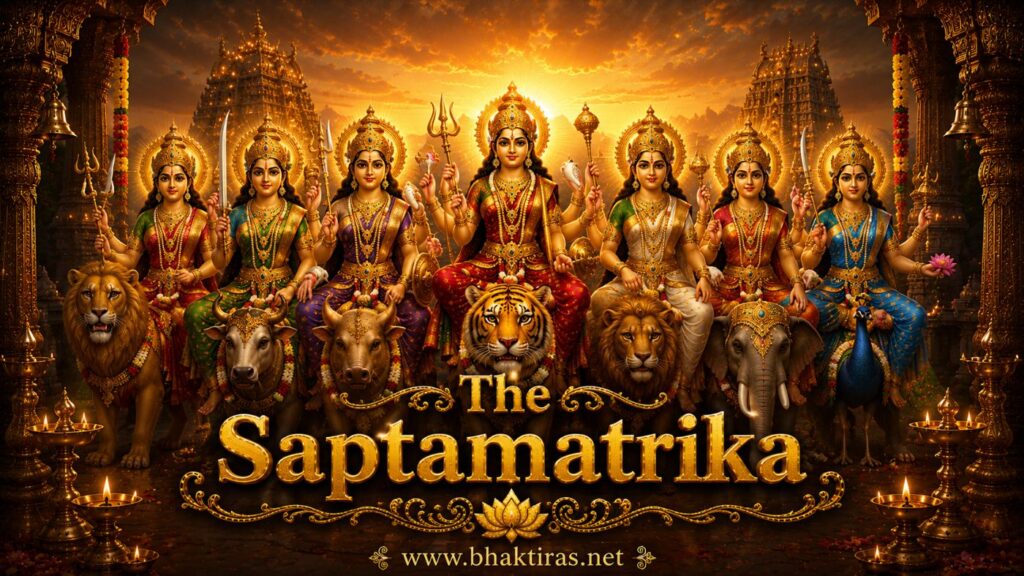
The Saptamatrika are the seven mother goddesses of Hinduism, the feminine powers or Shaktis of the great gods. In the Devi Mahatmya they spring from the bodies of the gods to help the Great Goddess destroy the demons Shumbha, Nishumbha and Raktabija. Each mother carries her god's weapons and mount, and together they are worshipped as fierce, protective mothers.
Who Are the Saptamatrika?
The Saptamatrika are a set of seven mother goddesses honoured across Hindu tradition as the collected powers of the divine. Their name is simple and direct – sapta means seven, matrika means little mother or mother. Together they are the seven mothers, worshipped not as separate rivals but as a single circle of feminine force.
Each of the seven is the Shakti, the active energy, of one of the great gods. Where a god sits in stillness, his power moves through his goddess. So Brahmani is the power of Brahma, Maheshwari of Shiva, Vaishnavi of Vishnu, and so on. The gods hold the thrones; the mothers do the work of the world.
You will find them almost everywhere in India once you learn to look. They appear as a row of seated figures on temple walls, carved onto old hero-stones that mark a warrior’s death, and enshrined in Tantric sanctuaries where their fierce aspect is central. In most panels they are flanked by Virabhadra, a fierce form of Shiva, on one side and Ganesha on the other, framing the seven mothers between them.
Sometimes the group is counted as eight rather than seven. When the lion-headed Narasimhi is added, they become the Ashtamatrika, the eight mothers. The number shifts with region and text, but the idea holds steady: the one Divine Mother expresses herself through many powers, and here those powers stand together.
The Shaktis of the Great Gods
To understand the Matrikas you first have to understand Shakti. In Hindu thought, a god is the still ground of a thing, and his Shakti is that thing in motion. A lamp is nothing without its flame; the flame is the Shakti of the lamp. In the same way, each great god has a goddess who is his energy set loose in the world.
This is why the seven mothers mirror their gods so closely. Brahmani rides the swan and carries the water-pot and rosary of Brahma. Maheshwari sits on the bull and holds the trident of Shiva, a crescent moon on her brow. Vaishnavi rides Garuda and bears the conch and discus of Vishnu. Kaumari carries the spear and peacock of Kartikeya. Varahi wears the boar’s face of the Varaha avatar. Indrani rides the great elephant Airavata and wields the thunderbolt of Indra. Each mother is her god turned feminine, keeping his emblems, his mount and his ornaments.
The teaching hidden in this mirroring is gentle but firm. Power is not male alone. The very strength that the gods are famous for lives fully in these goddesses, and in the hour of real danger it is the mothers, not the gods, who ride out to fight. The masculine principle rests; the feminine principle acts.
The Seven Mothers
Here are the seven Matrikas as the Devi Mahatmya and the Puranas name them, each paired with the god whose power she carries.
Brahmani
The Shakti of Brahma, the creator. She shares his four faces and rides the swan, holding the water-pot, rosary and sacred ladle. Golden in colour, she carries the calm authority of creation itself, the mother from whom ordered life begins.
Maheshwari
The Shakti of Shiva, also called Rudrani or Maheshi. She rides the bull Nandi, wears a crescent moon and serpents, and holds Shiva’s trident. Hers is the power of stern, austere lordship, at once ascetic and fierce.
Kaumari
The Shakti of Kartikeya, the youthful war-god also called Skanda or Kumara. She rides the peacock and carries his spear. Kaumari is the energy of fresh, fearless valour, the mother who moves with a soldier’s speed.
Vaishnavi
The Shakti of Vishnu, the preserver. She rides Garuda, the eagle, and holds the conch, discus, mace and lotus of her lord. Vaishnavi carries the steadying power that keeps the worlds from falling apart.
Varahi
The Shakti of Varaha, Vishnu’s boar avatar. She wears the boar’s head and often rides a buffalo. Varahi is a deep, earthy power, closely honoured in Tantra as a fierce guardian who lifts the devotee out of danger as Varaha once lifted the earth.
Indrani
The Shakti of Indra, king of the gods, also called Aindri. She rides the great elephant Airavata and wields the thunderbolt, the vajra. Many-eyed and crowned, Indrani carries the sovereign power of the heavens.
Chamunda
The fierce one, born from the wrath of the Goddess herself. Gaunt, garlanded with skulls and seated on a corpse or preta, Chamunda is the mother who devours darkness. She is the destroyer of the demons Chanda and Munda, and stands slightly apart from the rest as pure, terrible power.
How the Matrikas Aided the Devi
The war against Shumbha and Nishumbha
The great story of the Matrikas comes from the Devi Mahatmya, the ancient hymn to the Goddess. Two demon brothers, Shumbha and Nishumbha, had seized the three worlds and driven the gods from heaven. The gods poured out their prayers, and from that combined cry the Great Goddess arose to fight. As the battle grew vast, she needed her powers to take separate forms.
The mothers stream forth
In the thick of the fighting, the Shaktis of the gods came out from the bodies of Brahma, Shiva, Vishnu, Kartikeya, Indra and the rest, each in the shape and colour of her god, mounted on his vehicle and armed with his weapons. These were the Matrikas. They fell upon the demon armies together, a wave of mothers laughing and roaring across the field, cutting down the hosts of Shumbha and Nishumbha.
The problem of Raktabija
Then came Raktabija, a demon with a terrible gift. Every drop of his blood that touched the ground sprang up as a new demon exactly like him. Each wound the Matrikas gave him only multiplied him, until the field swarmed with a thousand Raktabijas. The mothers’ weapons, made to destroy, were now feeding the very enemy they struck.
Kali drinks the blood
The answer was Chamunda-Kali, the darkest mother. As the Matrikas struck Raktabija again and again, Kali spread her enormous tongue and drank every falling drop of blood before it could reach the earth, swallowing the clones as fast as they were born. Drained dry, Raktabija at last fell dead, and soon after, the Goddess destroyed Shumbha and Nishumbha themselves. Heaven was returned to the gods, and the mothers, their work done, dissolved back into the one Devi from whom they had come.
The Ashtamatrika – the Eighth Mother
In many regions and texts the seven mothers become eight, and the group is then called the Ashtamatrika. The mother most often added is Narasimhi, the Shakti of Narasimha, Vishnu’s fierce man-lion avatar. Lion-headed and maned, she is said to shake the worlds when she tosses her mane, and demons scatter before her roar.
The choice of an eighth is not fixed. Some lists name Narasimhi, others include Vinayaki, the elephant-headed Shakti of Ganesha, and a few traditions count Mahalakshmi or Yogeshwari among the mothers. The number and the names shift from Purana to Tantra and from one part of India to another. What never changes is the underlying idea. Whether they are seven or eight, the mothers are a single sisterhood of divine power, and adding one more simply widens the circle without changing its heart.
The Mothers as Guardians and Protectors
Away from the great battle, the Matrikas are honoured most tenderly as mothers who protect. They watch over children, and old prayers ask them to keep the young safe from illness, fever and unseen harm. In some early traditions the mothers were feared as fierce spirits who could bring sickness to a child if neglected, and worshipped so that they would give health and long life instead. Their fierceness and their tenderness are two faces of the same maternal power.
They are also guardians of space. In temple architecture the mothers are set to watch the directions and to seal the boundaries of a sacred site, so that no negative force may enter. On hero-stones they stand beside the fallen warrior, escorting him onward. In Tantric practice the Matrikas are placed at the points of a mandala, each mother holding her quarter, forming a living wall of protection around the seeker and the rite.
To pray to them is to ask for a mother’s guarding hand over everything one loves – the home, the children, the threshold, the inner life. They are strict guardians, quick to defend, and their protection is felt as something solid, like a door that will not be forced.
How the Saptamatrika Are Worshipped
Worship of the seven mothers is old and widespread, and takes many simple forms in temple, shrine and home.
- As a row of seven – the mothers are most often honoured together as a panel or set of seven images, worshipped as one group rather than singly, with Ganesha and Virabhadra guarding the two ends.
- Lighting the lamp and offering – devotees offer a lit lamp, incense, red flowers, kumkum and turmeric before the mothers, treating them as the fierce yet loving mothers of the family.
- During Navaratri – the nine nights of the Goddess are a natural time to honour the Matrikas as forms and helpers of the Devi, with recitation of the Devi Mahatmya.
- Reciting the Devi Mahatmya – chanting the Durga Saptashati, which tells the mothers’ story, is itself a form of their worship and is believed to invite their protection.
- In Tantric ritual – practitioners install the Matrikas at the points of a mandala or yantra, invoking each mother in her quarter to guard the sacred space.
- For the protection of children – families pray to the mothers for the health and safety of newborns and young children, an old and enduring aspect of their worship.
- At Matrika shrines and hero-stones – small roadside and village shrines to the seven mothers receive quiet daily reverence as guardians of the place.
Prayers and Mantras
The simplest way to call on the seven mothers is with a short mantra of salutation, offered with a lamp and a still mind. A traditional prayer honours them as the collected Shaktis of the gods.
ॐ सप्तमातृभ्यो नमः
Om Saptamatribhyo Namah
Salutations to the Seven Mothers.
A fuller invocation names them in turn, so that the devotee greets each mother and her power:
ब्राह्मी माहेश्वरी चैव कौमारी वैष्णवी तथा। वाराही चैव माहेन्द्री चामुण्डा सप्तमातरः॥
Brahmi Maheshwari chaiva Kaumari Vaishnavi tatha, Varahi chaiva Mahendri Chamunda sapta matarah.
Brahmani and Maheshwari, Kaumari and Vaishnavi, Varahi and Indrani, and Chamunda – these are the seven mothers.
Whether chanted in full or held as a single line, these prayers place the devotee inside the circle of the mothers, asking for their guarding strength over body, home and heart.
Frequently Asked Questions about the Saptamatrika
Who are the Saptamatrika?
The Saptamatrika are the seven mother goddesses of Hinduism, worshipped together as the Shaktis, or feminine powers, of the great gods. In the Devi Mahatmya they emerge from the bodies of the gods to help the Great Goddess destroy the demons Shumbha, Nishumbha and Raktabija, and they are honoured as fierce, protective mothers.
Who are the seven mother goddesses?
The seven mothers are Brahmani, the power of Brahma; Maheshwari, of Shiva; Kaumari, of Kartikeya; Vaishnavi, of Vishnu; Varahi, of the boar Varaha; Indrani, of Indra; and Chamunda, the fierce one born from the Goddess. Each carries the weapons and mount of her god, so she mirrors him in feminine form.
What do the Matrikas represent?
The Matrikas represent the truth that the one Divine Mother expresses herself through many powers. Each mother is the active energy of a god, showing that divine strength is fully feminine as well as masculine. Together they stand for protection, motherhood and the victory of the sacred over demonic forces.
What is the difference between Saptamatrika and Ashtamatrika?
Saptamatrika means the seven mothers, the most common count. Ashtamatrika means the eight mothers, formed by adding an eighth goddess, most often the lion-headed Narasimhi. The names and number of the eighth vary by region and text, but the group's meaning as a sisterhood of divine power stays the same.
Who is Chamunda among the seven mothers?
Chamunda is the fiercest of the seven, born directly from the wrath of the Great Goddess rather than from a god. Gaunt and garlanded with skulls, she is closely linked with Kali, and it was she who drank the blood of the demon Raktabija so that his clones could not be reborn from each drop that fell.
How were the Matrikas involved in the killing of Raktabija?
The demon Raktabija created a new clone from every drop of his blood that touched the ground. As the Matrikas wounded him, he only multiplied. The problem was solved when Chamunda-Kali spread her tongue and drank each falling drop before it reached the earth, allowing the Goddess to finally destroy him.
Where are the Saptamatrika found in temples?
The seven mothers are often carved as a row of seated goddesses on temple walls, flanked by Virabhadra and Ganesha. They also appear on old hero-stones marking a warrior's death and in Tantric shrines, where they guard the directions and the boundaries of the sacred space.
May the seven mothers keep their guarding hands over your home, your loved ones and your inner life.