
Goddess Brahmani
ब्राह्मणी
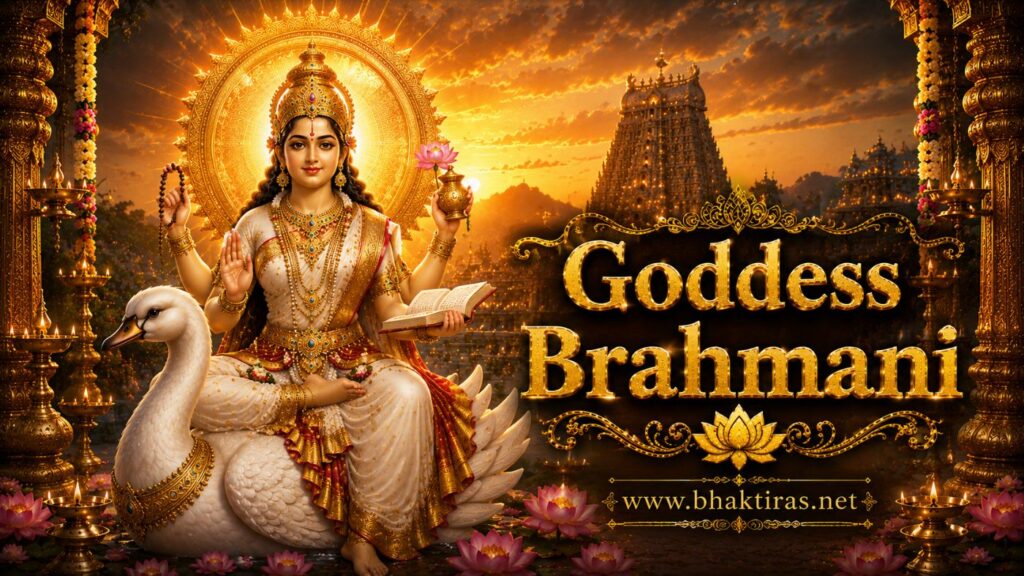
Brahmani, also called Brahmi, is the Shakti of Lord Brahma and the first of the Saptamatrika, the seven mother goddesses. She mirrors the creator in feminine form, shown with four faces, a golden complexion, and the swan as her mount. Holding the water pot, rosary and the Vedas, she embodies sacred knowledge and the primal energy of creation.
Who Is Goddess Brahmani
Goddess Brahmani is the feminine power of Lord Brahma, the creator among the Hindu trinity. Where Brahma shapes the worlds through thought and the spoken sound of the Vedas, Brahmani is the living energy that makes that shaping possible. She is worshipped as Brahmi, the mother who carries within her the impulse to bring form out of the formless.
She holds a special place as the first of the Saptamatrika, the seven mother goddesses who each embody the Shakti of a great deity. In the circle of the Matrikas, Brahmani is always named at the beginning, for creation must come before all else. Her presence at the head of that group reflects an old idea in Hindu thought – that every act of the universe begins with a creative spark, and that spark has a mother.
Devotees turn to Brahmani when they seek clarity of mind, the growth of learning, and the quiet strength to begin something new. She is not a fierce goddess of the battlefield alone, though she takes her place in the Devi’s great war. She is gentle, watchful and wise, the kind of divine mother who teaches rather than frightens.
Her image gathers the whole meaning of her nature into a single serene form: four calm faces, a golden glow, a swan resting near her feet, and in her hands the tools of prayer and knowledge. To look upon Brahmani is to be reminded that creation and wisdom are two sides of one sacred power.
The Shakti of the Creator
In Hindu thought, every god has his Shakti, the feminine energy without which he cannot act. Brahma, seated on his lotus, is the mind that conceives the universe, but it is Brahmani who gives that conception life and motion. She is the difference between an idea and a world that breathes.
This partnership is not one of ruler and servant but of two halves of a single whole. The Puranas describe Shakti as the power inseparable from the one who holds it, the way heat cannot be parted from fire. So Brahmani is Brahma’s creative will made active, the current that turns the potential of creation into the shapes of stars, seasons and living things.
Because Brahma is the source of the Vedas and of ordered speech, Brahmani carries the same authority over sacred sound and learning. Priests and seekers who honour the beginnings of things – a new study, a new dwelling, a fresh season of worship – call upon her to bless that first step. She stands at the threshold of every creative act, unseen but essential.
The Mirror of Brahma
Brahmani is often described as Brahma seen in a mirror, her form built to echo his. Brahma is famed for his four heads, which look in the four directions and recite the four Vedas. Brahmani too is shown with four faces, so that whichever way a devotee approaches her, a calm gaze meets them and the whole compass of knowledge is present.
Her mount is the hamsa, the swan or wild goose that also carries Brahma. In old teaching the swan is said to separate milk from water, a picture of the discerning wisdom that sorts truth from illusion. Riding upon it, Brahmani becomes the goddess who helps the seeker tell what is lasting from what merely glitters.
Her hands hold the emblems of Brahma’s own world. The kamandalu, the ascetic’s water pot, holds the pure waters from which creation is nourished. The akshamala, the rosary of beads, marks the endless repetition of sacred sound and the turning of time. In her remaining hands she may carry the Vedas themselves or a lotus, the flower on which Brahma is born. Golden in colour, seated in unhurried grace, she gathers every mark of the creator and holds them in a mother’s keeping.
Brahmani Among the Saptamatrika
The Saptamatrika are seven mother goddesses who appear together in Hindu myth and sculpture, each drawn from the energy of a major deity. Brahmani stands first, followed by Maheshvari, Kaumari, Vaishnavi, Varahi, Indrani and Chamunda. Carved side by side on temple panels, they form a row of watchful mothers, and Brahmani opens the line with her swan and her serene four faces.
In the Devi Mahatmya, the account of the Great Goddess and her battles, the Matrikas are born at a moment of need. As the Devi wars against the armies of the demons, the gods send forth their energies in female form to fight beside her. From Brahma comes Brahmani, seated on her swan, water pot in hand, joining the great mother in the field. She does not fight for herself but pours her creative strength into the Devi’s cause.
This story gives Brahmani a double character that devotees cherish. She is the gentle goddess of learning and beginnings, and she is also a warrior-mother who answers the call when order itself is threatened. In the Matrika group her presence reminds worshippers that even creation must sometimes defend the world it has made.
Goddess of Wisdom and Creative Power
Because she springs from the god of creation and of the Vedas, Brahmani is honoured above all as a goddess of wisdom and creative power. Students, teachers, poets and craftsmen have long looked to her for the clear thinking that lets an idea take shape. Her rosary and her books speak of study and steady practice, the patient work by which knowledge is gained.
Her creative power is not only about the making of the world in myth. It reaches into ordinary life – the founding of a home, the start of a harvest, the first line of a new work. In each of these small acts of beginning, devotees feel the same energy that Brahmani carries on the cosmic scale. To honour her is to ask that one’s own efforts be fruitful and true.
There is a gentleness to this power. Brahmani grants growth without haste, learning without pride. Her golden calm suggests that real creativity comes from a settled mind rather than a restless one. In her, wisdom and creation are joined, so that what is made carries understanding within it.
Iconography & Symbols
Four Faces
Brahmani’s four faces mirror the four heads of Brahma, each turned to a direction and each linked with one of the four Vedas. Together they show a goddess whose knowledge and gaze reach across the whole of creation.
The Hamsa (Swan)
Her mount is the swan, the same bird that bears Brahma. Said to separate milk from water, the hamsa stands for the discerning wisdom that tells truth from illusion, carried always beneath the goddess.
Kamandalu (Water Pot)
The ascetic’s water pot in her hand holds the pure waters that nourish creation. It marks her link to sacred ritual, to purity, and to the primal waters from which the world is said to arise.
Akshamala (Rosary)
The rosary of beads speaks of repeated prayer, the chanting of sacred sound, and the endless turning of time. It is the sign of steady spiritual practice and of the ordered rhythm behind creation.
The Vedas & Lotus
Brahmani may hold the Vedas, the body of sacred knowledge, or a lotus, the flower on which Brahma is born. Both point to her role as keeper of wisdom and as the mother from whom creation blossoms.
Golden Form
Her golden complexion recalls the colour of dawn and of sacrificial fire. Seated in unhurried grace, she appears as a serene mother whose calm holds within it the vast energy of the creator.
How Goddess Brahmani Is Worshipped
Brahmani is honoured mostly within the group of the Saptamatrika and in Tantric traditions, though her gentle nature draws devotees seeking learning and new beginnings. Worship of her tends to be quiet and inward, fitting a goddess of wisdom.
- Chanting her mool mantra, Om Brahmanyai Namah, especially before study, prayer or the start of a new task.
- Offering water, white flowers and lamps at Matrika shrines where the seven mothers are worshipped together.
- Honouring her within the wider worship of the Saptamatrika during Navaratri and other festivals of the Great Goddess.
- Reciting or listening to the Devi Mahatmya, in which Brahmani appears among the mothers aiding the Devi.
- Seeking her blessing for learning, clear thought and creative work, often alongside prayers to Saraswati and Brahma.
- Approaching her in Tantric practice as one of the Matrika energies, with the guidance of a teacher.
Temples & Sacred Sites
Brahmani is rarely the sole deity of a large temple. She is most often found as part of a Saptamatrika group, carved or installed alongside the other six mothers. These shrines appear across India, from ancient sculptural panels to living places of worship.
- Saptamatrika shrines and sculptural panels found in temples across India, where Brahmani opens the row of seven mothers.
- Matrika reliefs at heritage temple sites in Rajasthan, Madhya Pradesh, Karnataka and Odisha, treasured for their early carvings.
- Village and folk shrines in western and southern India where Brahmani or Brahmi is venerated as a guardian mother.
- Tantric temples and Devi shrines where the Matrikas are worshipped together as protective energies.
- Temples of the Great Goddess where the Saptamatrika are honoured as her attendant powers during festival worship.
Prayers & Mantras
The simplest way to honour Brahmani is through her mool mantra, offered with a settled mind. It calls on her as the feminine power of the creator and the mother of sacred knowledge. The mantra is given below in Devanagari with its transliteration and meaning.
ॐ ब्राह्मण्यै नमः
Om Brahmanyai Namah
I bow to Brahmani, the Shakti of Brahma, the mother of creation and sacred wisdom. May she bless my thought, my learning and every new beginning with clarity and grace.
Frequently Asked Questions about Goddess Brahmani
Who is Goddess Brahmani?
Brahmani, also called Brahmi, is the Shakti or feminine energy of Lord Brahma, the creator. She is the first of the Saptamatrika, the seven mother goddesses. Shown with four faces, a golden form and the swan as her mount, she embodies creative power and sacred knowledge.
Is Brahmani the same as Saraswati?
No. Both are linked to Brahma, but they are distinct. Saraswati is Brahma's consort and the goddess of speech, music and learning. Brahmani is the Matrika Shakti of Brahma, one of the seven mothers, who mirrors his four-faced form and joins the Devi's battle in the Devi Mahatmya.
What does Brahmani represent?
Brahmani represents the creative power of the universe joined with sacred wisdom. As the energy of Brahma, she stands for the impulse that brings form out of the formless, and for the knowledge held in the Vedas. She is honoured as a mother of learning, growth and new beginnings.
Why does Brahmani have four faces?
Her four faces mirror the four heads of Brahma, from whom she draws her energy. Each face is linked with one of the four directions and one of the four Vedas. Together they show a goddess whose gaze and knowledge reach across the whole of creation.
What is Brahmani's vahana?
Her vahana, or mount, is the hamsa, the swan or wild goose, the same bird that carries Brahma. In tradition the swan can separate milk from water, which makes it a symbol of the discerning wisdom that tells truth from illusion.
What is the role of Brahmani in the Devi Mahatmya?
In the Devi Mahatmya, when the Great Goddess wars against the demons, the gods send their energies in female form to help her. From Brahma comes Brahmani, seated on her swan with her water pot, who joins the other Matrikas in aiding the Devi against the demon armies.
What is the mantra of Goddess Brahmani?
Her mool mantra is <em>Om Brahmanyai Namah</em>, written in Devanagari as ॐ ब्राह्मण्यै नमः. It bows to Brahmani as the Shakti of Brahma and mother of sacred knowledge, and is often chanted before study, prayer or the start of a new undertaking.
May Goddess Brahmani, the golden mother of creation and wisdom, bless your every beginning with clarity, learning and grace.