
Saptamatrika Puja 2026 – Worship of the Seven Mother Goddesses
सप्तमातृका पूजा
When is Saptamatrika Puja in 2026?
Saptamatrika Puja in 2026 falls on Monday, 19 October, on the Ashtami (eighth day) of Sharad Navratri. On this day the Sapta Matrikas – the seven mother goddesses Brahmani, Maheshwari, Kaumari, Vaishnavi, Varahi, Indrani and Chamunda – are worshipped together as the collective feminine power of the gods. The rite is central to Shakta and Tantric traditions and is performed with special intensity on Durga Ashtami.
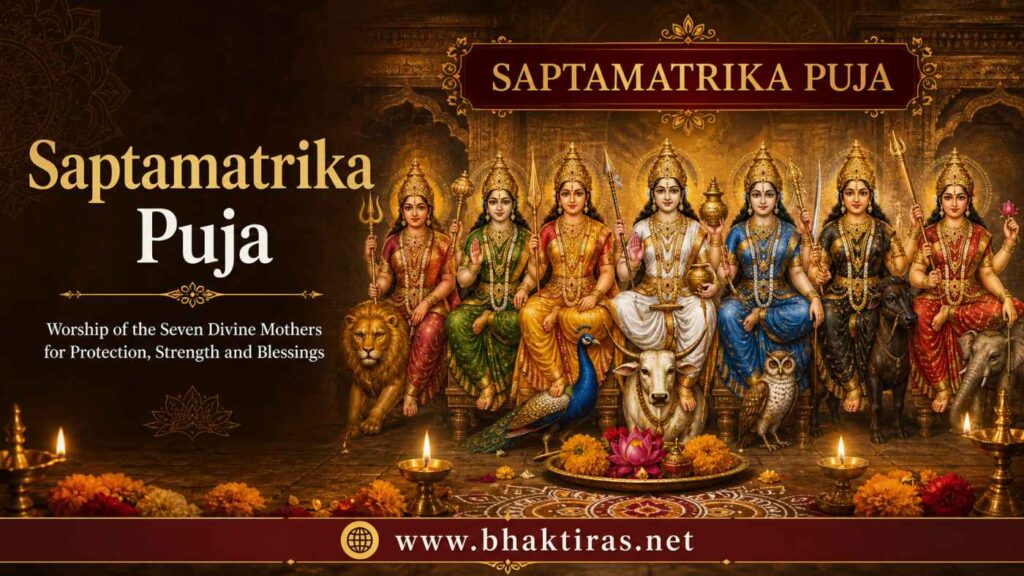
Saptamatrika Puja honours the Sapta Matrikas, the seven mother goddesses who embody the shakti or active power of the great gods. Brahmani, Maheshwari, Kaumari, Vaishnavi, Varahi, Indrani and Chamunda are worshipped as one collective, most prominently on the Ashtami of Sharad Navratri, which falls on 19 October in 2026. Rooted in the Devi Mahatmya’s account of the goddesses who helped Durga slay the demon army, and carved as sculptural panels in temples across Odisha, Bengal and the south, the seven mothers are a living part of Shakta and Tantric worship.
Saptamatrika Puja 2026-2028: Dates & Calendar
Saptamatrika Puja is tied to Maha Ashtami of Sharad Navratri, so its date follows the lunar calendar and shifts each year. In 2026 it falls on 19 October.
| Year | Date | Day | Tithi |
|---|---|---|---|
| 2026 | 19 October | Monday | Maha Ashtami, Sharad Navratri |
| 2027 | 7 October | Thursday | Maha Ashtami, Sharad Navratri |
| 2028 | 26 September | Tuesday | Maha Ashtami, Sharad Navratri |
The Ashtami tithi in 2026 begins on the morning of 18 October and ends on 19 October, so worship follows the tithi rather than the fixed calendar day. Many households and temples also honour the Matrikas on other Ashtami days through the year and at the start of any major puja.
Why Saptamatrika Puja Is Observed
The Saptamatrikas are worshipped as the concentrated feminine energy of the principal gods, and their puja invokes protection, courage and the destruction of negativity.
In the Devi Mahatmya, when Durga fought the demon armies of Shumbha and Nishumbha, the shaktis of the gods emerged from the bodies of Brahma, Shiva, Vishnu, Skanda, Varaha and Indra to fight alongside her, each carrying the weapons and mount of the god she sprang from. A parallel legend links them to Shiva’s battle with Andhaka, where the mothers were summoned to drink the demon’s blood before it could regenerate. These stories place the seven mothers at the heart of the goddess mythology of demon-slaying.
Shaktis of the gods
Each Matrika is the female power of a male deity – Brahmani of Brahma, Maheshwari of Shiva, and so on. Worshipping them together is a way of invoking the combined force of the whole pantheon in its active, maternal form.
Ashtami of Navratri
The eighth day of Sharad Navratri, Maha Ashtami, is the peak of Durga worship, and the Matrikas are honoured on this day as the fierce protectors who turned the tide against the demons. In many temples the Sandhi Puja at the junction of Ashtami and Navami is the most charged moment of the year.
A pillar of Tantra
In the Shakta and Tantric traditions the Matrikas are not only deities but a map of sound and power; the fifty letters of the Sanskrit alphabet are themselves called matrikas, seeds of the mantras through which the goddess is reached. Their worship is therefore both devotional and esoteric.
Carved in stone
From the fifth century CE onward the seven mothers were sculpted as a single panel in Shakta temples, usually flanked by Virabhadra and Ganesha. These reliefs across Odisha, the Deccan and the south make the Matrika cult one of the most widely represented in Indian temple art.
The Seven Matrikas
The Sapta Matrikas are always shown as a group of seven, each mirroring the god whose power she carries, with Chamunda as the sole independent goddess born of Durga herself.
Brahmani
The power of the creator, four-faced like Brahma, seated on a swan or riding a hamsa. She holds a rosary, a water pot and the sacred texts, representing knowledge and the ordering of creation.
Maheshwari
The energy of Shiva, riding the bull Nandi and bearing a trident, a serpent and the crescent moon. She embodies austerity, dissolution and the calm strength of the great ascetic.
Kaumari
The power of Kumara or Kartikeya, the god of war, mounted on a peacock and carrying a spear. She stands for youthful valour and the martial energy of the divine army.
Vaishnavi
The energy of Vishnu, seated on Garuda and holding the conch, discus and mace. She represents preservation, order and the sustaining force that keeps the cosmos in balance.
Varahi
The power of Vishnu’s boar avatar, with the head of a sow, riding a buffalo and holding a plough and a skull cup. A fierce Tantric goddess, she is worshipped for protection and the removal of obstacles, with her own temple at Chaurasi near Puri.
Indrani
Also called Aindri, the energy of the king of the gods, riding an elephant and wielding the thunderbolt (vajra). She carries the authority and majesty of the heavens.
Chamunda
The most fearsome of the seven, emaciated and garlanded with skulls, holding a trident, sword and skull cup. Unlike the others she is not the shakti of a god but sprang directly from Durga to slay the demons Chanda and Munda, from whom she takes her name.
Key Rituals, Step by Step
Saptamatrika Puja can be a household observance or a temple rite; on Ashtami it is often folded into the larger Durga worship.
- Sankalpa and purification. The devotee bathes, cleans the puja space and takes a sankalpa (vow), stating the intention to worship the seven mothers for protection and well-being.
- Setting the seats. Seven small mounds of rice, seven kalashas, or a Matrika panel or image are arranged, often with Ganesha and Virabhadra at the two ends as the traditional guardians of the group.
- Invocation (avahana). Each goddess is invited by name – Brahmani, Maheshwari, Kaumari, Vaishnavi, Varahi, Indrani, Chamunda – with her mantra, and asked to take her seat in the puja.
- Sixteen honours (shodashopachara). The mothers are offered water, sandal paste, red kumkum, flowers, incense, a lamp and cloth, one upachara after another, exactly as a guest of the highest rank would be received.
- Naivedya (food offering). Cooked rice, khichuri, fruit and sweets are placed before the goddesses; in Shakta practice a portion is offered to the fierce forms before it is shared as prasad.
- Chanting. Verses from the Devi Mahatmya, especially the passages describing the shaktis of the gods, along with the Matrika mantras, are recited during the worship.
- Sandhi and aarti. On Ashtami the puja may join the Sandhi worship at the junction with Navami; it closes with aarti, waving of lamps and a prayer for the family’s protection.
- Visarjan or continuation. The invoked energies are respectfully released, or, if part of Navratri, carried forward into the Navami and Vijayadashami worship.
Foods Offered on Ashtami
The bhog for the Matrikas on Ashtami follows the wider Navratri and Durga Puja food tradition, varying by region and household custom.
Khichuri bhog
A soft rice-and-lentil khichuri cooked with ghee and mild spices is the classic Ashtami offering in eastern India, served with fried vegetables (labra) and a sweet chutney as part of the community bhog.
Ashtami sweets
Kheer, halwa, laddoo and coconut-jaggery sweets are prepared as naivedya. In many homes nine kinds of prasad or a simple sweet like suji halwa are offered to the goddess before distribution.
Puri and chana
Where Ashtami is marked with Kanya Puja, the standard meal of puri, kala chana (spiced black chickpeas) and suji halwa is cooked, first offered to the goddess and young girls, then shared.
Sattvic vrat food
Those keeping the Navratri fast prepare kuttu (buckwheat) or singhara flour dishes, sabudana khichdi, fruit and sendha namak (rock salt) preparations, avoiding grain, onion and garlic.
Regional Context
The Matrikas are worshipped across India, though the emphasis shifts between temple sculpture, Tantric ritual and Navratri observance.
Odisha
Odisha holds some of the finest Saptamatrika panels and living shrines, and the fierce Varahi temple at Chaurasi near Puri is a major Tantric centre where the boar-headed mother is the presiding deity.
Bengal
During Durga Puja the Matrikas are honoured within the larger goddess worship, and the Ashtami khichuri bhog and Sandhi Puja bring their fierce, protective aspect to the fore.
South India
Temples across Tamil Nadu, Karnataka and Andhra carry Saptamatrika reliefs, often placed near the sanctum as guardians; the mothers are also linked to the sixty-four Yoginis of the Tantric tradition.
Deccan & Central India
Chalukya and Rashtrakuta-era temples of the Deccan preserve elaborate Matrika panels, reflecting how widely the cult spread from the fifth century onward as an established part of Shakta worship.
Saptamatrika Puja Do's and Don'ts
The Matrikas include fierce forms, so the worship is treated with care, respect and, where Tantric rites are involved, proper guidance.
Do
- Bathe and keep the puja area clean before beginning.
- Invoke all seven mothers by name, not selectively.
- Offer red flowers, kumkum and a ghee lamp with devotion.
- Recite the Devi Mahatmya or Matrika mantras if you know them.
- Approach Tantric forms of the rite only under a qualified guru.
Avoid
- Do not attempt esoteric Tantric practices without proper initiation.
- Avoid offering worship in an unclean or disrespectful manner.
- Do not treat the fierce goddesses casually or mockingly.
- Avoid onion, garlic and non-sattvic food if keeping the Navratri vrat.
- Do not leave a puja started as part of Navratri unfinished.
Frequently Asked Questions
When is Saptamatrika Puja in 2026?
Saptamatrika Puja in 2026 is on Monday, 19 October, the Maha Ashtami of Sharad Navratri. The seven mother goddesses are worshipped together on this day, which is the eighth and one of the most powerful days of the Navratri festival.
When is Saptamatrika Puja in 2027 and 2028?
Saptamatrika Puja follows the Ashtami of Sharad Navratri, so it moves with the lunar calendar. It falls on Thursday, 7 October 2027, and on Tuesday, 26 September 2028.
Who are the seven Matrikas?
The seven Matrikas are Brahmani, Maheshwari, Kaumari, Vaishnavi, Varahi, Indrani (Aindri) and Chamunda. Each is the shakti or active power of a great god – Brahma, Shiva, Skanda, Vishnu, Varaha and Indra respectively – while Chamunda sprang directly from Durga to slay the demons Chanda and Munda.
Why are the Saptamatrikas worshipped?
The Saptamatrikas are worshipped as the combined feminine power of the gods and as protectors who helped Durga destroy the demon armies in the Devi Mahatmya. Their puja is invoked for protection, courage and the removal of negativity, and holds a central place in the Shakta and Tantric traditions.
Which goddess is connected to Saptamatrika Puja?
Saptamatrika Puja is closely tied to Durga, since the seven mothers emerged to fight alongside her against the demons and are worshipped most intensely on Durga Ashtami. Together the Matrikas represent the many faces of the one great Devi or Shakti.
What is the link between the Matrikas and Tantra?
In the Tantric tradition the Matrikas are both goddesses and the seed-sounds of the Sanskrit alphabet, whose fifty letters are themselves called matrikas. They are also connected to the sixty-four Yoginis, making their worship both devotional and esoteric within Shakta practice.
Where can Saptamatrika panels be seen?
Saptamatrika panels are carved in Shakta temples across Odisha, Bengal, the Deccan and South India, usually as a single relief slab flanked by Virabhadra and Ganesha. The Varahi temple at Chaurasi near Puri in Odisha is a well-known living shrine to one of the seven mothers.
How is Saptamatrika Puja performed?
Saptamatrika Puja is performed by invoking all seven mothers by name onto seven seats, kalashas or a Matrika image, then offering the sixteen traditional honours – water, flowers, incense, lamp and food. On Ashtami it is often folded into the larger Durga worship and closed with aarti and a prayer for protection.
May the seven mothers watch over your home with their fierce and loving power this Ashtami. Jai Mata Di.