
Rang Panchami 2027 – The Big Colour Day of Malwa and Maharashtra
रंग पंचमी
When is Rang Panchami in 2027?
Rang Panchami falls on Saturday, 27 March 2027. It lands on the fifth day (Panchami) of the dark fortnight of Chaitra, five days after the main Holi. In Madhya Pradesh and Maharashtra this is the day dry gulal is thrown into the air until the sky itself turns colour.
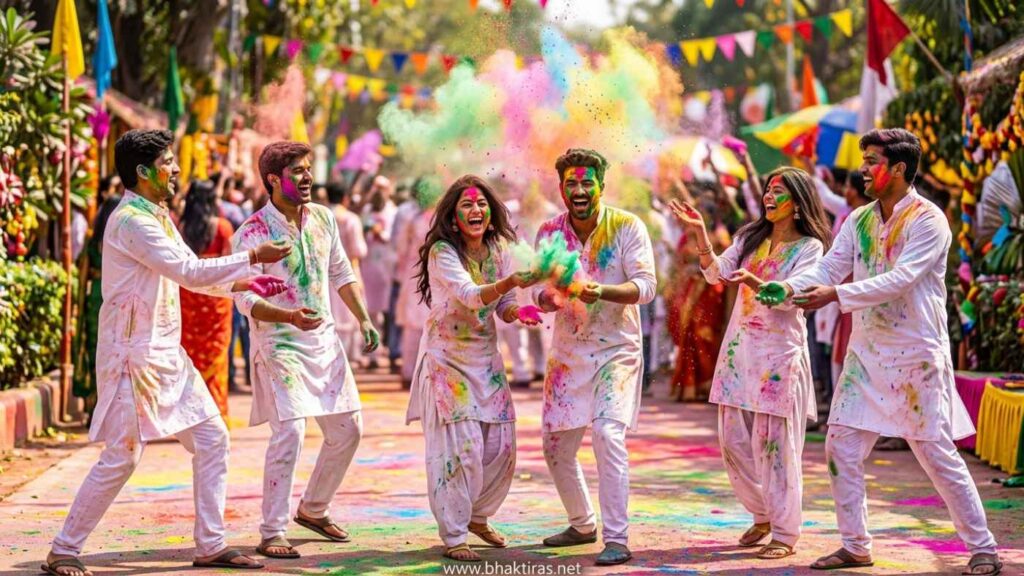
Rang Panchami is the colour festival that arrives five days after Holi, on the fifth day of Chaitra’s dark fortnight. Across Malwa towns like Indore and Ujjain, and through much of Maharashtra, it is the day people actually save their gulal for, not Holi itself. Dry colour is flung skyward by the fistful so the air turns pink and saffron, water tankers spray the crowds, and the streets fill with drums and dance. The colours here are read as an offering that draws the gods down among the celebrants.
Rang Panchami 2026-2028: Dates & Calendar
The next Rang Panchami is Saturday, 27 March 2027. The date shifts each year because it is fixed to the lunar tithi of Chaitra Krishna Panchami rather than a fixed calendar day.
| Year | Date | Day | Notes |
|---|---|---|---|
| 2026 | 9 March | Monday | Fell five days after Holi |
| 2027 | 27 March | Saturday | Next occurrence |
| 2028 | 16 March | Thursday | Chaitra Krishna Panchami |
Why Rang Panchami Is Celebrated
Rang Panchami marks the exuberant close of the Holi season, when colour is offered up to the divine and spring is welcomed in full.
Colour as an offering
The gulal thrown on Rang Panchami is treated less as play and more as devotion. Filling the air with colour is believed to invite the gods themselves to descend and share in the joy, so the day carries a spiritual charge that the earlier Holi lacks.
Krishna and Radha's leela
The colours are tied to the playful leela of Krishna and Radha, whose games with gulal at Vrindavan gave the tradition its shape. Rang Panchami keeps that story alive as a celebration of divine love expressed through colour.
The real colour day
In Malwa and much of Maharashtra, Holi itself is a quieter bonfire night, and the colour play is held back for Rang Panchami. This is when whole towns pour into the streets, making it the largest gathering of the season.
Spring and renewal
Coming at the turn into the warm months, the festival welcomes spring and the end of winter. The riot of colour stands for the earth bursting back into bloom and the season of plenty ahead.
Deities & Figures Worshipped
Rang Panchami is associated chiefly with Krishna and Radha, whose colour-play at Vrindavan is echoed in the day’s celebrations.
Krishna
Krishna is the presiding deity of the colour tradition. His mischievous games of smearing gulal on Radha and the gopis are remembered as the origin of playing with colour, and devotees see the day’s revelry as a way of joining that leela.
Radha
Radha is honoured alongside Krishna as the beloved on whom the first colours were said to be thrown. Together the pair represent the devotion and delight that the festival channels through its washes of gulal.
Key Rituals, Step by Step
The day is loud, wet and colourful from morning onward. Here is how it typically unfolds in Malwa and Maharashtra.
- Early gulal. People step out with pouches of dry gulal soon after morning, greeting neighbours and passers-by with a smear of colour on the cheeks and forehead.
- Throwing colour skyward. By mid-morning fistfuls of dry gulal are flung high into the air rather than only at each other, until the sky over the lanes glows pink, red and yellow.
- Ger processions. In Indore, huge Ger processions wind through the old city, with groups carrying banners, playing music and showering colour over the crowds lining the route.
- Water cannons and tankers. Municipal and community tankers, along with mounted water cannons, spray coloured water over the gathered revellers to keep the streets soaked and cool.
- Folk music and dance. Drums, dhol and folk songs set the rhythm as people dance through the streets, the celebration building into a shared open-air party.
- Dhulivandan link in Maharashtra. In parts of Maharashtra the colour play of Rang Panchami follows on from Dhulivandan, the day after Holi, extending the season of revelry.
- Sharing sweets. Families and neighbours gather afterwards to wash up and share festive foods, closing the day around the table.
Special Foods of Rang Panchami
The colour play is matched by rich seasonal cooking, much of it shared with the wider Holi week.
Puran poli
A flatbread stuffed with a sweet paste of jaggery and split chickpeas, served warm with ghee. It is the classic festive bread of the region and a fixture on Rang Panchami tables.
Thandai
A chilled milk drink flavoured with almonds, fennel, pepper and rose. On the colour days it is sometimes prepared with bhang, so it is offered with care and only to willing adults.
Gujiya
Crescent-shaped pastries filled with sweetened khoya and dry fruit, then fried until crisp. They are made in batches for the Holi season and shared freely with visitors.
Shrikhand
A thick sweet made from strained yoghurt flavoured with cardamom and saffron, often eaten with puran poli. Its cool, tangy sweetness balances the heavier festive fare.
Regional Names & Variations
Rang Panchami is strongest across central and western India, with the celebration taking a distinct shape in each region.
Malwa (Indore, Ujjain)
Here Rang Panchami eclipses Holi as the main colour day. Indore’s Ger processions are the highlight, drawing enormous crowds who fill the old city with dry gulal and coloured water.
Maharashtra
The colour play is tied to Dhulivandan and held on Rang Panchami rather than Holi day. Communities gather to throw gulal, and puran poli and shrikhand mark the festive meal.
Rajasthan
In parts of Rajasthan the fifth day after Holi is observed with colour and folk celebration, carrying the season’s revelry a little further into the week.
Konkan Karnataka
Along the Konkan belt of Karnataka the day is kept as a colour celebration too, blending local custom with the wider Rang Panchami tradition.
Rang Panchami Do's and Don'ts
A few simple courtesies keep the day joyful and safe for everyone.
Do
- Use natural or herbal gulal that washes off easily
- Oil your hair and skin beforehand to protect from colour
- Ask before applying colour to elders or strangers
- Keep water use sensible and avoid wastage
- Look out for children and older people in the crowds
Avoid
- Do not use synthetic or chemical dyes that irritate skin and eyes
- Do not throw colour or water at anyone who has declined
- Do not offer bhang thandai to minors or unwilling guests
- Do not force strangers into the celebration
- Do not aim gulal or water at faces or eyes
Frequently Asked Questions
When is Rang Panchami in 2027?
Rang Panchami in 2027 falls on Saturday, 27 March. It is observed on the fifth day of the dark fortnight of Chaitra, five days after the main Holi celebration.
When is Rang Panchami in 2026 and 2028?
Rang Panchami was on Monday, 9 March 2026 and will next fall on Thursday, 16 March 2028. The date changes each year because it follows the Hindu lunar tithi of Chaitra Krishna Panchami.
Why is Rang Panchami celebrated?
Rang Panchami is celebrated as the day colour is offered up to the divine to close the Holi season and welcome spring. Throwing gulal into the air is believed to invite the gods to join the festivities, and the colours recall the playful leela of Krishna and Radha.
Which god is worshipped on Rang Panchami?
Rang Panchami is associated mainly with Krishna, along with Radha. The colour play echoes their games at Vrindavan, and devotees treat the day’s revelry as a way of sharing in that divine leela.
How is Rang Panchami different from Holi?
Rang Panchami comes five days after Holi and, in Malwa and Maharashtra, is the bigger colour day of the two. While Holi centres on the bonfire, Rang Panchami is when people actually flood the streets with dry gulal, water cannons and processions.
What are the Ger processions of Indore?
The Ger processions are large street parades held in Indore on Rang Panchami. Groups march through the old city with music and banners, showering dry gulal and coloured water over the crowds, and they are the centrepiece of the city’s celebration.
Where is Rang Panchami celebrated?
Rang Panchami is celebrated most strongly in Madhya Pradesh, especially the Malwa region around Indore and Ujjain, and across Maharashtra. It is also observed in parts of Rajasthan and the Konkan belt of Karnataka.
What foods are eaten on Rang Panchami?
Traditional foods include puran poli, gujiya, shrikhand and thandai, which is sometimes prepared with bhang for adults. These rich seasonal dishes are shared with family and neighbours after the colour play.
However you mark the day, may your Rang Panchami be full of colour and good company. Shubh Rang Panchami!