
Phagli Festival 2027 – Himachal's Masked Spring Rite
फागली
When is Phagli Festival in 2027?
Phagli (Faguli) falls in February-March 2027, during the Hindu month of Phalguna, with dates varying from valley to valley across Himachal Pradesh. It is a spring festival of purification in which villagers wear grass-and-leaf costumes and grotesque masks to drive out the evils of winter and welcome the new season.
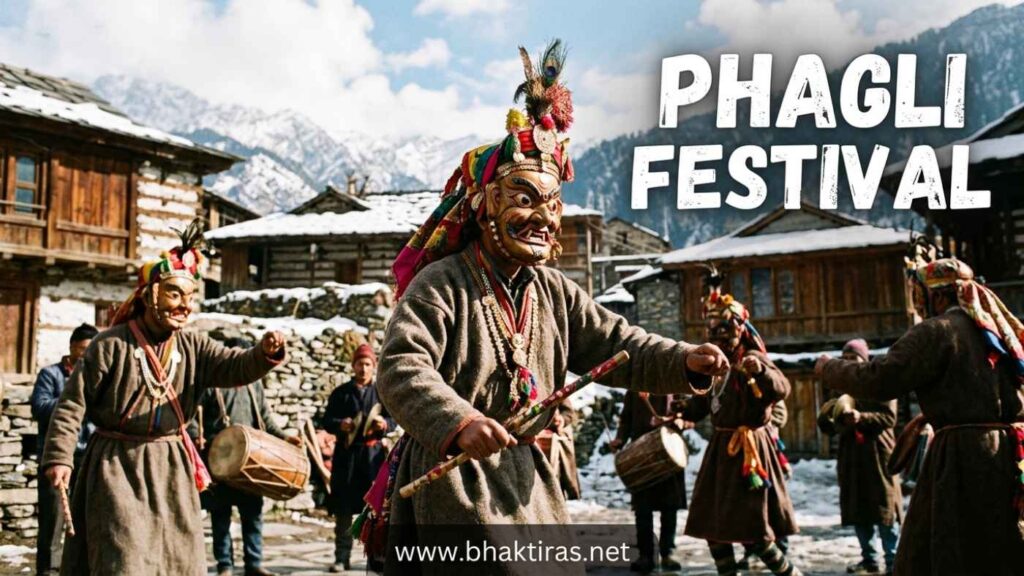
Phagli, also spelt Faguli, is a folk spring festival of the high Himalayan valleys of Himachal Pradesh, kept mainly in Kullu, Lahaul, the Pattan valley and Kinnaur during the month of Phalguna (February-March). Its heart is a striking piece of village theatre: men put on costumes of dried grass, leaves and animal hair and wear fierce wooden or painted masks to act out demons and winter spirits, then dance them into defeat. Behind the spectacle sits a simple, old idea – clearing out the cold, the sickness and the ill-luck of winter so a clean new season can begin.
Phagli Festival 2026-2028: Dates & Calendar
Phagli is a Phalguna-month festival, so it moves each year with the Hindu lunar calendar and, crucially, from valley to valley. The dates below are approximate; each village sets its own day by local custom and its deity’s calendar.
| Year | Approx. date | Month | Notes |
|---|---|---|---|
| 2026 | Mid-Feb (approx.) | Phalguna | Observed; dates varied by valley |
| 2027 | Feb-Mar (approx.) | Phalguna | Next occurrence; exact day set locally |
| 2028 | Feb-Mar (approx.) | Phalguna | Confirm locally nearer the date |
Because there is no single fixed Phagli date for the whole state, treat any calendar listing as a guide only. A village in Lahaul may hold its Phagli days apart from one in Kullu, and some communities spread the observance over two or three days rather than one.
Why Phagli Is Celebrated
Phagli marks the turning of winter into spring and the victory of good over evil, acted out as a purification of the whole village before the new agricultural season.
Driving out winter
In the high valleys winter is long, harsh and isolating. Phagli is the moment the community formally pushes it away – the masked demon dancers stand for cold, disease and misfortune, and dancing them out (or burning their effigy) is a public act of cleansing before spring work begins.
Good over evil
Like Holi in the plains, Phagli carries the theme of good defeating evil. The grotesque masked figures are confronted and overcome by the community, a small yearly re-enactment of order winning out over the forces that threaten the village.
Honouring deities and ancestors
The festival is also devotional. Households and temples make offerings to the local village deities and remember ancestors, asking for protection, good harvests and health through the coming year. Faith and folk custom sit side by side here.
Deities & Figures Worshipped
Phagli centres on local Himalayan village deities rather than a single pan-Indian god, alongside the masked spirit-figures that are ritually defeated.
Local village deities
Each valley honours its own gram-devta or devi – the presiding deity of the village temple – with offerings and prayers for a safe, fruitful year. The deity’s own calendar often fixes when a village holds Phagli.
Ancestors
Remembering forebears is woven into the observance, with food offerings and household rites that ask ancestral blessings for the family and the fields.
The masked demons
The costumed figures of grass, leaves and masks represent the demons and winter spirits. They are not worshipped but confronted – danced out and overcome so their hold on the village ends with winter.
Key Rituals, Step by Step
Customs differ between valleys, but a Phagli observance usually moves through these stages.
- Preparing the costumes and masks. In the days before, villagers gather dried grass, leaves and animal hair and ready the wooden or painted masks, some kept and reused across generations.
- Offerings at the temple. Households bring sattu and local foods to the village deity, and prayers open the observance with the community gathered.
- Donning the demon guise. The chosen men put on the grass-and-leaf costumes and fierce masks, transforming into the winter spirits the village will drive away.
- The masked dance. To drums and folk songs the masked figures move through the village lanes and open ground, their dance enacting the confrontation between the community and the evils of winter.
- Defeating the demons. The spirits are symbolically overcome – and in many places an effigy of the demon is burnt – marking the end of winter’s grip.
- Shared feast and songs. The day closes with sattu and local dishes shared around, folk singing and community gathering that carry the celebration into the evening.
- Blessings for the season. With winter cleared, families ask the deity and ancestors for good harvests, health and protection through the coming year.
Special Foods of Phagli
Phagli food is simple mountain fare, shared across the village, with roasted-grain sattu at its centre.
Sattu
Flour of roasted grains, offered to the deity and eaten through the festival. Filling and warming, it is well suited to a late-winter mountain celebration.
Local breads and grains
Everyday hill staples of wheat and barley appear as festival breads and preparations, cooked in quantity for the community feast.
Seasonal home cooking
Households prepare their own local dishes to share, so the exact spread shifts from valley to valley and family to family – part of what keeps each village’s Phagli distinct.
Regional Names & Variations
Phagli is a family of related valley customs rather than one fixed rite, and it changes as you move across Himachal’s mountains.
Kullu valley
In Kullu the masked dances and the driving-out of winter spirits are the best-known face of the festival, tied closely to the valley’s strong village-deity tradition.
Lahaul and Pattan valley
In the higher, colder Lahaul region and the Pattan valley, Phagli carries added weight as the marker that the long isolating winter is ending, with its own local timing and rites.
Malana
The famously self-contained village of Malana keeps its own version of the observance, shaped by its distinct customs and its devotion to its deity.
Kinnaur
In Kinnaur the spring purification is observed with local song, dance and offerings, again on dates set by the community rather than a shared state calendar.
Phagli Do's and Don'ts
A few simple pointers for taking part in or visiting a Phagli celebration.
Do
- Confirm the exact local date with the village temple committee or panchayat before travelling.
- Join the offerings and the community feast if invited – sharing food is central here.
- Respect the masks and costumes as ritual objects, some old and reused for generations.
- Ask permission before photographing dancers, deities or temple rites.
- Dress warmly – the high valleys are still cold in Phalguna.
Avoid
- Do not assume one fixed date; Phagli varies from valley to valley.
- Do not treat the masked dance as mere spectacle – it is a purification rite with meaning.
- Do not enter temple spaces or touch offerings without local guidance.
- Do not disturb or handle the masks and costumes without being invited to.
- Do not ignore local customs at reserved villages such as Malana, where norms are strict.
Frequently Asked Questions
When is Phagli Festival in 2027?
Phagli (Faguli) is expected in February-March 2027, during the Hindu month of Phalguna. The exact day is not fixed statewide – it varies from valley to valley across Himachal Pradesh, so confirm locally before planning to attend.
When is Phagli in 2026 and 2028?
Phagli in 2026 fell in mid-February (Phalguna), and in 2028 it is again expected in the February-March window. In every year the dates are approximate and set by each village’s own custom and deity calendar rather than a single shared date.
Why is Phagli celebrated?
Phagli is celebrated to purify the village and mark the victory of good over evil as winter turns to spring. Villagers dance out the demons and spirits of the cold season, welcome the new season, and honour their local deities and ancestors for a safe, fruitful year.
Where is Phagli celebrated?
Phagli is a Himalayan folk festival of Himachal Pradesh, kept mainly in the Kullu valley, Lahaul, the Pattan valley and Kinnaur. Villages such as Malana keep their own distinct versions, so the customs shift as you move between valleys.
What happens during the Phagli masked dance?
During Phagli, men dress in costumes of grass, leaves and animal hair and wear grotesque masks to represent demons and winter spirits. They dance through the village to drums and folk songs, and the spirits are symbolically defeated, with an effigy of the demon burnt in many places.
Is Phagli like Holi?
Phagli shares Holi’s spring timing in Phalguna and its theme of good triumphing over evil, but it is a distinct Himalayan folk festival. Instead of coloured powders, its signature is masked demon dances and grass-and-leaf costumes used to drive out winter.
What food is eaten during Phagli?
Sattu, a flour of roasted grains, is the central Phagli food, offered to the deity and eaten through the festival. Local hill breads and home-cooked seasonal dishes are shared at the community feast, with the exact spread varying by valley and family.
Which deities are worshipped during Phagli?
Phagli honours local Himalayan village deities – each village’s gram-devta or devi – rather than a single pan-Indian god, along with remembrance of ancestors. The masked demon figures are not worshipped but ritually confronted and defeated.
Whichever valley you find it in, Phagli is the mountains shaking off winter together – masks, drums, sattu and song, all clearing the way for spring.