
Losar 2027 – New Year of Kinnaur & Spiti's Buddhist Valleys
ल्होसर
When is Losar in Himachal Pradesh in 2027?
Losar in Himachal’s Kinnaur and Spiti valleys is expected around early February 2027, following the Tibetan lunar calendar. It is the Buddhist New Year of the high Himalayan communities, marked by bonfires, fresh prayer flags, monastery rituals and masked Chaam dances. Exact dates shift by valley – Kinnauri Losar (Halda) often falls a little earlier than the main Tibetan reckoning.
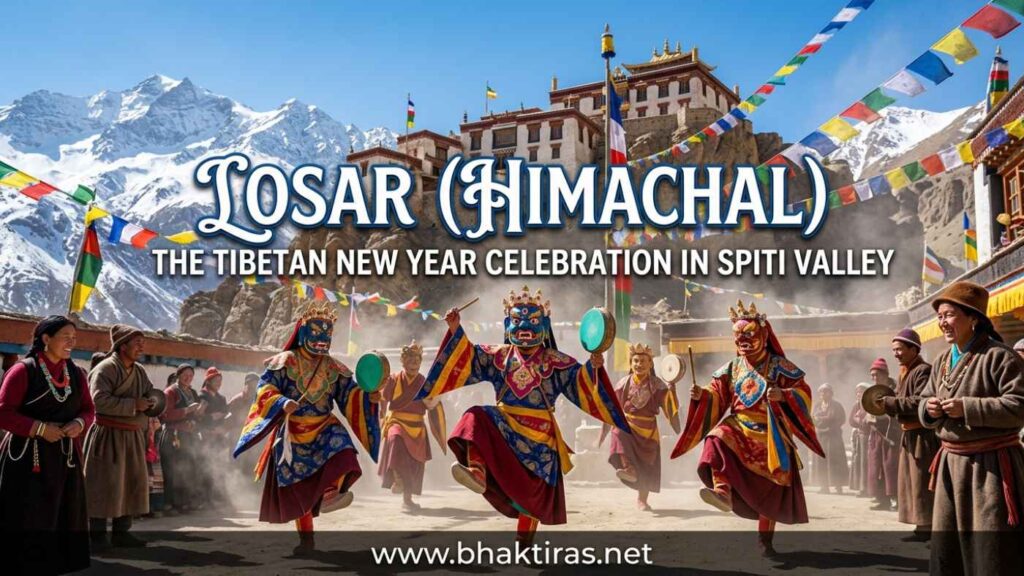
Losar is the New Year of the Buddhist communities living in Himachal Pradesh’s highest valleys – Kinnaur, Spiti and Lahaul. Following the Tibetan lunar calendar, it usually arrives in late January or February, when the passes are snowbound and villages turn inward for warmth and worship. In Kinnaur it blends with the local Halda bonfire and the goddess Dorje; in Spiti and Lahaul it centres on the gompas, where monks light butter lamps and dance the masked Chaam. Families clean their homes, raise new prayer flags and gather over chhang and shared food.
Losar in Himachal 2026-2028: Dates & Calendar
The next Himachali Losar is expected around early February 2027. The date moves each year because it tracks the Tibetan lunar calendar, and it can differ by a few days between Kinnaur, Spiti and Lahaul.
| Year | Approx. date | Basis | Notes |
|---|---|---|---|
| 2026 | Around 18 February | Tibetan lunar new year | Kinnauri Halda often falls earlier |
| 2027 | Around 6 February | Tibetan lunar new year | Next occurrence (approx.) |
| 2028 | Around 26 February | Tibetan lunar new year | Varies by valley |
Because each valley’s monks fix the day against local astronomical reckoning, treat these as guides rather than fixed dates. In Kinnaur the Halda bonfires may be lit a fortnight before Spiti’s monastery Losar.
Why Losar Is Celebrated in Kinnaur & Spiti
Losar marks the turning of the year for Himachal’s Buddhist highlanders – a moment to clear out the old, settle debts and quarrels, and greet the new season with blessings and light.
For communities cut off by winter snow, Losar is as much a social reset as a religious one. Houses are scrubbed, old grievances are meant to be laid to rest, and elders formally bless the young. In Spiti and Lahaul the festival draws directly on Tibetan Buddhist tradition, with monastery rites to dispel the misfortunes of the passing year.
A fresh year in the high valleys
Losar closes one lunar year and opens the next. In the short, hard winters of Kinnaur and Spiti, it is the year’s warmest gathering – a signal that light and the coming season are on their way.
Halda and the goddess Dorje
In Kinnaur, Losar overlaps with Halda, when villagers light cedar-torch bonfires at night and offer worship to the goddess Dorje. The flames are believed to burn away the past year’s ills and carry prayers upward.
Clearing the year's misfortune
Spiti and Lahaul follow the Tibetan pattern of ritually sweeping out bad luck before the new year. Monks perform protective rites at the gompas so the community steps into the year clean and shielded.
Who Is Honoured at Losar
Losar is a Buddhist observance rather than a deity’s festival, but each valley has its own focus of worship and protection.
Goddess Dorje
In Kinnaur’s Halda celebrations, villagers offer worship to the goddess Dorje, a local guardian figure. Her blessing is sought for a safe and prosperous year as the bonfires are lit.
Buddha and the protectors
At Spiti’s gompas the rites honour the Buddha and the Dharma protectors. Monastery prayers ask these guardians to shield the valley through the coming year.
Local mountain spirits
Across these valleys, offerings also acknowledge the local land and mountain deities. Fresh prayer flags carry mantras on the wind to bless the wider landscape.
Key Losar Rituals, Step by Step
The festival unfolds over several days, moving from home preparation to monastery ceremony and village celebration.
- Cleaning and decorating. Families thoroughly clean their homes, whitewash walls and lay out fresh food, symbolically clearing away the old year before the new one arrives.
- Raising prayer flags. New five-coloured prayer flags are hoisted over rooftops, gompas and mountain passes, replacing the sun-faded ones from the year before.
- Lighting the Halda bonfires (Kinnaur). On the Kinnauri new-year night, villagers carry cedar-wood torches and light communal bonfires, offering worship to the goddess Dorje.
- Butter-lamp offerings. At home shrines and in the gompas, rows of butter lamps are lit as offerings, filling the halls with light through the cold nights.
- Monastery Chaam dances (Spiti & Lahaul). At gompas such as Key and Tabo, monks perform masked Chaam dances to drive out the past year’s misfortune and invoke protection.
- Sharing food and chhang. Households exchange special festive foods and the local barley brew chhang, moving from house to house to feast together.
- Archery and folk dance. Younger people take to archery contests and circle folk dances, a lively counterpart to the solemn monastery rites.
- Elders blessing the young. The festival closes with elders formally blessing children and juniors, passing on good wishes for health and fortune in the new year.
Special Foods of Himachali Losar
Losar food is winter food – warming, grain-based and made to be shared across the village.
Chhang
A mildly fermented local brew made from barley or millet, chhang is the customary Losar drink, shared house to house as families visit one another.
Thukpa and momos
Hearty noodle soup (thukpa) and steamed dumplings (momos) are staples of the Tibetan-influenced valleys, warming fare for the snowbound days.
Buckwheat and barley breads
Kinnauri kitchens turn out flatbreads and cakes from local buckwheat and barley, the grains that grow at these altitudes, served through the festival.
Butter tea
Salted butter tea (po cha) keeps guests warm during the long rounds of Losar visiting, offered again and again as people gather.
Dried fruit and roasted grains
Kinnaur’s apricots, walnuts and roasted barley are set out for guests, part of the spread that marks a household’s welcome at new year.
How Losar Differs Across Himachal's Valleys
Though it is one festival, Losar looks quite different depending on which high valley you are in.
Kinnaur (Halda)
Here Losar merges with Halda, a bonfire new year. Villagers light cedar torches after dark and worship the goddess Dorje. Kinnauri Losar frequently falls earlier than the main Tibetan date.
Spiti
Spiti keeps closest to the Tibetan Losar, centred on its gompas. At Key and Tabo, monks perform Chaam dances and elaborate prayer rites over several days of monastery ceremony.
Lahaul
Lahaul, linked to Spiti across the high passes, follows the same Tibetan reckoning. Monastery rituals, butter lamps and community feasting mark the turn of the year.
Losar Do's and Don'ts
A few pointers if you are joining or visiting during Losar in the high valleys.
Do
- Clean your home and settle small debts and disputes before the new year.
- Raise fresh prayer flags and let the old, faded ones go respectfully.
- Accept butter tea and chhang graciously when offered – it is a gesture of welcome.
- Watch the Chaam dances quietly and follow the monastery’s guidance on where to stand.
- Greet elders first and receive their blessing with both hands.
Avoid
- Do not treat the masked Chaam as mere entertainment – it is a sacred rite.
- Do not photograph inside gompas or during rituals without asking permission.
- Do not assume a single fixed date – dates vary by valley, so check locally.
- Do not carry unresolved quarrels into the new year; the spirit is one of clearing.
- Do not disturb prayer flags or altars while visiting.
Frequently Asked Questions
When is Losar in Himachal Pradesh in 2027?
Losar in Himachal’s Kinnaur and Spiti valleys is expected around early February 2027, following the Tibetan lunar calendar. Because it is a lunar festival set locally, the exact day shifts by valley. Kinnauri Losar (Halda) often falls a little earlier than the main Tibetan reckoning.
When is Losar in 2026 and 2028?
Himachali Losar fell around 18 February 2026 and is expected around 26 February 2028. These dates are approximate because Losar tracks the Tibetan lunar calendar and is fixed locally by each valley’s monastery, so it can vary by a few days across Kinnaur, Spiti and Lahaul.
Why is Losar celebrated in Kinnaur and Spiti?
Losar is the Buddhist New Year of Himachal’s high valleys, marking the turn of the lunar year. It is a time to clean homes, clear away the old year’s misfortunes, raise new prayer flags and receive elders’ blessings. For these snowbound communities it is the warmest social and religious gathering of winter.
How is Losar in Kinnaur different from Spiti?
In Kinnaur, Losar blends with Halda, a bonfire new year with worship of the goddess Dorje, and often falls earlier than the Tibetan date. In Spiti and Lahaul, Losar follows the Tibetan calendar and centres on monastery rituals and masked Chaam dances at gompas such as Key and Tabo.
What is the Halda festival?
Halda is Kinnaur’s form of Losar, celebrated as a bonfire new year. Villagers light cedar-torch bonfires after dark and offer worship to the goddess Dorje, whose blessing is sought for the coming year. The flames are believed to burn away the past year’s troubles.
What are the Chaam dances at Losar?
Chaam are masked ritual dances performed by monks at Spiti and Lahaul gompas during Losar. Wearing elaborate masks and costumes, they enact the driving-out of the past year’s misfortune and invoke the protection of the Dharma guardians. They are a sacred rite, not a performance.
What foods are eaten during Himachali Losar?
Losar food is warming winter fare: chhang, a local barley or millet brew; thukpa noodle soup and momos in Spiti and Lahaul; buckwheat and barley breads in Kinnaur; and salted butter tea. Households share these from door to door as they visit one another.
Can visitors attend Losar in Kinnaur and Spiti?
Visitors are generally welcome to witness Losar, but it falls in deep winter when the valleys are cold and access can be difficult. Confirm dates with local gompas in advance, respect the monastery rituals and Chaam dances, and always ask before photographing inside gompas.
However you mark the turning year in the high valleys, may the new prayer flags carry your wishes far – Losar Tashi Delek.