
Nag Panchami 2026 – The Festival of Serpent Worship
नाग पंचमी
When is Nag Panchami in 2026?
Nag Panchami falls on Monday, 17 August 2026. It is observed on the fifth day (Panchami) of the bright fortnight of the Hindu month of Shravan (Sawan). On this day devotees honour the Nagas, the divine serpents, offering milk, flowers and prayers for protection from snakebite and for the welfare of the family.
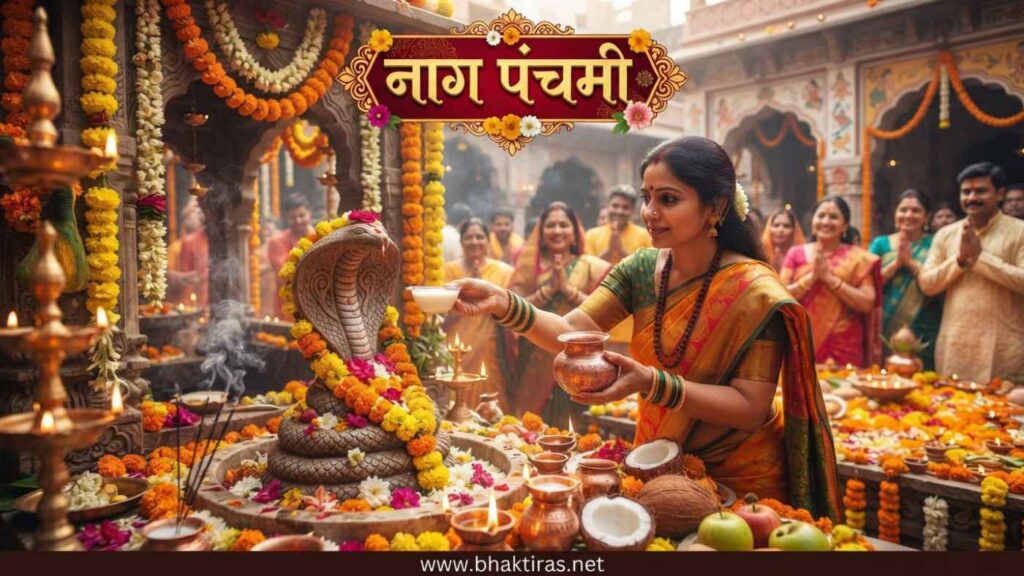
Nag Panchami is the Hindu festival of serpent worship, held on the fifth day of the waxing moon in Shravan, the monsoon month of July or August. On this day people revere the Nagas – the semi-divine serpents of Hindu tradition – along with cosmic serpents such as Shesha and Vasuki. Worshippers visit anthills, temple snake idols or painted images, pour milk, and offer flowers and turmeric while praying for safety from snakebite and for their family’s good fortune. It is one of the oldest nature-linked observances still kept across India and Nepal.
Nag Panchami 2026-2028: Dates & Calendar
The next Nag Panchami is on Monday, 17 August 2026. Because it is fixed to Shravan Shukla Panchami in the lunar calendar, the Gregorian date shifts each year, usually landing in late July or August.
| Year | Date | Day | Notes |
|---|---|---|---|
| 2026 | 17 August | Monday | Next occurrence |
| 2027 | 6 August | Friday | Shravan Shukla Panchami |
| 2028 | 26 July | Wednesday | Shravan Shukla Panchami |
Most of India observes the festival on Shravan Shukla Panchami (the bright fortnight). In parts of Gujarat and some other regions that follow the amanta reckoning, a Nag Pancham is instead kept in the dark fortnight (Shravan Krishna Panchami), so local dates can differ by about a fortnight.
Why Nag Panchami Is Celebrated
Nag Panchami honours the Nagas, the serpent beings of Hindu belief, to seek protection from snakebite and blessings for the family during the rainy season when snakes are most active.
Guardians of the earth
In Hindu tradition the Nagas are semi-divine serpents who guard water, fertility and hidden treasure. Rain-fed monsoon fields bring snakes close to homes, so a day set aside to honour rather than fear them carries both spiritual and practical weight.
Krishna and Kaliya
A popular story links the day to the young Krishna subduing Kaliya, the venomous serpent poisoning the Yamuna. Krishna danced on the many hoods of Kaliya and then spared his life, sending him away in peace. The tale is read as the taming of danger rather than its destruction.
Shesha and Vasuki
The festival also remembers the great cosmic serpents: Shesha (Ananta), on whom Vishnu reclines, and Vasuki, who served as the churning rope at the Samudra Manthan. Honouring them acknowledges the serpent’s place in the order of creation.
Protection and welfare
Many women observe the day for the long life and safety of their brothers and family, echoing the wider Shravan-month theme of vows for household wellbeing.
Deities & Figures Worshipped
Nag Panchami is not tied to a single god. The worship is directed at the Nagas as a class of serpent deities, with a few named serpents given special honour.
The Nagas
The collective serpent deities honoured through anthills, live snakes where safe, snake idols and painted images. Milk, water, flowers and turmeric are offered to them.
Shesha (Ananta)
The thousand-hooded cosmic serpent on whom Lord Vishnu rests between the ages. He represents endlessness and cosmic support.
Vasuki
The serpent king who was used as the rope to churn the ocean of milk. He is closely associated with Lord Shiva, who wears a serpent around his neck.
Kaliya
The serpent of the Yamuna subdued by Krishna. His story is central to the festival’s link with Krishna worship.
Key Rituals, Step by Step
The puja is simple and can be done at home, at an anthill, or at a temple with a serpent shrine.
- Wake early and bathe. Devotees rise before sunrise, bathe, and often keep a fast until the puja is complete.
- Prepare the image. A snake is drawn or shaped in clay, cow dung or turmeric paste, or a metal or stone Naga idol is set on a clean spot; some visit a live anthill.
- Offer milk and water. Fresh milk, water and sometimes a little rice are offered, symbolically feeding the serpent.
- Apply turmeric and kumkum. The image or idol is marked with turmeric, vermilion and sandal paste.
- Offer flowers and lamps. Flowers, especially lotus and other seasonal blooms, are placed before the Nagas and a lamp is lit.
- Recite prayers. Mantras and the names of the principal Nagas are chanted, seeking protection from snakebite and welfare for the family.
- Distribute prasad. After the puja the fast is broken and sweets and offerings are shared as prasad.
Special Foods of Nag Panchami
Foods are largely satvik, and many households avoid frying or cutting on the day out of respect for the serpents.
Kheer / doodh-based sweets
Milk is central to the day, so rice kheer and milk sweets are common offerings and prasad.
Dhindo and boiled dishes
In parts of Maharashtra people avoid frying and cutting on Nag Panchami, so steamed and boiled preparations replace fried snacks.
Puran poli
The sweet jaggery-and-lentil flatbread is a festive favourite in Maharashtrian homes during Shravan.
Roti and seasonal offerings
Simple satvik meals with milk, curd and seasonal fruit are offered to the Nagas and then eaten by the family.
Regional Names & Variations
Serpent worship on this day takes distinct local forms across India and Nepal.
Maharashtra – Battis Shirala
The village of Battis Shirala in Sangli district became famous for its large Nag Panchami gatherings devoted to live snakes; regulations have since reshaped the event, but the day remains a major local occasion.
South India
In Karnataka, Andhra Pradesh, Telangana and Tamil Nadu, families worship stone Naga idols placed under trees or at temples, and the day is often linked with prayers for children and family welfare.
North India
Across the northern states people draw serpent images on walls beside their doors and offer milk, keeping the festival firmly within the wider observances of the holy month of Shravan.
Nepal
Nag Panchami is widely kept in Nepal, where households paste pictures of the Nagas above their doorways and offer food and prayers for protection of the home.
Nag Panchami Do's and Don'ts
A few simple customs are widely followed on the day.
Do
- Wake early, bathe and keep the puja area clean.
- Offer milk, water, flowers and turmeric to the Naga image or idol.
- Recite the names of the principal Nagas and pray for family welfare.
- Prefer satvik, home-cooked food and share prasad.
- Respect live snakes from a safe distance rather than handling them.
Avoid
- Do not harm, capture or force-feed live snakes.
- Many families avoid frying and cutting vegetables on the day.
- Avoid digging the earth, as it is linked with disturbing serpent dwellings.
- Do not treat the fast or offerings carelessly.
- Avoid non-satvik food and intoxicants during the observance.
Frequently Asked Questions
When is Nag Panchami in 2026?
Nag Panchami in 2026 falls on Monday, 17 August. It is observed on Shravan Shukla Panchami, the fifth day of the bright fortnight of the Hindu month of Shravan.
When is Nag Panchami in 2027 and 2028?
Nag Panchami is on Friday, 6 August 2027 and on Wednesday, 26 July 2028. Because the festival follows the lunar calendar, its Gregorian date shifts each year between late July and August.
Why is Nag Panchami celebrated?
Nag Panchami is celebrated to honour the Nagas, the serpent deities of Hindu tradition, and to seek protection from snakebite and welfare for the family. It falls during the monsoon month of Shravan, when snakes come close to homes and fields.
Which deity is worshipped on Nag Panchami?
Nag Panchami is not tied to a single god; the worship is directed at the Nagas as a class of serpent deities. Named serpents such as Shesha, Vasuki and Kaliya receive special honour, and the day is also linked to Krishna.
What is the link between Krishna and Nag Panchami?
The festival is linked to the story of the young Krishna subduing Kaliya, the venomous serpent poisoning the Yamuna. Krishna danced on Kaliya’s hoods and then spared his life, and the day recalls this taming of the serpent.
How is Nag Panchami celebrated?
Devotees bathe early, prepare or visit a Naga image or anthill, and offer milk, water, flowers and turmeric while chanting prayers. Many keep a fast until the puja is done and then share prasad; some families avoid frying and cutting on the day.
Where is Nag Panchami most prominent?
Nag Panchami is observed across India and Nepal. It is especially strong in Maharashtra, notably the village of Battis Shirala, and in the southern states, where stone Naga idols are worshipped under trees and at temples.
Do people offer milk to real snakes on Nag Panchami?
Traditionally milk is offered to snake idols, anthills and painted images rather than forced upon live snakes. Wildlife groups discourage capturing or feeding real snakes, so most devotees now direct their offerings to images and idols.
May the Nagas guard your home and family this Shravan. Nag Panchami ki hardik shubhkamnayen.