
Shravan Maas 2026 – The Holiest Month of Lord Shiva
श्रावण मास
When does Shravan Maas (Sawan) begin in 2026?
In North India, Shravan Maas begins on Thursday, 30 July 2026 and ends on Friday, 28 August 2026, following the Purnimant calendar. It is the holiest month of the year for devotees of Lord Shiva, marked by Monday fasts (Shravan Somvar), water and milk abhishek on the Shiva lingam, and the Kanwar Yatra. In South and West India, where the Amanta reckoning is used, Shravana runs roughly a fortnight later, from about 13 August to 11 September 2026.
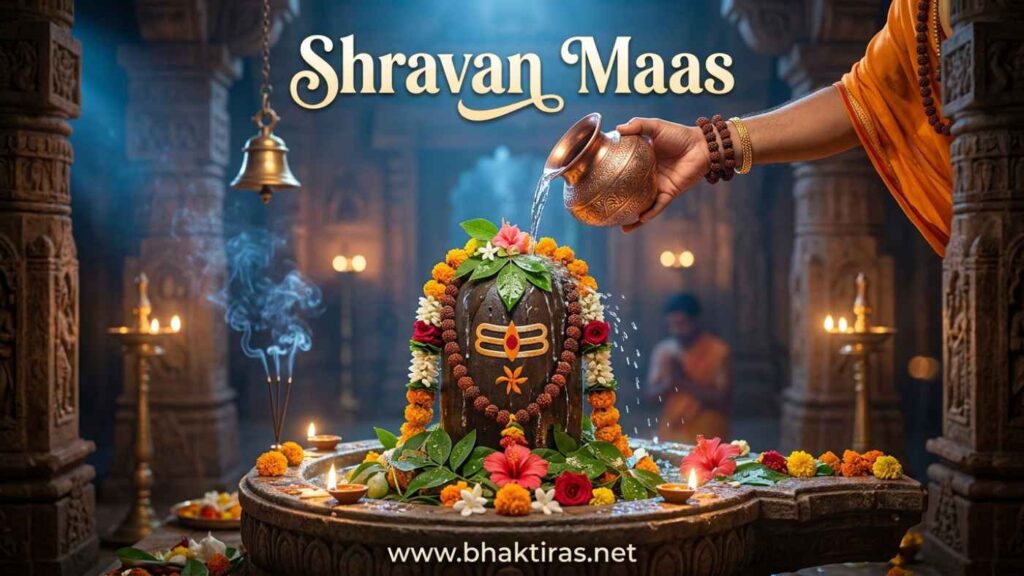
Shravan, called Sawan across the Hindi belt, is the fifth month of the Hindu lunar calendar and the one most closely tied to Lord Shiva. Falling in the monsoon of July and August, it is not a single festival but a whole month of devotion. Devotees fast on its Mondays, pour Ganga water and milk over the Shiva lingam, offer bel leaves, and many walk for days as kanwariyas carrying holy water to their local Shiva temple. In 2026 the North Indian Shravan runs from 30 July to 28 August.
Shravan Maas 2026-2028: Dates & Calendar
Shravan is a full lunar month, so it has a start and an end rather than a single date, and it shifts each year with the moon. The next Shravan begins on 30 July 2026 in North India.
| Year | North India (Purnimant) | Sawan Somvar (Mondays) | Notes |
|---|---|---|---|
| 2026 | 30 July – 28 August | 3, 10, 17 & 24 August | Next occurrence; four Somvar vrats |
| 2027 | mid-July – mid-August (approx.) | To be confirmed | Approximate – verify on panchang |
| 2028 | late July – late August (approx.) | To be confirmed | Approximate – verify on panchang |
In 2026 the four Shravan Somvars fall on 3, 10, 17 and 24 August. In South and West India, where the Amanta calendar is followed, Shravana instead runs from about 13 August to 11 September 2026, so the Monday fasts land on later dates there. Because the two systems differ by roughly a fortnight, always check which calendar your community follows before fixing your vrat dates.
Why Shravan Maas Is So Sacred
Shravan is considered the dearest month to Lord Shiva, and worship offered during it is believed to carry special merit.
The Samudra Manthan link
The month is tied to the churning of the ocean, when the poison Halahala emerged and threatened all creation. Shiva drank it to save the worlds, holding it in his throat, which turned blue and earned him the name Neelkanth. Devotees offer water and milk through Shravan to cool the burning of that poison.
Monsoon and renewal
Shravan arrives with the heaviest rains, when rivers swell and the earth turns green. The season of growth and abundance is read as a time of grace, and pouring water over the lingam mirrors the life the monsoon brings to the land.
A month of vows
Many devotees take on disciplines for the whole month – vegetarian food, no onion or garlic, no alcohol, and Monday fasting. Unmarried women in particular keep the Shravan Somvar vrat, traditionally praying for a good husband, following the example of Parvati who won Shiva through devotion.
Deities & Figures Worshipped
Shravan is centred on Lord Shiva, with Parvati and the wider Shaiva family honoured alongside him.
Lord Shiva
The whole month belongs to Shiva. Devotees worship him as the lingam, offering water, milk, bel leaves, bhang and dhatura, and chanting the Mahamrityunjaya mantra and Om Namah Shivaya. His forms as Neelkanth and Bholenath are especially remembered.
Goddess Parvati
Parvati is honoured beside Shiva through Shravan, and her month-long penance to win him is the model many devotees follow. Hariyali Teej, which falls in Shravan, celebrates the divine couple directly.
Nandi and the Shiva family
Nandi the bull, Ganesha and Kartikeya are remembered as part of Shiva’s household. In many temples devotees whisper their prayers into Nandi’s ear before approaching the lingam.
Key Rituals of Shravan, Step by Step
Worship through Shravan follows a familiar daily rhythm, intensified on Mondays.
- Morning bath and sankalp. Devotees rise early, bathe, and make a resolve (sankalp) to keep the fast or vow for the day or the month.
- Jalabhishek. Pure water, ideally from the Ganga, is poured slowly over the Shiva lingam, often followed by milk, honey, curd and ghee (panchamrit).
- Bel leaf offering. Bilva (bel) leaves in sets of three are placed on the lingam, along with dhatura, aak flowers and sandalwood paste.
- Chanting. Devotees recite Om Namah Shivaya, the Mahamrityunjaya mantra or the Shiv Chalisa, and read the Shiv Purana at home or in the temple.
- Shravan Somvar vrat. On Mondays many fast fully or take a single sattvic meal, breaking it after evening worship.
- Kanwar Yatra. Kanwariyas walk barefoot to sacred rivers, fill decorated pots with holy water, and carry it back on foot to offer at their chosen Shiva temple.
- Evening aarti. The day closes with lamp-lit aarti before the lingam and the distribution of prasad.
Fasting Food of Shravan
Because so many devotees fast or keep a sattvic diet, Shravan has its own set of vrat-friendly foods.
Sabudana khichdi & vada
Tapioca pearls cooked with peanuts, potato and cumin are the classic fasting staple, eaten as a soft khichdi or fried into crisp vadas.
Kuttu & singhara dishes
Buckwheat (kuttu) and water-chestnut (singhara) flour replace wheat during the vrat, made into puris, pakoras and simple rotis.
Fruit and dairy
Seasonal fruit, milk, curd, paneer and dry fruits sustain those keeping a lighter fast, often taken as the single Monday meal.
Sattvic thali
Many families turn fully vegetarian for the month, avoiding onion, garlic, alcohol and non-veg food, and cook simple sattvic meals with rock salt (sendha namak).
Regional Names & Variations
The same month is kept differently across India, and the calendar itself starts on different dates.
North India (Sawan)
In Uttar Pradesh, Bihar, Delhi and the wider Hindi belt the month is called Sawan and follows the Purnimant calendar. The Kanwar Yatra to temples like Kashi Vishwanath, Baidyanath and the Ganga ghats is at its most intense here.
Maharashtra & Gujarat
Following the Amanta calendar, Shravan begins about a fortnight later. Maharashtrians observe Mondays with great devotion and mark Nag Panchami and Narali Purnima; Gujarat keeps the month with Shiva worship and Hindola swings for Krishna.
South India (Shravana)
In the South the month brings Varalakshmi Vratam and the Shravana Somavaram fasts, with a strong focus on the goddess of prosperity alongside Shiva.
Overlapping festivals
Shravan holds several major festivals – Nag Panchami, Hariyali Teej and, on its full-moon day, Raksha Bandhan, which is why the month feels busy with observances beyond Shiva worship alone.
Shravan Maas Do's and Don'ts
Traditional observance of the month follows a few simple guidelines.
Do
- Wake early, bathe and offer water to the Shiva lingam
- Offer bel leaves, and chant Om Namah Shivaya or the Mahamrityunjaya mantra
- Keep the Shravan Somvar (Monday) fast if you are able
- Eat sattvic, vegetarian food through the month
- Give to charity and help pilgrims and kanwariyas on the road
Avoid
- Do not consume alcohol, non-vegetarian food, onion or garlic during vows
- Do not offer tulsi leaves or ketaki flowers to Shiva
- Avoid using haldi (turmeric) directly on the Shiva lingam
- Do not break a vrat early or without the proper evening worship
- Avoid cutting hair or nails on fasting days if your family keeps that custom
Frequently Asked Questions
When does Shravan Maas begin in 2026?
Shravan Maas in 2026 begins on Thursday, 30 July and ends on Friday, 28 August in North India, following the Purnimant calendar. In Maharashtra, Gujarat and South India, where the Amanta calendar is used, Shravana runs about a fortnight later, from roughly 13 August to 11 September 2026.
What are the Sawan Somvar dates in 2026?
In North India the four Sawan Somvars (Shravan Mondays) in 2026 fall on 3, 10, 17 and 24 August. These Mondays are the most auspicious fasting days of the month for Shiva devotees. In the Amanta regions the Monday fasts fall on later dates because the month itself starts later.
Why is Shravan the holiest month for Lord Shiva?
Shravan is considered the holiest month for Lord Shiva because it is linked to the churning of the ocean, when Shiva drank the poison Halahala to save creation and became Neelkanth, the blue-throated one. Devotees pour water and milk over the lingam through the month to cool that poison, and worship offered in Shravan is believed to carry special grace.
What is the Kanwar Yatra?
The Kanwar Yatra is a pilgrimage kept during Shravan in which devotees, called kanwariyas, walk barefoot to a sacred river, fill decorated pots with holy water, and carry it on foot to offer at a Shiva temple. Millions take part each year, walking to sites such as the Ganga ghats and the Baidyanath temple in Deoghar.
What do devotees offer during Shravan?
During Shravan devotees offer water and milk (jalabhishek and abhishek) over the Shiva lingam, along with bel (bilva) leaves, dhatura, honey, curd and sandalwood paste. Tulsi leaves and ketaki flowers are traditionally avoided, and turmeric is not applied to the lingam.
Which festivals fall during Shravan Maas?
Several major festivals fall during Shravan Maas, including Nag Panchami (worship of serpents), Hariyali Teej (celebrating Shiva and Parvati), and Raksha Bandhan on the full-moon day that ends the month. This is why Shravan feels like a whole season of observance rather than a single event.
What should you eat while fasting in Shravan?
While fasting in Shravan, devotees eat sattvic vrat foods such as sabudana (tapioca) khichdi, kuttu (buckwheat) and singhara (water-chestnut) flour dishes, fruit, milk and curd. Grains, onion, garlic, alcohol and non-vegetarian food are avoided, and rock salt is used in place of table salt.
Why do the Shravan dates differ across India?
The Shravan dates differ across India because North India follows the Purnimant calendar, in which the month ends on the full moon, while Maharashtra, Gujarat and the South follow the Amanta calendar, in which it ends on the new moon. The two systems are about a fortnight apart, so the same lunar month starts on different dates.
May the whole of Shravan bring the peace of Bholenath to your home. Har Har Mahadev.