
Madhavpur Mela 2027 – Krishna and Rukmini's Wedding Fair
માધવપુર ઘેડ મેળો
When is Madhavpur Mela in 2027?
Madhavpur Mela 2027 begins on Ram Navami, Thursday 15 April 2027, and runs for about five days to around 19 April. The fair is held at Madhavpur Ghed in Gujarat’s Porbandar district and re-enacts the wedding of Lord Krishna (worshipped here as Madhavrai) and Rukmini.
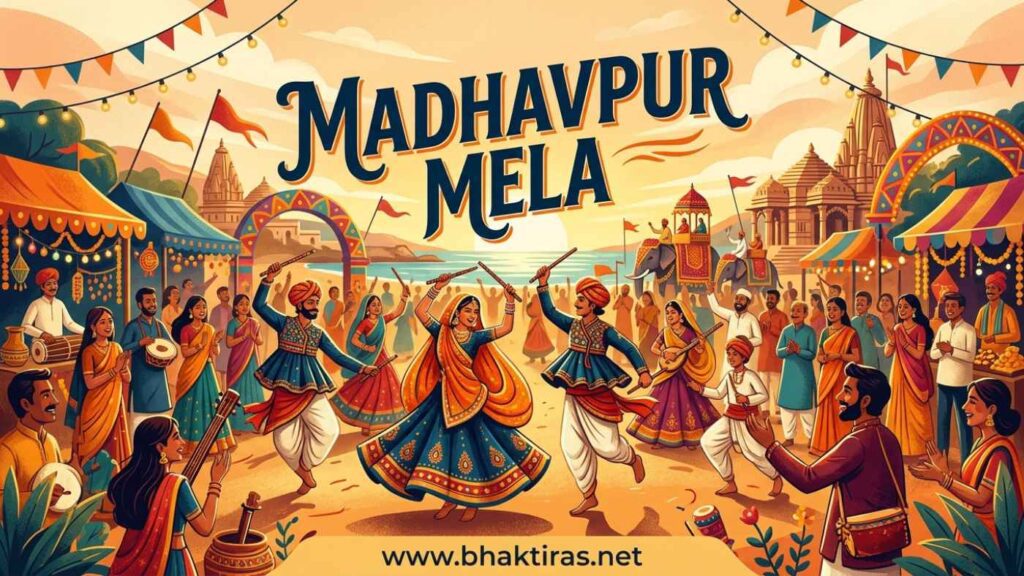
Madhavpur Mela is a five-day fair on the coast of Madhavpur Ghed, a village in Gujarat’s Porbandar district, that re-stages the wedding of Lord Krishna and Rukmini. It opens each year on Ram Navami in the month of Chaitra (March or April) and centres on the old Madhavrai temple, from where an image of Krishna is carried in procession to a symbolic marriage mandap. Because Rukmini is traditionally held to have come from the far north-east, the modern fair has grown into a cultural meeting point between Gujarat and India’s North-Eastern states.
Madhavpur Mela 2026-2028: Dates & Calendar
Madhavpur Mela 2027 opens on Ram Navami, Thursday 15 April 2027, and runs for roughly five days. The start shifts every year because it follows the Hindu lunar month of Chaitra, not the fixed Western calendar.
| Year | Opens (Ram Navami) | Approx. dates | Notes |
|---|---|---|---|
| 2026 | Friday, 27 March | 27-31 March | Held earlier in Chaitra |
| 2027 | Thursday, 15 April | 15-19 April | Next occurrence |
| 2028 | Monday, 3 April | 3-7 April | Opens early April |
The five-day span is approximate; some years the programme is trimmed or extended by a day. Treat the Ram Navami opening date as fixed and check the official Porbandar district or Gujarat Tourism schedule for the closing ceremony each year.
Why Madhavpur Mela Is Celebrated
Madhavpur Mela is celebrated to commemorate the wedding of Lord Krishna and Rukmini, believed by local tradition to have taken place at Madhavpur Ghed. The fair turns that story into a living five-day marriage ceremony for the whole village.
The setting comes straight from Krishna’s life story. Rukmini, daughter of King Bhishmaka, sent word to Krishna asking him to carry her away before she could be married against her wishes to Shishupala. Krishna did so, and folk memory places their wedding on this stretch of the Saurashtra coast. The 15th-century Madhavrai temple, rebuilt in 1840 by Rupaniba, the queen of Porbandar, marks the spot and gives the deity his local name, Madhavrai.
A wedding, not just a memory
Rather than only telling the story, the village actually performs the marriage. A canopy is raised, the groom’s image is brought in procession, and the ceremonies of a Gujarati wedding are carried out over several days, so the myth is re-enacted step by step each year.
Madhavrai, the local Krishna
Krishna is worshipped here as Madhavrai, and the temple that carries his name is the heart of the fair. The processions begin and end at this shrine, tying the celebration to a fixed, centuries-old place of worship on the shore.
A bridge to the North-East
Rukmini is widely believed to have come from the north-east, a tradition the Idu Mishmi community of Arunachal Pradesh connects to King Bhishmaka. Because of this, the fair has been developed as a cultural link between Gujarat and the North-Eastern states under the Ek Bharat Shreshtha Bharat programme.
Deities & Figures Worshipped
The fair honours Lord Krishna in his local form as Madhavrai, together with his bride Rukmini. The marriage of these two is the reason the whole event exists.
Krishna (Madhavrai)
Krishna is the presiding deity, worshipped at the Madhavrai temple. During the fair his image is placed in a decorated chariot or palanquin and carried through the village as the bridegroom on his way to the wedding mandap.
Rukmini
Rukmini, daughter of King Bhishmaka, is the bride whose wedding the fair re-enacts. Local and North-Eastern tradition holds that she journeyed a long way to marry Krishna, which is why the fair carries a strong theme of union across distant regions.
Key Rituals, Step by Step
The five days follow the shape of a traditional Gujarati wedding, moving from the raising of the canopy to the marriage procession and the closing rites.
- Mandap Ropan. The fair opens on Ram Navami with the erection of the wedding canopy (mandap) near the Madhavrai temple, formally beginning the marriage rites.
- Preparations and worship. The temple and village are decorated, and daily prayers and offerings are made to Madhavrai as the household of the groom readies itself for the ceremony.
- Mameru. A mid-morning rite in which the maternal side brings gifts of clothes and ornaments for the couple, mirroring the customary maternal-uncle role in a Gujarati wedding.
- Fuleku (Shrini Varnagi) Yatra. In the evening procession, the image of Madhavrai is placed in a colourful chariot or palanquin and carried from the temple towards Brahmakund, accompanied by drums, folk music and dancing.
- The marriage. Krishna and Rukmini are symbolically wed in the mandap with the rituals of a Hindu wedding, the moment the whole fair builds towards.
- Folk performances. Alongside the rites, artists present Garba, Dandiya and Raas from Gujarat, while troupes from the North-East bring their own songs and instruments such as the dhol, pepa and flute.
- Crafts and food mela. Stalls of handicrafts, handloom, toys and regional food line the fairground, drawing pilgrims, tourists and traders through the whole run of the event.
- Closing rites. Over the final day the ceremonies are completed and the deity is returned to the temple, bringing the five-day wedding to its close.
Special Foods of Madhavpur Mela
Food at the fair is classic Saurashtra fare, sweet-leaning and vegetarian, sold from stalls and shared as prasad from the temple.
Temple prasad
Simple sweet offerings such as pedha, sukhdi or sheera are distributed as prasad after worship of Madhavrai, and many visitors queue for it as part of the darshan.
Gujarati thali
Full vegetarian thalis of rotli, shaak, dal, kadhi, rice, farsan and a sweet are served at eateries around the fair, giving visitors a proper regional meal between the processions.
Fair sweets and snacks
Stalls sell jalebi, ganthiya, fafda, gota and sugarcane juice, the everyday sweets and fried snacks that make a Gujarati fair, best eaten fresh from the pan.
Coastal touches
Being on the coast, the village also offers fresh coconut water and seasonal fruit, an easy refreshment for the long, warm days of the mela.
The Gujarat-North-East Cultural Bridge
What sets this fair apart is its role in joining two distant parts of India around a shared story.
Madhavpur Ghed, Porbandar
The core fair is rooted in Madhavpur Ghed, a coastal village in Porbandar district, and draws pilgrims and visitors from across Saurashtra and the rest of Gujarat to the Madhavrai temple.
The North-Eastern link
Because Rukmini is believed to have come from the north-east, states such as Arunachal Pradesh, Assam, Manipur, Mizoram, Nagaland and Tripura take part, with the Idu Mishmi community tracing kinship to King Bhishmaka.
Ek Bharat Shreshtha Bharat
Under the Union Ministry of Culture’s Ek Bharat Shreshtha Bharat initiative, the fair has been expanded so troupes from the West and the North-East perform together, presenting the wedding as a symbol of national unity.
Madhavpur Mela Do's and Don'ts
A few simple points make a visit to the fair smoother and more respectful.
Do
- Plan to arrive around Ram Navami, the opening day, when the main rituals begin.
- Dress modestly for temple darshan and remove footwear before entering the Madhavrai shrine.
- Watch the evening Fuleku procession, the visual high point of the fair.
- Carry water, a cap and light cotton clothing, as the coastal days can be hot.
- Support local artisans by buying handloom and handicrafts from the mela stalls.
Avoid
- Do not treat it as only a shopping fair; the wedding rituals are the heart of the event.
- Avoid blocking or pushing during the chariot procession, which can be crowded.
- Do not litter the temple grounds or the beach around Madhavpur.
- Avoid loud or disruptive behaviour during the marriage ceremonies and prayers.
- Do not photograph performers or worshippers up close without asking first.
Frequently Asked Questions
When is Madhavpur Mela in 2027?
Madhavpur Mela 2027 begins on Ram Navami, Thursday 15 April 2027, and runs for about five days to around 19 April. It is held at Madhavpur Ghed in Porbandar district, Gujarat.
When is Madhavpur Mela in 2026 and 2028?
Madhavpur Mela 2026 was held from about 27 to 31 March, opening on Ram Navami. In 2028 it will open on Ram Navami, Monday 3 April, running to around 7 April. The dates move each year because the fair follows the Hindu lunar month of Chaitra.
Why is Madhavpur Mela celebrated?
Madhavpur Mela is celebrated to commemorate the wedding of Lord Krishna and Rukmini, which tradition places at Madhavpur Ghed. Over five days the village re-enacts the marriage, from raising the canopy to the groom’s procession, keeping the story alive as a living ceremony.
Which god is worshipped at Madhavpur Mela?
The fair honours Lord Krishna, worshipped locally as Madhavrai, along with his bride Rukmini. The centuries-old Madhavrai temple in the village is the focus of the worship and the starting point of the processions.
Where is Madhavpur Mela held?
Madhavpur Mela is held at Madhavpur Ghed, a coastal village in Porbandar district on the Saurashtra coast of Gujarat. The Madhavrai temple in the village is the main site, with processions running from there towards Brahmakund.
What is the connection between Madhavpur Mela and North-East India?
Rukmini is traditionally believed to have come from the north-east, and the Idu Mishmi community of Arunachal Pradesh traces kinship to her father, King Bhishmaka. Because of this, the fair has been developed under the Ek Bharat Shreshtha Bharat programme as a cultural bridge, with North-Eastern states joining the celebrations.
What are the main rituals of Madhavpur Mela?
The main rituals follow a Gujarati wedding: Mandap Ropan (raising the canopy) on the opening day, the Mameru gift ceremony, the evening Fuleku procession carrying Madhavrai’s image, and the symbolic marriage of Krishna and Rukmini. Folk dances such as Garba, Dandiya and Raas run alongside.
How long does Madhavpur Mela last?
Madhavpur Mela lasts about five days, opening on Ram Navami in Chaitra. In 2027 that means roughly 15 to 19 April, though the exact closing day is set each year by the organisers.
May the wedding of Madhavrai and Rukmini bless your home with joy and union. Jai Shri Krishna.