
Dwarka Janmashtami 2026 – Krishna's Birth at the Jagat Mandir
द्वारका जन्माष्टमी
When is Dwarka Janmashtami in 2026?
Dwarka Janmashtami falls on Friday, 4 September 2026. It marks Krishna’s birth celebrated at the Dwarkadhish Temple (Jagat Mandir) in Dwarka, Gujarat – the city Krishna is said to have ruled as king. The day peaks at midnight with the Janmotsav, when devotees welcome the newborn Lord.
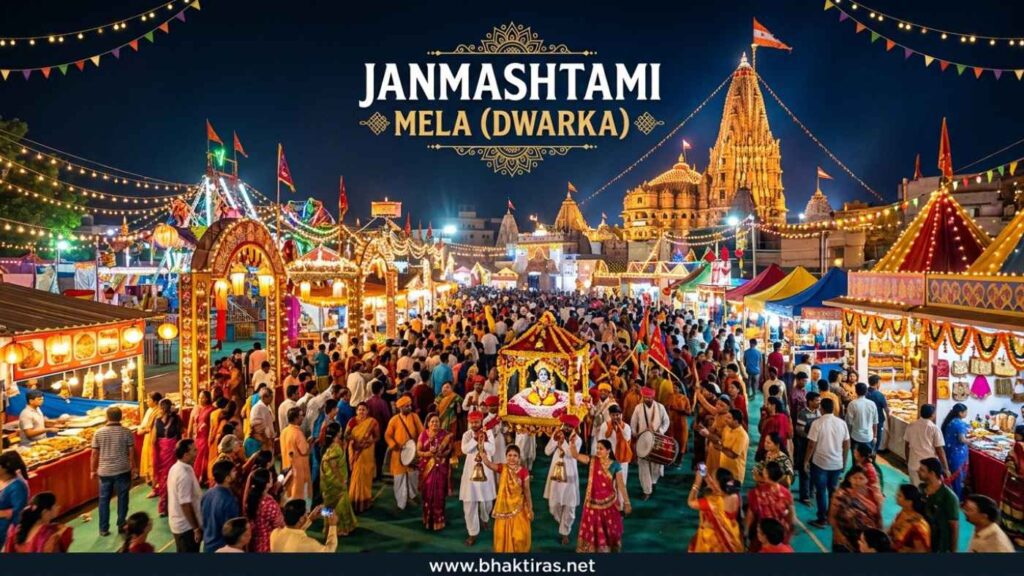
Dwarka Janmashtami is the celebration of Krishna’s birth in the city he is believed to have ruled as king. On Bhadrapada Krishna Ashtami, tens of thousands of pilgrims gather at the Dwarkadhish Temple, also called the Jagat Mandir, on the Gujarat coast where the Gomti river meets the Arabian Sea. The day carries a special weight here because Dwarka is one of the four Char Dham sites and one of the seven Mokshapuri cities. Rituals run from the dawn mangla aarti to the midnight Janmotsav, when the newborn Lord is welcomed with song, panchamrit and the ringing of bells.
Dwarka Janmashtami 2026-2028: Dates & Calendar
Dwarka Janmashtami next falls on Friday, 4 September 2026. The date shifts each year because it follows the Hindu lunar calendar, landing on the Ashtami (eighth tithi) of the dark fortnight of Bhadrapada.
| Year | Date | Day | Notes |
|---|---|---|---|
| 2026 | 4 September | Friday | Next occurrence – midnight Janmotsav at the Dwarkadhish Temple |
| 2027 | 25 August | Wednesday | Bhadrapada Krishna Ashtami |
| 2028 | 12-13 August | Sat-Sun | Ashtami spans two days; temple observes the midnight tithi |
In Dwarka the abhishek darshan of the deity is offered only twice a year, and Janmashtami is one of those rare occasions, so pilgrims plan their trip months ahead.
Why Dwarka Janmashtami Is Special
Dwarka Janmashtami is special because it celebrates Krishna’s birth in the very city he is said to have founded and ruled. While Mathura marks where he was born, Dwarka honours him as king – Dwarkadhish, the Lord of Dwarka.
Hindu tradition holds that after leaving Mathura, Krishna built the golden city of Dwarka on the western coast and reigned there as a just and beloved ruler. Celebrating his birthday in his own kingdom gives the festival a distinct royal character, with the deity dressed in gold, diamonds and topaz.
Krishna's own kingdom
Dwarka is remembered as the seat of Krishna’s rule after he left Mathura. Marking his birth in the city he governed connects the Janmashtami story to the mature, kingly form of the Lord rather than only the infant of Gokul.
One of the Char Dham
Dwarka is one of the four Char Dham pilgrimage sites fixed by tradition, alongside Badrinath, Puri and Rameswaram. That status draws pilgrims from across India, so Janmashtami here is both a birthday and a major yatra.
A Mokshapuri city
Dwarka counts among the seven Mokshapuri cities believed to grant liberation. Worshipping at the Jagat Mandir on Janmashtami is felt to carry added spiritual merit, which is why the crowds swell to their yearly peak.
The rare abhishek
The ceremonial bathing of the deity, the abhishek, is performed at Dwarkadhish only twice a year. Being present for it on Janmashtami is one of the main reasons devotees make the journey.
Deities & Figures Worshipped
The festival centres on Krishna in his form as Dwarkadhish, the Lord of Dwarka, also revered locally as Ranchhodrai.
Krishna as Dwarkadhish
The presiding image is Krishna as Dwarkadhish, the king of Dwarka. The four-armed deity is worshipped in a five-storey shrine supported by dozens of carved pillars, and is dressed in fresh royal finery for the birthday.
Ranchhodrai
Locally Krishna is also called Ranchhodrai, a name recalling the episode where he strategically withdrew from battle to protect his people. Devotees use both names for the same Lord of Dwarka.
Devaki and Vasudeva
The Janmotsav retells the birth of Krishna to Devaki and Vasudeva in the prison of Mathura. Their story is chanted at midnight even though the festival is set in Dwarka, tying the whole life of Krishna together.
Key Rituals, Step by Step
At the Dwarkadhish Temple the day unfolds from an early morning aarti to the midnight birth celebration, in a fixed sequence pilgrims follow closely.
- Mangla aarti. The day opens with the mangla aarti around 7 am, the first darshan of the deity, when devotees begin lining up in large numbers.
- Abhishek snana. Between roughly 8 and 10 am the deity is given the sacred bath, first in panchamrit (milk, curd, ghee, honey and sugar) and then in water. This abhishek is offered only twice a year.
- The dhwaja change. The temple flag is changed on its 43-metre spire; the great 52-gaj dhwaja, embroidered with the sun, moon and Krishna’s emblems, is hoisted by families who often wait a long time for the honour.
- Royal shringar. Through the day the deity is adorned in fresh clothing and heavy gold jewellery set with diamonds and topaz, dressing Krishna as the king of Dwarka for his birthday.
- Bhajan and kirtan. Devotional singing, kirtan and readings from the Bhagavata build through the evening as the temple fills, keeping the crowd in a state of anticipation.
- Midnight Janmotsav. At midnight, the hour of Krishna’s birth, conches and bells sound, mantras are chanted and the newborn Lord is welcomed with joy and a jhanki (tableau) of his infancy.
- Panchamrit and mahabhog. After the birth moment the deity is offered panchamrit and a grand bhog; the temple closes near 2 am once the mahabhog is complete, and prasad is shared with devotees.
Special Foods of Dwarka Janmashtami
Many devotees fast until midnight and break it only after the Janmotsav, so the food is closely tied to the birth moment and to prasad.
Panjiri
A roasted mix of wheat flour, ghee, sugar and dry fruits, panjiri is a classic Janmashtami offering. It is prepared for Krishna and then shared as prasad once the fast is broken.
Dhaniya prasad
Coriander seed powder blended with sugar and dry fruits, dhaniya prasad is favoured because coriander is permitted during the vrat. It is the traditional first bite after the midnight birth.
Panchamrit
The five-nectar mix of milk, curd, ghee, honey and sugar used in the abhishek is also distributed to devotees as a blessed offering after the bath of the deity.
Gujarati bhog
Being in Gujarat, the offerings often include local sweets and farsan such as sukhdi, mohanthal and shrikhand, reflecting the regional kitchen around Dwarka.
Chappan bhog
On the grandest scale the deity may be offered a spread of many dishes in the spirit of the 56-item chappan bhog, a lavish thanksgiving meal laid before Krishna.
Around Dwarka: Where to Be
The celebration spills beyond the main temple into the pilgrim town and its nearby sacred sites, each with its own draw on Janmashtami.
Dwarkadhish Temple (Jagat Mandir)
The Jagat Mandir is the heart of the festival. Pilgrims enter through the Swarg Dwar after climbing the steps from the Gomti ghat and leave through the Moksh Dwar, the two named gates of the complex.
Gomti Ghat
The ghat where the Gomti stream meets the sea is where many pilgrims bathe before darshan. On Janmashtami the steps and the riverfront stay busy from before dawn.
Beyt Dwarka
The island of Beyt Dwarka, reached by boat, is believed to be Krishna’s residence and is a popular add-on for pilgrims. Its temples also mark Janmashtami, extending the celebration offshore.
ISKCON and town temples
ISKCON Dwarka and smaller neighbourhood temples hold their own kirtans, jhankis and midnight aartis, so the whole town feels like one long night of worship.
Dwarka Janmashtami Do's and Don'ts
A few simple habits make the day smoother given the very large crowds at the temple.
Do
- Reach the temple early for the mangla aarti and abhishek darshan, before the queues lengthen.
- Dress modestly and follow the temple dress code expected at the Char Dham shrine.
- Keep your footwear and valuables at the stalls outside; the shrine does not allow them in.
- Stay hydrated and patient – the midnight Janmotsav is worth the wait.
- Share the panchamrit and prasad respectfully and carry a little home for family.
Avoid
- Do not carry mobile phones or cameras into the inner sanctum where photography is barred.
- Do not push in the crowd near the birth hour; move with the flow of pilgrims.
- Do not break your fast before the midnight Janmotsav if you have taken the vrat.
- Do not litter around the Gomti ghat or the temple steps.
- Do not expect quick darshan – plan for long queues on this peak day.
Frequently Asked Questions
When is Dwarka Janmashtami in 2026?
Dwarka Janmashtami falls on Friday, 4 September 2026. It is celebrated at the Dwarkadhish Temple (Jagat Mandir) in Dwarka, Gujarat, on Bhadrapada Krishna Ashtami, with the main rituals peaking at midnight.
When is Dwarka Janmashtami in 2027 and 2028?
Dwarka Janmashtami is on Wednesday, 25 August 2027, and on 12-13 August 2028. The date changes each year because it follows the Hindu lunar calendar, always on the Ashtami of the dark fortnight of Bhadrapada.
How is Dwarka Janmashtami special compared to other places?
Dwarka Janmashtami is special because it celebrates Krishna’s birthday in the city he is believed to have ruled as king, Dwarkadhish. Unlike Mathura, which marks where he was born, Dwarka honours his royal form, with the deity dressed in gold and a rare abhishek performed only twice a year.
Which god is worshipped at Dwarka Janmashtami?
The festival worships Krishna in his form as Dwarkadhish, the Lord of Dwarka, also revered as Ranchhodrai. The presiding image sits in the five-storey Jagat Mandir and is dressed in royal finery for the birthday.
What is the 52-gaj dhwaja at the Dwarkadhish Temple?
The 52-gaj dhwaja is the large flag hoisted on the spire of the Dwarkadhish Temple. It is changed several times a day and is embroidered with the sun, moon and Krishna’s emblems; offering the flag is a coveted honour that families sometimes wait years for.
What are the main rituals at Dwarka on Janmashtami?
The main rituals are the morning mangla aarti, the rare abhishek bath of the deity in panchamrit, the changing of the dhwaja, royal shringar of the image, evening kirtan, and the midnight Janmotsav welcoming the newborn Krishna. The temple closes near 2 am after the mahabhog.
What food is offered and eaten on Dwarka Janmashtami?
Common offerings and prasad include panjiri, dhaniya prasad, panchamrit and Gujarati sweets, with a lavish chappan bhog on the grandest scale. Devotees who fast usually break the vrat only after the midnight birth celebration.
Is Dwarka Janmashtami the same as Krishna Janmashtami?
Dwarka Janmashtami is the same festival of Krishna Janmashtami, observed on the same tithi, but focused on the celebration at Dwarka. The distinctive elements are the Dwarkadhish deity, the dhwaja ceremony and the Char Dham setting on the Gujarat coast.
May Dwarkadhish bless your journey to his city of gold – Jai Dwarkadhish, Happy Janmashtami.