
Kojagari Lakshmi Puja 2027 – Bengal's All-Night Worship of the Goddess
কোজাগরী লক্ষ্মী পূজা
When is Kojagari Lakshmi Puja in 2027?
Kojagari Lakshmi Puja falls on Thursday, 14 October 2027, on the full-moon night (Ashwin Purnima) of the Bengali autumn. It is the main worship of Goddess Lakshmi in West Bengal, Odisha and Assam, when families keep an all-night vigil because the goddess is believed to bless those who stay awake. The name comes from the Sanskrit question Ko jagarti? – “Who is awake?”
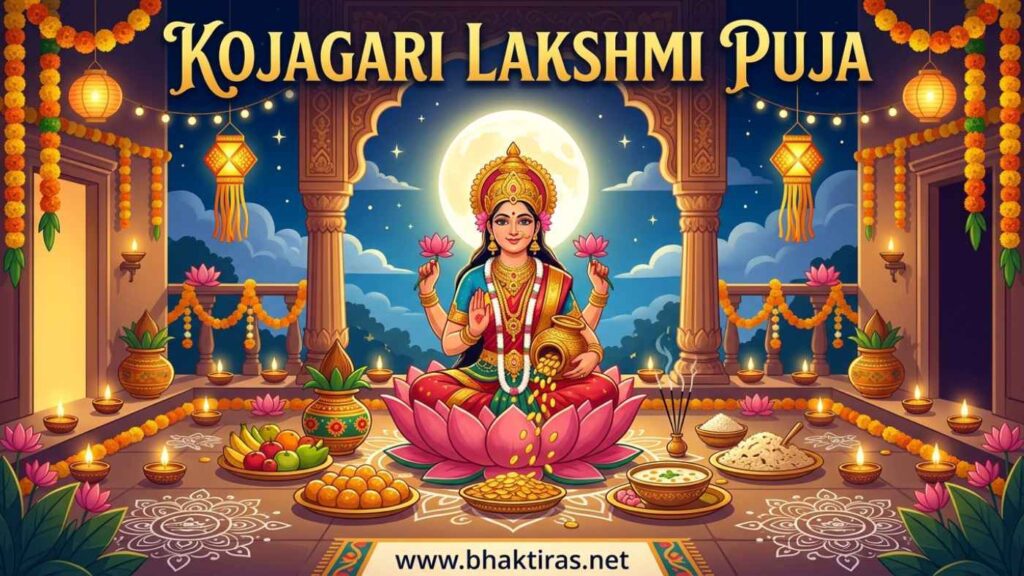
Kojagari Lakshmi Puja is the great autumn worship of Goddess Lakshmi across Bengal, Odisha and Assam, held on the full-moon night of the month of Ashwin. Its name traces to the Sanskrit words Ko jagarti – “Who is awake?” – for the goddess is said to walk the earth this night, rewarding households that stay watchful and keep their lamps burning. Families clean and decorate their homes, draw white alpana footprints leading to the shrine, offer kheer cooled under the moon, and sit up together until dawn.
Kojagari Lakshmi Puja 2026-2028: Dates & Calendar
The next Kojagari Lakshmi Puja is on Thursday, 14 October 2027. The date shifts each year because it follows the Hindu lunar calendar, always falling on the full moon (Purnima) of Ashwin.
| Year | Date | Day | Notes |
|---|---|---|---|
| 2026 | 25 October | Sunday | Purnima from 11:55 AM (25 Oct) to 9:41 AM (26 Oct) |
| 2027 | 14 October | Thursday | Next occurrence – all-night vigil |
| 2028 | 2 October | Monday | Purnima from 7:33 PM (2 Oct) to 9:54 PM (3 Oct) |
Because the worship centres on the moonlit night, the puja and the kheer offering are timed to the Nishita (midnight) period when the full moon is highest. The same Ashwin full moon is observed elsewhere in India as Sharad Purnima.
Why Kojagari Lakshmi Puja Is Celebrated
Kojagari Lakshmi Puja is celebrated because Lakshmi, goddess of wealth and wellbeing, is believed to descend on the Ashwin full-moon night and bless the homes she finds awake, clean and devout. The vigil turns an ordinary night into an act of watchful devotion.
The meaning of Kojagari
The word comes from the Sanskrit Ko jagarti – “Who is awake?” Legend says Lakshmi moves from house to house at midnight asking exactly this, and pours her grace on whoever answers by staying alert. Sleep, by contrast, is thought to send her on to the next door.
A goddess of the harvest moon
The festival lands right after the monsoon, when the paddy is ripening and granaries are filling. Worshipping Lakshmi on the brightest full moon of autumn is a thanksgiving for the coming harvest and a prayer that plenty stays in the household through the year ahead.
Vigil as devotion
Staying awake all night is the heart of the vrat. Families pray, sing, read the Lakshmi Panchali, share sweets and often play pasha (dice) to pass the hours. The wakefulness is both literal and symbolic – a mind attentive to fortune uses wealth wisely rather than squandering it.
Moonlight and amrita
The Ashwin full moon is held to shed cooling, nourishing rays. Kheer is set out in the open so the moonlight can touch it, a belief that the night’s beams carry a trace of amrita, the nectar of immortality, into the food shared at dawn.
Deities & Figures Worshipped
The night belongs to Goddess Lakshmi, worshipped for prosperity, harmony and grace. Her owl mount and, in some homes, the moon and the god of rain also receive prayers.
Lakshmi
Lakshmi, the goddess of wealth, fertility and good fortune, is the sole focus of the puja. In Bengali homes she is worshipped as the giver of sri – grace and abundance – and installed either as a clay idol, a framed image, or represented by a decorated kalash (pot) and a heap of paddy.
Uluka, the owl
Lakshmi’s vehicle is the owl, called uluka or pecha in Bengal. Awake and watchful through the night, the owl mirrors the vigil the festival demands, and is read as a reminder to see clearly and use wealth with wisdom rather than blind attachment.
The moon and Indra
Because the puja depends on the full moon, Chandra (the moon) is honoured through the kheer offering. Older accounts also link the night to Indra, the rain god, and his elephant Airavata, tying the festival to the waters that fed the harvest.
Key Rituals, Step by Step
The observance runs from an evening of preparation into an all-night vigil under the moon. The order below reflects how most Bengali households keep the puja.
- Cleanse the home. The house is swept and washed through the day, since Lakshmi is believed to enter only clean, orderly homes. Doorways and the shrine area are wiped down and readied for her arrival.
- Bathe and dress. Devotees take an evening bath and put on fresh clothes before touching the puja materials, entering the ritual pure and unhurried.
- Draw the alpana. White rice-paste alpana is painted across the floor, most importantly small footprints (Lakshmir paa) that lead from the door to the shrine, showing the goddess the way in.
- Set the ghot and image. A brass or earthen kalash (ghot) is filled with water, topped with mango leaves and a coconut, and placed beside Lakshmi’s idol or image on a heap of paddy or a decorated wooden seat.
- Offer and read the Panchali. Lamps and incense are lit; flowers, sweets, chirwa, naru, fruits and batasha are offered while the Lakshmi Panchali (the goddess’s story) is read or recited by the family.
- Set kheer under the moon. A bowl of kheer or payasam is placed in the open where the full moon can shine on it, so the moonlight may bless the offering before it is shared.
- Keep the night vigil. Family and neighbours stay awake together – singing, praying, chatting and often playing pasha (dice) – so the goddess finds the household watchful when she passes at midnight.
- Share prasad at dawn. As the night ends, the moon-touched kheer and the other offerings are distributed as prasad, closing the vigil on a note of shared sweetness.
Special Foods of Kojagari Lakshmi Puja
The spread is simple, homemade and mostly uncooked or moon-cooled, built around new-harvest rice, coconut and jaggery.
Kheer / Payasam
Rice and milk simmered with sugar and cardamom, then left under the full moon so the rays can touch it. It is the signature offering, shared as blessed prasad once the moon has “cooked” it through the night.
Narikel naru
Small round coconut ladoos bound with jaggery (gur) or sugar. Made fresh at home, they are among the most beloved offerings placed before Lakshmi.
Chirwa (chira)
Flattened rice, offered plain, sweetened with jaggery, or tossed with grated coconut and banana. A light, uncooked prasad that suits the vigil’s simple, homemade spirit.
Moa & khoi
Puffed rice (khoi) and puffed-rice-and-jaggery balls (moa) are heaped in the offering tray, prized for their airy sweetness and links to the new autumn crop.
Batasha & fruits
Sugar drops (batasha), seasonal fruits such as coconut, banana, sugarcane and singhara (water chestnut) round out the naivedya set before the goddess.
Regional Names & Variations
The same Ashwin full moon carries different names and customs across eastern India.
West Bengal
Here it is the principal Lakshmi Puja of the year, kept in almost every home just days after Durga Puja. Alpana footprints, the ghot, narikel naru and the Lakshmi Panchali reading are central, and many households stay awake past midnight for the goddess’s visit.
Odisha
In Odisha the night is often observed as Kumar Purnima. Alongside Lakshmi’s worship, unmarried girls rise early to salute the sun and later the moon, keeping a fast and praying for a good husband, with folk games and songs marking the day.
Assam
Assamese families keep Kojagari Lakshmi Puja with the same all-night vigil, offering kheer, pitha and fruits. Lakshmi is worshipped for a prosperous home, and the moonlit prasad is shared among relatives and neighbours.
Elsewhere in India
The broader northern and western observance of the same full moon is called Sharad Purnima, where kheer left under the moon and the Raas Leela of Krishna take centre stage rather than the Kojagari vigil for Lakshmi.
Kojagari Lakshmi Puja Do's and Don'ts
A few simple customs help keep the observance respectful and in keeping with tradition.
Do
- Clean and tidy the whole home before the puja begins
- Draw alpana footprints leading from the door to the shrine
- Light a lamp and keep it burning through the night
- Set the kheer where the full moon can shine on it
- Keep the vigil together as a family and share prasad at dawn
Avoid
- Do not fall asleep before the midnight puja if keeping the vrat
- Do not leave the house dark or the doorway cluttered
- Do not serve non-vegetarian food or alcohol during the puja
- Do not use torn, dirty or unwashed clothes for the worship
- Do not waste or discard the moon-touched kheer – share it as prasad
Frequently Asked Questions
When is Kojagari Lakshmi Puja in 2027?
Kojagari Lakshmi Puja is on Thursday, 14 October 2027. It is observed on the Ashwin Purnima (full moon), with the main worship and vigil kept through the night into the early hours of 15 October.
When is Kojagari Lakshmi Puja in 2026 and 2028?
Kojagari Lakshmi Puja falls on Sunday, 25 October 2026 and on Monday, 2 October 2028. The date changes each year because it tracks the full moon of Ashwin on the Hindu lunar calendar.
What does "Kojagari" mean?
Kojagari comes from the Sanskrit phrase Ko jagarti?, meaning “Who is awake?” Lakshmi is believed to move from house to house at midnight asking this question, and she blesses the households she finds awake, watchful and devout.
Why is Kojagari Lakshmi Puja celebrated?
Kojagari Lakshmi Puja is celebrated to invite Goddess Lakshmi, the giver of wealth and wellbeing, into the home. Falling after the monsoon as the harvest ripens, it is both a thanksgiving for plenty and a prayer that prosperity and harmony stay in the family through the year.
Which god is worshipped on Kojagari Lakshmi Puja?
Goddess Lakshmi is the deity worshipped on Kojagari Lakshmi Puja. Her owl mount (uluka or pecha) is honoured alongside her, and because the ritual depends on the full moon, Chandra the moon is also revered through the kheer offering.
How is Kojagari Lakshmi Puja different from Sharad Purnima?
Kojagari Lakshmi Puja and Sharad Purnima fall on the same Ashwin full-moon night, but the emphasis differs. In Bengal, Odisha and Assam the night is dedicated to worshipping Lakshmi with an all-night vigil, while in much of northern and western India the same day is kept as Sharad Purnima, centred on kheer under the moon and Krishna’s Raas Leela.
Why do people stay awake all night?
People stay awake because Lakshmi is said to visit at midnight asking “Who is awake?” and bless only those she finds alert. The vigil, kept with prayers, songs and games of pasha (dice), is the defining ritual of the festival and the reason it is called Kojagari.
Why is kheer left under the moonlight?
Kheer is placed in the open moonlight because the Ashwin full moon is believed to shed cooling, healing rays that carry a trace of amrita, the nectar of immortality. The moon-touched kheer is then shared as prasad at the close of the vigil.
May the goddess find your home awake and your lamp burning this Kojagari night. Shubho Kojagari Lakshmi Puja!