
Hornbill Festival 2026 – Nagaland's Festival of Festivals
When is the Hornbill Festival in 2026?
The Hornbill Festival runs from 1 to 10 December 2026 at the Kisama Heritage Village, about 12 km from Kohima in Nagaland. It is the state’s flagship cultural event, bringing all the major Naga tribes together for war dances, folk songs, crafts, indigenous games and food. The dates are fixed at 1-10 December every year.
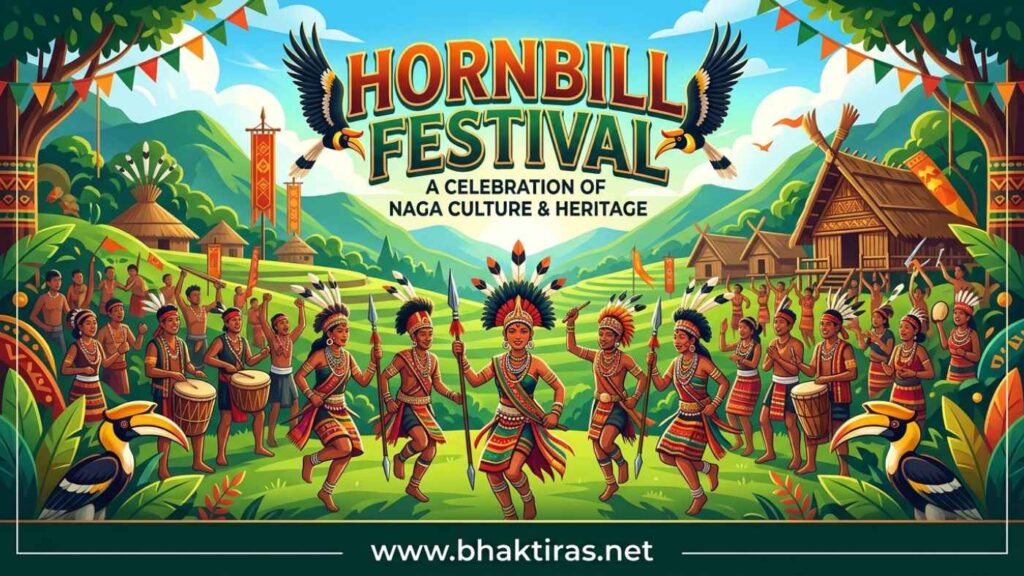
The Hornbill Festival is Nagaland’s biggest cultural celebration, held every year from 1 to 10 December at the Kisama Heritage Village near Kohima. Organised by the state government, it gathers all of Nagaland’s major tribes in one place, each hosting a traditional morung where visitors can watch war dances, hear folk songs, taste tribal cooking and buy handmade crafts. Named after the Indian hornbill, a bird woven deeply into Naga folklore and dress, the ten-day event is often called the Festival of Festivals because it packs so many tribal celebrations into a single window.
Hornbill Festival 2026-2028: Dates & Calendar
The Hornbill Festival is held on fixed calendar dates – 1 to 10 December – every year, so it does not shift with the moon like Hindu festivals do.
| Year | Dates | Days | Notes |
|---|---|---|---|
| 2025 | 1-10 December | Mon-Wed | Past edition, drew over 214,000 visitors |
| 2026 | 1-10 December | Tue-Thu | Next occurrence |
| 2027 | 1-10 December | Wed-Fri | Same fixed window |
| 2028 | 1-10 December | Fri-Sun | Same fixed window |
The 1st of December also marks Nagaland Statehood Day, so the opening of the festival doubles as a state celebration. The main daytime programmes run at Kisama, while evening events such as the rock contest and night bazaar are usually held in Kohima.
Why the Hornbill Festival Is Celebrated
The Hornbill Festival exists to keep Naga tribal heritage alive and to introduce it to the wider world. It was started by the Nagaland government in 2000 to give the state’s many tribes a shared stage and to encourage inter-tribal understanding.
A festival of festivals
Nagaland has many tribes, and each traditionally held its own harvest and community festivals. The Hornbill Festival pulls these separate celebrations into one place and one week so visitors can experience the whole of Naga culture at once. That is why it earned the name Festival of Festivals.
The hornbill in folklore
The event is named after the Indian hornbill, a large forest bird that appears throughout Naga stories, songs and traditional dress. Hornbill feathers were long a mark of honour on warrior headgear, so the bird stands for courage and pride across many tribes.
Heritage and tourism
By reviving crafts, dances and games that were fading, the festival helps younger Nagas stay connected to their roots. It has also become the state’s main tourism draw, bringing visitors from across India and abroad to Kohima each December.
What Happens at the Festival, Day by Day
The Hornbill Festival is a cultural programme rather than a religious rite, so its schedule is built around performances, contests and community life at Kisama.
- Opening at Kisama. The festival opens on 1 December, coinciding with Nagaland Statehood Day, with a formal ceremony and a grand parade of the participating tribes in full traditional dress.
- The morungs come alive. Each tribe builds and staffs its own morung, a traditional bamboo-and-thatch hut, where visitors can watch daily life, sample home cooking and buy crafts.
- War dances and folk songs. Tribes take turns in the central arena performing war dances, log-drum beats and polyphonic folk songs handed down over generations.
- Indigenous games and sports. Traditional contests such as Naga wrestling, archery, top-spinning and climbing greased bamboo poles run through the ten days.
- Eating contests. The famous Raja Mircha (king chilli) eating contest and the pork-fat eating contest draw big crowds and plenty of laughter.
- Crafts, cuisine and the night bazaar. Stalls sell woven shawls, wood carvings, bamboo work and Naga dishes, while an evening night bazaar in Kohima keeps the celebration going after dark.
- Hornbill Music Festival. An evening rock contest, one of the country’s better-known live-music competitions, runs alongside the daytime programme and closes out most nights.
- Closing on 10 December. The festival ends with a final day of massed performances and prize-givings for the various contests before the tribes depart.
Food at the Hornbill Festival
Naga cuisine is smoky, fermented and famously fiery, and the festival’s food stalls are one of its biggest draws.
Smoked pork with bamboo shoot
Smoked or dried pork slow-cooked with fermented bamboo shoot and axone (fermented soybean) is the dish most visitors seek out. It is rich, tangy and deeply savoury.
Raja Mircha (king chilli)
The Raja Mircha, one of the hottest chillies in the world, features in the festival’s chilli-eating contest and in fiery chutneys served at the stalls. It is handled with respect even by locals.
Zutho and rice beer
Zutho is a mildly sour, milky rice beer brewed by the Angami and shared at community gatherings. It is a traditional part of Naga hospitality during the festival.
Akhuni and fermented foods
Fermented soybean (akhuni or axone) and fermented fish give Naga cooking its distinctive pungent depth, appearing in stews and chutneys across the tribal morungs.
Sticky rice and Naga breads
Steamed sticky rice, often cooked inside bamboo tubes over an open fire, is the base of most meals and a comforting counterpoint to the chilli-heavy dishes.
The Tribes You'll See at Kisama
The festival is a showcase of Nagaland’s tribes, each with its own dress, dialect, dances and morung at the heritage village.
Angami
The Angami, based around Kohima, are the local hosts of Kisama. They are known for their terraced rice farming, the Sekrenyi festival and the sour rice beer zutho shared at gatherings.
Ao
The Ao of Mokokchung are famous for the Moatsu festival and rich folk-song traditions, and they were among the first Naga tribes to take up formal education.
Konyak
The Konyak of Mon district, once known as headhunters, are recognised by their tattooed faces, brass ornaments and elaborate warrior headgear tipped with hornbill feathers.
Sumi (Sema)
The Sumi are known for spirited war dances and the Tuluni festival, a mid-year celebration of friendship and plenty in the farming calendar.
Lotha, Chakhesang and others
Alongside these, tribes such as the Lotha, Chakhesang, Zeliang, Phom and Pochury each set up their own morungs, so a walk through Kisama is a tour of the whole state.
Hornbill Festival Do's and Don'ts
A little planning makes the trip to Kisama far smoother, as December in Nagaland is cold and the site gets very busy.
Do
- Dress in warm layers – Kohima is chilly in December, especially in the mornings and evenings.
- Reach Kisama early in the day to catch the war dances and parade before the crowds peak.
- Ask before photographing people in traditional dress; most are happy to oblige if asked.
- Book accommodation in Kohima well in advance, as rooms fill up months ahead.
- Try the tribal food and mild rice beer, and stay hydrated through the day.
Avoid
- Do not take the king chilli lightly – it is genuinely one of the hottest in the world.
- Do not touch or handle ceremonial weapons, drums or costumes without permission.
- Do not litter at the heritage village; carry your waste out with you.
- Do not expect to see everything in one day – the ten-day programme is spread out.
- Do not skip warm clothing or a torch, as evenings turn cold and dark quickly.
Frequently Asked Questions
When is the Hornbill Festival in 2026?
The Hornbill Festival 2026 runs from 1 to 10 December at the Kisama Heritage Village near Kohima, Nagaland. The dates are fixed at 1-10 December every year, so they do not change from year to year.
When is the Hornbill Festival in 2027 and 2028?
The Hornbill Festival is held on 1-10 December in 2027 and again on 1-10 December in 2028. Because the schedule is fixed by the Nagaland government rather than tied to the moon, the ten-day window stays the same each year.
Where is the Hornbill Festival held?
The Hornbill Festival is held at the Kisama Heritage Village, about 12 km south of Kohima in Nagaland. The purpose-built village has permanent morungs for each of the state’s tribes, while some evening events take place in Kohima itself.
Why is it called the Hornbill Festival?
The festival is named after the Indian hornbill, a large forest bird that features widely in Naga folklore, songs and traditional dress. Hornbill feathers were a mark of honour on warrior headgear, so the bird symbolises courage and pride across the tribes.
Why is the Hornbill Festival called the Festival of Festivals?
It is called the Festival of Festivals because it brings the separate celebrations of all Nagaland’s tribes into one place and one week. Rather than travelling across the state, visitors can experience the whole of Naga culture at Kisama in a single event.
Is the Hornbill Festival a religious festival?
No, the Hornbill Festival is a cultural celebration rather than a religious one. Started by the Nagaland government in 2000, it is designed to preserve and showcase the heritage of the Naga tribes and to promote tourism to the state.
What can you see and do at the Hornbill Festival?
At the Hornbill Festival you can watch tribal war dances and folk songs, explore each tribe’s morung, join or watch indigenous games, and try Naga food and rice beer. Popular draws include the king chilli and pork-fat eating contests, a crafts bazaar, a night market and an evening rock-music competition.
What is the best time to visit and how cold is it?
The only time to catch the Hornbill Festival is 1-10 December, when it takes place. December in Kohima is cold, often dropping to single-digit temperatures at night, so warm layers are essential.
If you can brave the December chill and the king chilli, the Hornbill Festival is one of the finest windows into living Naga culture. Kuknalim – a warm Naga greeting to send you on your way.