
Bonalu 2026 – Telangana's Festival of the Mother Goddess
బోనాలు
When is Bonalu in 2026?
Bonalu is celebrated through the month of Ashadha, roughly mid-July to mid-August 2026, not on a single fixed day. It unfolds temple by temple across Telangana on successive Sundays, honouring the Mother Goddess Mahankali. Golconda Fort usually opens the season and Ujjaini Mahankali in Secunderabad marks its high point.
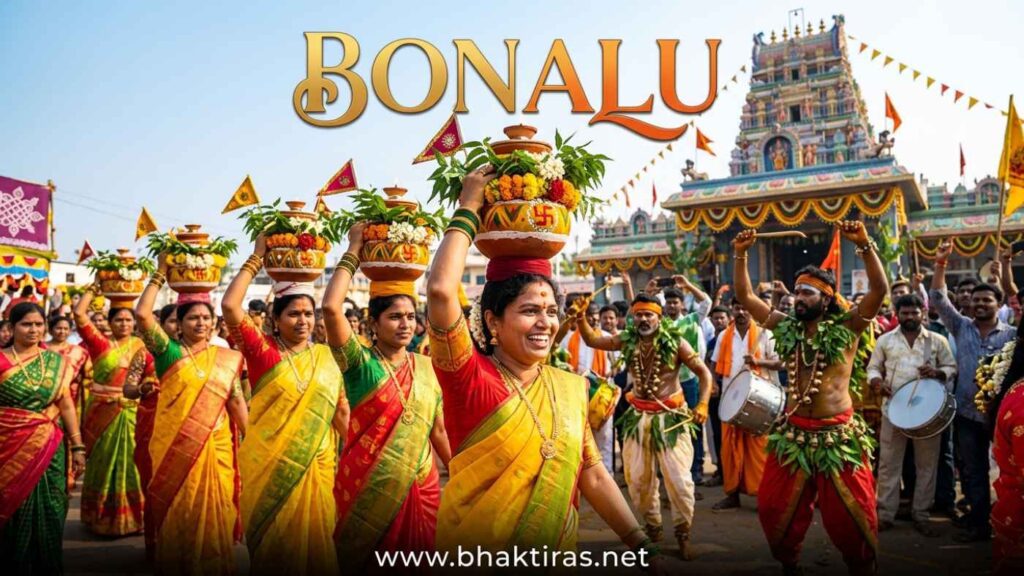
Bonalu is Telangana’s own thanksgiving to the Mother Goddess, kept alive most fiercely in the twin cities of Hyderabad and Secunderabad. The word bonam simply means a meal: women cook rice with milk, jaggery and curd in a fresh earthen or brass pot, crown it with a lit lamp, and carry it on their heads to the goddess’s temple. Held through the Ashadha month in July and August, it is at heart a promise kept – a gratitude for protection, especially after seasons of sickness.
Bonalu 2026-2028: Dates & Calendar
Bonalu 2026 falls through Ashadha, roughly mid-July to mid-August, with the main temple days landing on successive Sundays. Because it follows the lunar Hindu calendar, the window shifts by a couple of weeks each year.
| Year | Month span | Main Sundays (approx.) | Notes |
|---|---|---|---|
| 2026 | Mid-July to mid-August | 19 & 26 July, 2 August | Golconda opens, then Ujjaini Mahankali, Balkampet |
| 2027 | July to August | Successive Sundays in Ashadha | Approximate; confirm with local temples |
| 2028 | July to August | Successive Sundays in Ashadha | Approximate; confirm with local temples |
There is no single Bonalu date. The festival travels from temple to temple over four to five weeks – beginning at the hilltop Jagadamba Mahankali shrine inside Golconda Fort, peaking at Ujjaini Mahankali in Secunderabad, and continuing through Balkampet Yellamma, Lal Darwaza in the old city and dozens of neighbourhood shrines.
Why Bonalu Is Celebrated
Bonalu is celebrated as a thanksgiving to the Mother Goddess for guarding her people, and as a plea for continued protection through the rainy Ashadha month when illness once spread easily.
A promise of gratitude
Ashadha, at the start of the monsoon, was historically a time of fever and epidemic. Families offer the goddess a cooked meal to thank her for keeping their household safe and to ask her to hold sickness away for another year. The offering is personal – each pot is a private vow made good in public.
Rooted in the 19th century
Local memory ties the festival’s spread to a plague that struck the Hyderabad-Secunderabad region in the 1800s. A military battalion is said to have prayed to the goddess and installed her idol on their return; when the outbreak eased, Bonalu grew into an annual thanksgiving that the twin cities have kept ever since.
The Mother in many names
The goddess is honoured under whichever form watches over a locality – Mahankali, Yellamma, Pochamma, Maisamma, Ankalamma. They are understood as faces of the same fierce, protective Mother, close to everyday life and quick to answer those who keep faith with her.
A festival of the people
Bonalu belongs to households and neighbourhoods rather than to priests alone. Women lead it, streets become processions, and folk drums set the pace. In 2014 the new state of Telangana declared it a state festival, and it is now marked with official honour across the region.
Deities & Figures Worshipped
Bonalu centres on the Mother Goddess in her fierce, protective form – Mahankali and her local sisters – with Pothuraju, her guardian brother, leading the way.
Mahankali
Mahankali, a fierce form of the Great Goddess, is the presiding deity. The bonam is carried to her – at Golconda’s Jagadamba shrine, at Ujjaini Mahankali in Secunderabad and at temples across the region. She is the Mother who both punishes disease and shelters her children from it.
Yellamma, Pochamma, Maisamma
Alongside Mahankali stand the village mothers – Yellamma at Balkampet, Pochamma and Maisamma in countless neighbourhood shrines. Each is worshipped as a form of the same goddess, tied closely to the health and fortune of the streets that keep her.
Pothuraju
Pothuraju is the goddess’s brother and protector. A bare-chested man, body smeared with turmeric and vermilion, a thick rope-whip in hand and bells at his ankles, dances at the head of the procession. He clears the path, cracks his whip and rouses the crowd, embodying the fierce energy that guards the Mother.
Key Rituals, Step by Step
Bonalu moves from a private kitchen to a public procession and ends with an oracle’s word. Here is how a temple’s day unfolds.
- Cleaning and preparing. Homes and the local shrine are cleaned and the goddess’s idol is dressed and adorned. Women bathe, wear fresh clothes, often in green and red, and set aside a new earthen or brass pot for the offering.
- Cooking the bonam. Rice is cooked with milk, jaggery and curd and packed into the decorated pot. The pot is painted, wound with neem leaves, daubed with turmeric and vermilion, and topped with a small lit lamp – the finished offering that gives the festival its name.
- Carrying the pot. Balancing the bonam on her head, each woman walks to the temple, often joined by family. Many dance to the beat of dappu drums along the route, some falling into a swaying trance believed to be the goddess’s presence moving through them.
- The Ghatam procession. A copper pot shaped like the goddess and decorated as her form, the Ghatam, is carried by a priest in traditional dress from the temple through the streets. It is the ceremonial heart of the day’s procession.
- Pothuraju leads. At the front, Pothuraju dances with his whip and bells, clearing the way and lifting the crowd, while drummers keep the procession surging forward.
- Offering at the temple. At the shrine the pots are presented to the goddess. The lamp, turmeric and food are offered, prayers of thanks and petition are made, and the cooked rice is later shared as prasad among family and neighbours.
- Rangam – the oracle. On the morning after, a woman believed to be possessed by the goddess stands balanced on an earthen pot and, in trance, answers questions and foretells the year ahead – the harvest, the rains, the fortunes of the community.
- Immersion. The festival closes as the Ghatam is taken in a final procession and immersed in water, sending the goddess on her way until the following Ashadha.
Special Foods of Bonalu
The food of Bonalu is the offering itself and the home cooking shared afterwards – simple, sweet and made to be given away.
The bonam
The offering that names the festival: rice cooked with milk, jaggery and curd, carried to the goddess in a decorated pot crowned with a lamp. After it is offered, the sweetened rice is shared as prasad among family and neighbours.
Bellam annam
Jaggery rice – rice sweetened with bellam (jaggery) – is a common home preparation of the day, echoing the sweet rice of the bonam and offered to guests who visit.
Homemade sweets and payasam
Households prepare milk-and-jaggery payasam and simple festive sweets. Food is cooked in larger quantity than a family needs, because giving it away to visitors and neighbours is part of the day’s spirit.
Where Bonalu Is Celebrated
Bonalu is a Telangana festival, keenly kept in the twin cities and across the state’s temple towns, with the season passing from one famous shrine to the next.
Golconda
The season traditionally opens at the Jagadamba Mahankali temple atop Golconda Fort in Hyderabad. Devotees climb to the hilltop shrine to offer the first bonams of the year.
Secunderabad
The Ujjaini Mahankali temple in Secunderabad hosts the grandest day of Bonalu, drawing enormous crowds. Its Rangam oracle the next morning is among the most closely watched.
Balkampet & the old city
Balkampet Yellamma temple and the Lal Darwaza Simhavahini Mahankali temple in Hyderabad’s old city hold their own major Bonalu days, along with hundreds of neighbourhood shrines across the region.
Across Telangana
Beyond the twin cities, temple towns and villages throughout Telangana keep Bonalu on their own Ashadha Sundays, each community honouring its local Mother Goddess.
Bonalu Do's and Don'ts
A few simple ways to take part respectfully if you join a Bonalu procession or visit a temple.
Do
- Use a clean, fresh pot and clean hands to prepare the bonam.
- Dress modestly; many wear traditional clothes, often green and red.
- Keep to the sides and let the Ghatam and Pothuraju pass freely.
- Share the offered food afterwards – giving prasad is part of the day.
- Ask before photographing women in trance or the Rangam oracle.
Avoid
- Do not touch or block the Ghatam or the bonam pots being carried.
- Do not mock or crowd those who fall into a trance state.
- Do not taste the bonam before it has been offered to the goddess.
- Do not push into the front of a procession or obstruct Pothuraju.
- Do not treat the Rangam oracle as a spectacle for close-up filming.
Frequently Asked Questions
When is Bonalu in 2026?
Bonalu 2026 is celebrated through the month of Ashadha, roughly mid-July to mid-August, rather than on a single day. The main temple days fall on successive Sundays – around 19 and 26 July and 2 August – beginning at Golconda and peaking at Ujjaini Mahankali in Secunderabad. Exact dates vary by temple, so check locally.
Why is Bonalu celebrated?
Bonalu is celebrated as a thanksgiving to the Mother Goddess Mahankali for protecting her people, especially through the monsoon month of Ashadha when illness once spread. Local tradition links its spread to a plague in 19th-century Hyderabad, after which offering the goddess a cooked meal, a bonam, became an annual promise of gratitude.
What does bonam mean?
Bonam means a meal or offering of food. It is rice cooked with milk, jaggery and curd, packed into a decorated earthen or brass pot topped with a lit lamp. Women carry the bonam on their heads to the goddess’s temple as their offering, which is why the festival is called Bonalu, the plural of bonam.
Which goddess is worshipped during Bonalu?
Bonalu worships the Mother Goddess in her fierce form, chiefly Mahankali, along with her local forms Yellamma, Pochamma and Maisamma. All are honoured as faces of the same protective Mother. Her guardian brother Pothuraju leads the processions as a whip-cracking, turmeric-smeared dancer.
What is Rangam in Bonalu?
Rangam is the oracle of Bonalu. On the morning after the main offering, a woman believed to be possessed by the goddess balances on an earthen pot and, in trance, foretells the year ahead – the rains, the harvest and the fortunes of the community. It is one of the most watched moments of the festival.
Who is Pothuraju in Bonalu?
Pothuraju is the Mother Goddess’s brother and protector. A bare-chested man, his body smeared with turmeric and vermilion, bells at his ankles and a rope-whip in hand, dances at the head of the procession. He clears the path and rouses the crowd, embodying the fierce energy that guards the goddess.
Where is Bonalu celebrated?
Bonalu is a Telangana festival, celebrated most intensely in Hyderabad and Secunderabad. The season opens at the Jagadamba Mahankali temple in Golconda Fort, peaks at Ujjaini Mahankali in Secunderabad, and continues at Balkampet, Lal Darwaza and hundreds of shrines across the state. It was declared a Telangana state festival in 2014.
Is Bonalu the same as Bathukamma?
No. Both are major Telangana festivals for the Mother Goddess, but they are distinct. Bonalu falls in Ashadha (July-August) and centres on carrying cooked-rice offerings to Mahankali’s temples. Bathukamma comes later, in autumn, and is a flower festival in which women build and float stacked floral arrangements.
However you keep the goddess this Ashadha, may the Mother watch over your home. Bonala panduga subhakankshalu.