
Bipattarini Vrat 2026 – The Bengali Vow Against Danger
বিপত্তারিণী ব্রত
When is Bipattarini Vrat in 2026?
Bipattarini Vrat in 2026 falls on Saturday 18 July and Tuesday 21 July. It is a Bengali vow kept by women to seek deliverance from danger and hardship, honouring the goddess Bipattarini, a gentle form of Durga. The observance always lands on the Saturday and Tuesday that sit between Puri’s Rath Yatra and the return Ulto Rath.
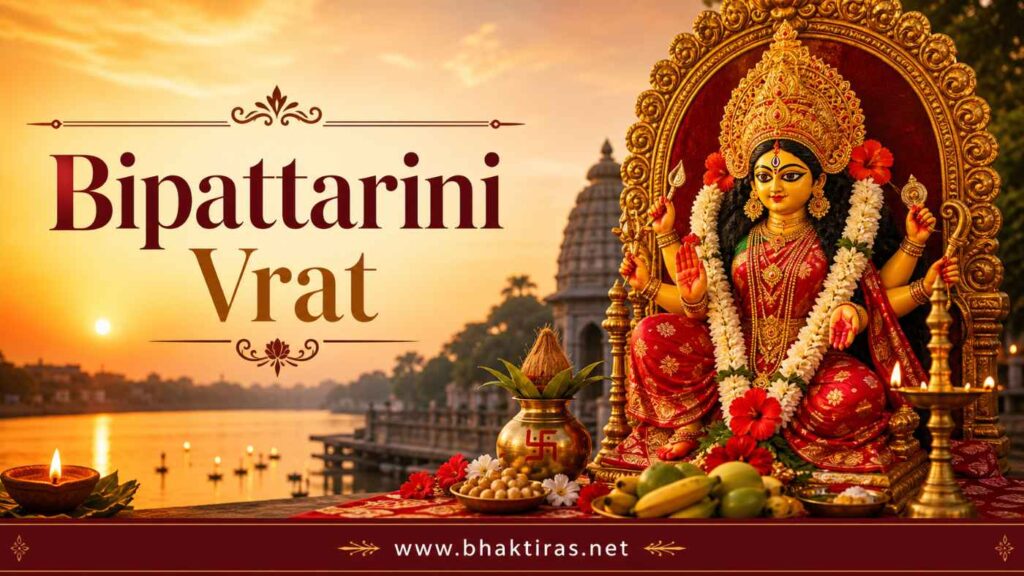
Bipattarini Vrat is one of Bengal’s most quietly powerful women’s vows. Kept in the bright fortnight of Ashadha, in the short window between Puri’s Rath Yatra and the return Ulto Rath, it is offered to Bipattarini – literally “she who carries you across danger,” a benevolent face of Durga. Women fast through the day, listen to her deliverance story, and tie a red thread of thirteen knots on the arm. The whole rite turns on the number thirteen: thirteen knots, thirteen blades of durba grass, thirteen kinds of fruit and sweets.
Bipattarini Vrat 2026-2028: Dates & Calendar
In 2026 the vrat is kept on Saturday 18 July and Tuesday 21 July. Because it is fixed to a lunar window rather than a fixed calendar day, the dates shift each year between late June and mid-July.
| Year | Saturday | Tuesday | Notes |
|---|---|---|---|
| 2026 | 18 July | 21 July | Next observance |
| 2027 | 10 July (approx) | 6 July (approx) | After Rath Yatra on 5 July |
| 2028 | 1 July (approx) | 27 June (approx) | After Rath Yatra on 24 June |
Most households keep the Saturday as the main day of the vow; a few families, following their own tradition, observe the Tuesday instead. Both fall inside the same Ashadha bright-fortnight window.
Why Bipattarini Vrat Is Kept
Bipattarini Vrat is kept to ask the goddess for protection from bipod – danger, illness, loss and sudden trouble – and to thank her for troubles already survived.
The name says everything about the vow. Bipod means calamity or danger, and tarini means the one who ferries you across it. Bengali families turn to Bipattarini not for wealth or fame but for something plainer and more urgent: to be carried safely through the hard patches of life. Mothers keep it for ailing children, wives for absent husbands, whole households for a year without ruin.
The vrat katha
The story told on this day is about a low-caste woman and a cruel test. Forbidden to eat beef by her mistress yet curious about it, she was caught carrying meat hidden in her clothes. When the queen demanded she open the cloth, she prayed to the goddess – and the meat had turned to flowers. Bipattarini had saved her from disgrace and death. The tale is a promise: sincere devotion is answered when danger is closest.
A gentler Durga
Bipattarini is counted among the many forms of Durga, the protective mother goddess. Where Durga is often shown slaying the buffalo demon, Bipattarini is approached in her rescuing, danger-removing aspect. Devotees do not fear her; they lean on her the way one leans on a mother in a crisis.
The power of thirteen
Thirteen is woven through every part of the vow – thirteen knots in the thread, thirteen durba grass blades, thirteen fruits, thirteen sweets, thirteen offerings. The repeated number is meant to bind the promise firmly, each knot a request the goddess is asked to keep in mind through the coming year.
The Goddess Worshipped
The vow is dedicated to Bipattarini Devi, a benevolent, danger-removing form of the great goddess Durga.
Bipattarini Devi
Bipattarini, also written Bipodtarini or Bipattarini, is the goddess “who takes you across danger.” She is worshipped chiefly in West Bengal and neighbouring regions as a compassionate mother who intervenes when a devotee is cornered by trouble.
Durga
Bipattarini is understood as one of the countless forms of Durga, the mother goddess who defeats evil and shelters her children. Keeping this vrat is, at heart, an appeal to Durga in her most protective mood.
Key Rituals, Step by Step
The vow is simple to keep at home and turns on fasting, the katha, and the sacred thread.
- Fast from the previous night. Women who take the vow eat a light meal the evening before and then fast on the day itself, often taking no food until the puja is complete.
- Prepare the thirteen offerings. Thirteen kinds of fruit, thirteen sweets, flowers, durba grass and other items are arranged – the count of thirteen kept carefully for each group.
- Make the sacred thread (taga). A red thread is knotted thirteen times and bound together with thirteen blades of durba grass, ready to be tied on the arm.
- Offer worship to Bipattarini. The goddess is invoked before her image or picture, the offerings are placed before her, and prayers are made for protection from danger.
- Listen to the vrat katha. The deliverance story – the meat that turned to flowers – is read or told, and everyone keeping the vow listens attentively, as hearing it is part of the vow.
- Tie the thread on the arm. The blessed thirteen-knot thread is tied on the arm – the left for women, the right for men where men join – carrying the goddess’s protection for the year.
- Break the fast with prasad. After the puja the offerings are shared as prasad, and the fast is broken with the goddess’s blessing.
Offerings & Food of Bipattarini Vrat
The food of the day is defined by the number thirteen and by simple, home-made sweets offered to the goddess before being eaten as prasad.
Thirteen fruits
Thirteen kinds of fruit are gathered for the goddess – seasonal produce like banana, mango, jackfruit, coconut and whatever the monsoon markets of Bengal offer. Presenting the full count of thirteen is part of keeping the vow correctly.
Thirteen sweets
Thirteen sweets, often small home-made ones, are placed before Bipattarini. Bengali households may include batasa, naru (coconut sweets) and other simple mishti rather than elaborate confections.
Luchi and bhog
After the fast is broken, many families cook a vegetarian meal of luchi, chholar dal and vegetables, shared as the goddess’s bhog. The eating is deliberately modest, in keeping with the vow’s spirit of gratitude rather than feasting.
Bipattarini Vrat Do's and Don'ts
A few simple observances help keep the vow with the right spirit.
Do
- Keep the fast sincerely from the previous evening until the puja is done
- Prepare each set of offerings in the correct count of thirteen
- Listen to the full vrat katha before tying the thread
- Tie the blessed thread on the arm and keep it on
- Share the offerings as prasad after the worship
Avoid
- Do not eat before completing the puja if you have taken the fast
- Do not skip the katha – hearing it is part of the vow
- Do not cut the count short; the thirteen offerings are central
- Do not treat the day as a feast; keep the meal simple
- Do not remove or discard the thread carelessly during the year
Frequently Asked Questions
When is Bipattarini Vrat in 2026?
Bipattarini Vrat in 2026 is kept on Saturday 18 July and Tuesday 21 July. These are the Saturday and Tuesday that fall between Puri’s Rath Yatra and the return Ulto Rath. The Saturday is the more widely observed of the two.
When is Bipattarini Vrat in 2027 and 2028?
Bipattarini Vrat is expected around Saturday 10 July in 2027 and Saturday 1 July in 2028, with the alternate Tuesday falling a few days on either side. Because the vow follows the Bengali lunar calendar, these dates are approximate and should be confirmed against a current panjika closer to the year.
Why is Bipattarini Vrat kept?
Bipattarini Vrat is kept to seek the goddess Bipattarini’s protection from bipod – danger, illness, loss and sudden misfortune – and to thank her for troubles already survived. Bengali women take the vow for the wellbeing of their families over the coming year.
Which goddess is worshipped on Bipattarini Vrat?
Bipattarini Vrat honours Bipattarini Devi, a benevolent, danger-removing form of the goddess Durga. Her name means “she who carries you across danger,” and she is approached as a rescuing mother rather than a fierce warrior.
What is the significance of the number thirteen?
Thirteen is central to Bipattarini Vrat: the sacred thread has thirteen knots, bound with thirteen durba grass blades, and the offerings include thirteen fruits and thirteen sweets. The repeated count is meant to bind the vow firmly, each knot standing for a prayer entrusted to the goddess.
What is the Bipattarini vrat katha about?
The Bipattarini vrat katha tells of a devoted woman caught carrying forbidden meat, who prayed to the goddess in her moment of danger. When she was forced to reveal what she carried, the meat had turned to flowers. The story shows that Bipattarini rescues sincere devotees at the very edge of disaster.
Who keeps the Bipattarini Vrat?
Bipattarini Vrat is kept chiefly by Bengali Hindu women, in West Bengal and neighbouring regions, for the protection of their households. They fast, hear the katha, and tie the thirteen-knot red thread on the arm as a mark of the goddess’s blessing.
When during the year does Bipattarini Vrat fall?
Bipattarini Vrat falls in the bright fortnight of Ashadha, in June or July, on the Saturday and Tuesday that lie between Puri’s Rath Yatra and the return Ulto Rath. This ties the vow closely to the Rath Yatra season in the Bengali festival calendar.
May Bipattarini carry you safely across every danger this year – বিপত্তারিণী মায়ের কৃপা হোক।